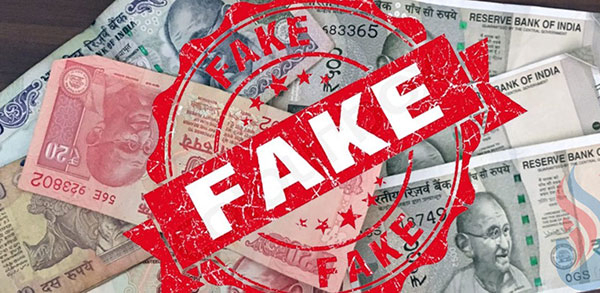
New Delhi, March 27 – India’s security agencies have flagged the increasing number of entry points through which counterfeit currency is being circulated in the market. Initially, counterfeit currency was being pushed into Nepal from Pakistan before entering India. However, with Indian agencies increasing vigilance at the Nepal border, the focus shifted to Malda in West Bengal.
The National Investigation Agency (NIA), which is investigating most of these cases, found that Malda had sophisticated printing units. They sourced the materials from Pakistan through the Bangladesh border and then printed the counterfeit notes before circulating them.
An official from the Intelligence Bureau says that currently, the number of areas from which this racket is being operated has increased. Murshidabad and Nadia in West Bengal have also become hotspots for this racket, he said.
He further stated that the other main points where this racket is flourishing are Coastal Andhra, Tamil Nadu, Kerala, Gujarat, Delhi, and Maharashtra.
In addition to West Bengal being the main supplier of counterfeit currency, these notes are also originating from Dubai before making their way into the South Indian states, the officials also added.
Another official said that the network is still controlled across India by the Dawood Ibrahim syndicate.
The ISI has instructed the syndicate to ramp up production and take a pan-India approach while running this racket, the official added. This explains why there are so many instances of counterfeit currency rackets being busted across the country.
In addition to increasing entry points, the syndicate has also been relying heavily on social media to run this racket. For instance, in Malkapur, Maharashtra, deals to trade in counterfeit currency were struck on social media.
In addition to Malkapur in Maharashtra, Pune and Bhiwandi have also become major points where this trade takes place, an official said.
The official said that apart from using social media as a meeting point, these people are using technology heavily to further the trade. These people were found to be using Artificial Intelligence (AI) to gather more information to make the note look authentic.
AI was used to ask questions on how to print the notes correctly and how to avoid being caught by law enforcement agencies. Most of the material to print the fake notes is sourced from Pakistan.
The Pakistan Security Printing Corporation (PSPC), Karachi, has been the main source for the syndicate to procure the material.
Now, the syndicate is also procuring Chinese-sourced paper, which is another added headache for the agencies.
The printing and distribution of counterfeit currency is part of an ISI strategy to hurt India economically. An official said it is clear that the ISI wants to expand this business and probably has a printing unit in every state.
For now, the distribution routes have been increased. The official adds that in addition to West Bengal, West Godavari and East Godavari in Andhra Pradesh have become a major hub for the circulation and distribution of counterfeit currency. The notes that land in these areas are circulated only in the southern states.
This goes on to show that the syndicate is being region-specific. It is creating similar points for circulation and distribution in other regions as well.
This reduces the risk of getting busted as the transportation routes are shorter. Further, the syndicate does not want any interaction between the units in the various regions as more contact would mean that the chances of detection are high.