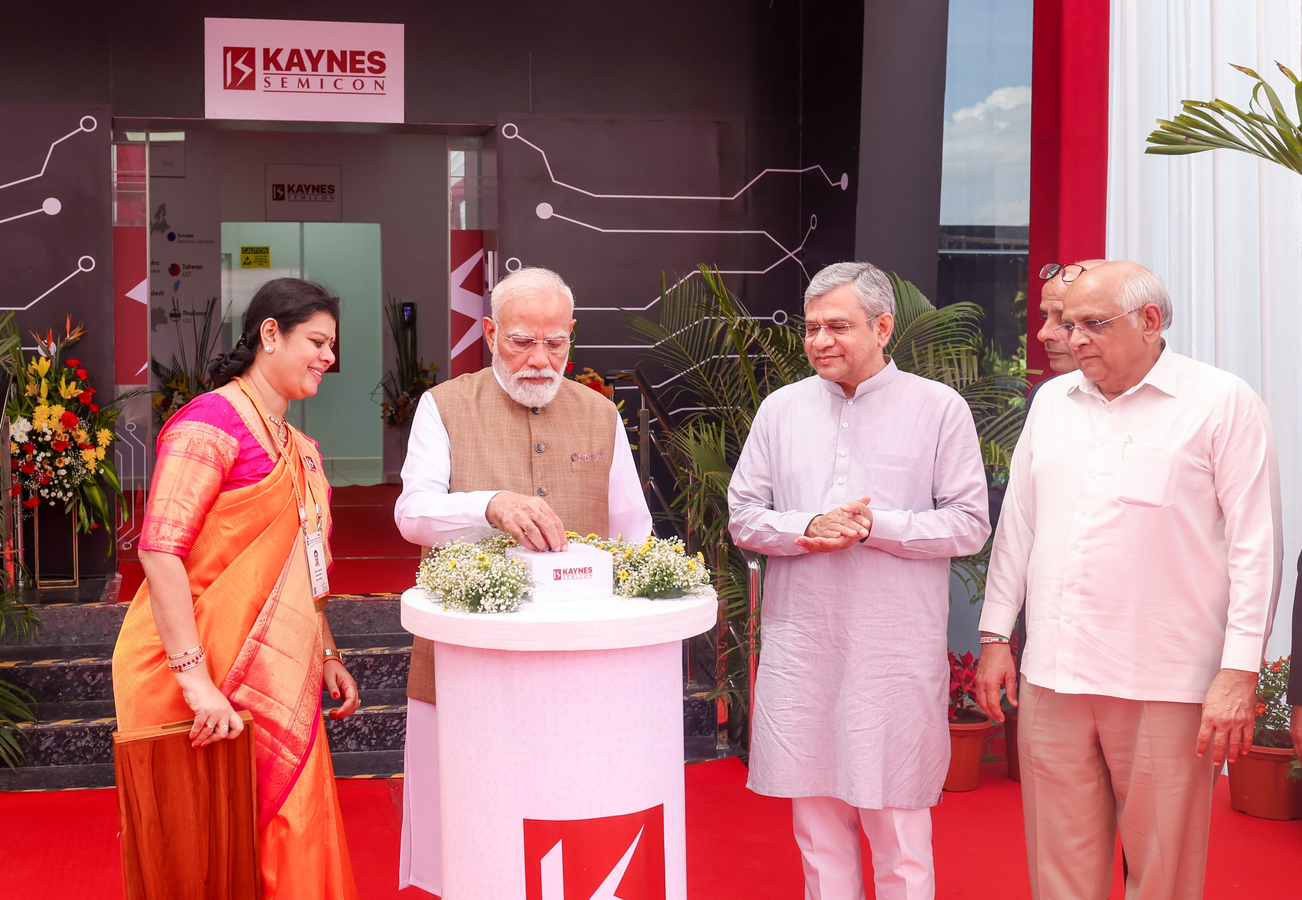
Sanand (Gujarat), March 31 Union Electronics and Information Technology Minister Ashwini Vaishnaw said on Tuesday that four semiconductor plants are expected to be operational in India by 2026, as he outlined an accelerated roadmap for the sector following the inauguration of a new facility in Gujarat.
In comments after Prime Minister Narendra Modi inaugurated Kaynes Semicon's OSAT plant in Sanand, Vaishnaw said: "Four plants will be ready by 2026, and two more in 2027. India's first fabrication unit will be ready in Dholera by 2028."
The Sanand unit is the country's second semiconductor plant to be inaugurated in quick succession, he noted.
"The first plant of Micron Technology was inaugurated on February 28, and today, on March 31, the second plant has been inaugurated. The third plant will be inaugurated in July," he said.
Highlighting the pace of execution, Vaishnaw said the facility moved from foundation to commercial production within 14 months.
He added that the development reflects the growing capabilities of India's semiconductor ecosystem and has encouraged engineers and students across the country.
On global competitiveness, the minister said: "We have to win on quality and cost; only then will we be able to sustain and make a position in the world."
He said the semiconductor programme is being supported by the development of a wider ecosystem, including machinery, chemicals, gases and testing infrastructure.
“Nearly 60,000 young engineers have been trained in specialised global tools such as Synopsys and Cadence,” he said.
Vaishnaw added that these engineers, drawn from 315 universities, are contributing to chip design efforts.
"Chips designed by these young engineers are being manufactured in a laboratory in Chandigarh," he said.
He also said global firms, including Nvidia, AMD and Intel, are undertaking advanced chip design work in India.
"Very complex 2-nanometre chips are being designed in India," he said, adding: "Our approach is design in India and make in India."
Referring to the next phase, Vaishnaw said: "Under Semicon 2.0, the Prime Minister has directed that the entire ecosystem -- machines, gases and chemicals -- should be available in India.”
He added that the country aims to be among the top six semiconductor nations by 2032 and among the top three by 2047.
Gujarat Chief Minister Bhupendra Patel said the state is advancing in technology-led sectors under the Prime Minister’s leadership.
"Sanand and Dholera will emerge as a semiconductor valley," he said.
He added that Gujarat’s youth would help meet the demand for skilled manpower in sectors such as semiconductors, artificial intelligence and deep technology.
“Gujarat is becoming a hub for AI, semiconductors, green hydrogen and renewable energy,” Patel said.
The Chief Minister said initiatives such as the establishment of an Advanced Material Centre and the introduction of semiconductor-related courses in educational institutions are underway.
He also pointed to improvements in logistics infrastructure and noted that the state introduced its semiconductor policy in 2022 as part of efforts to position Gujarat as a technology hub.