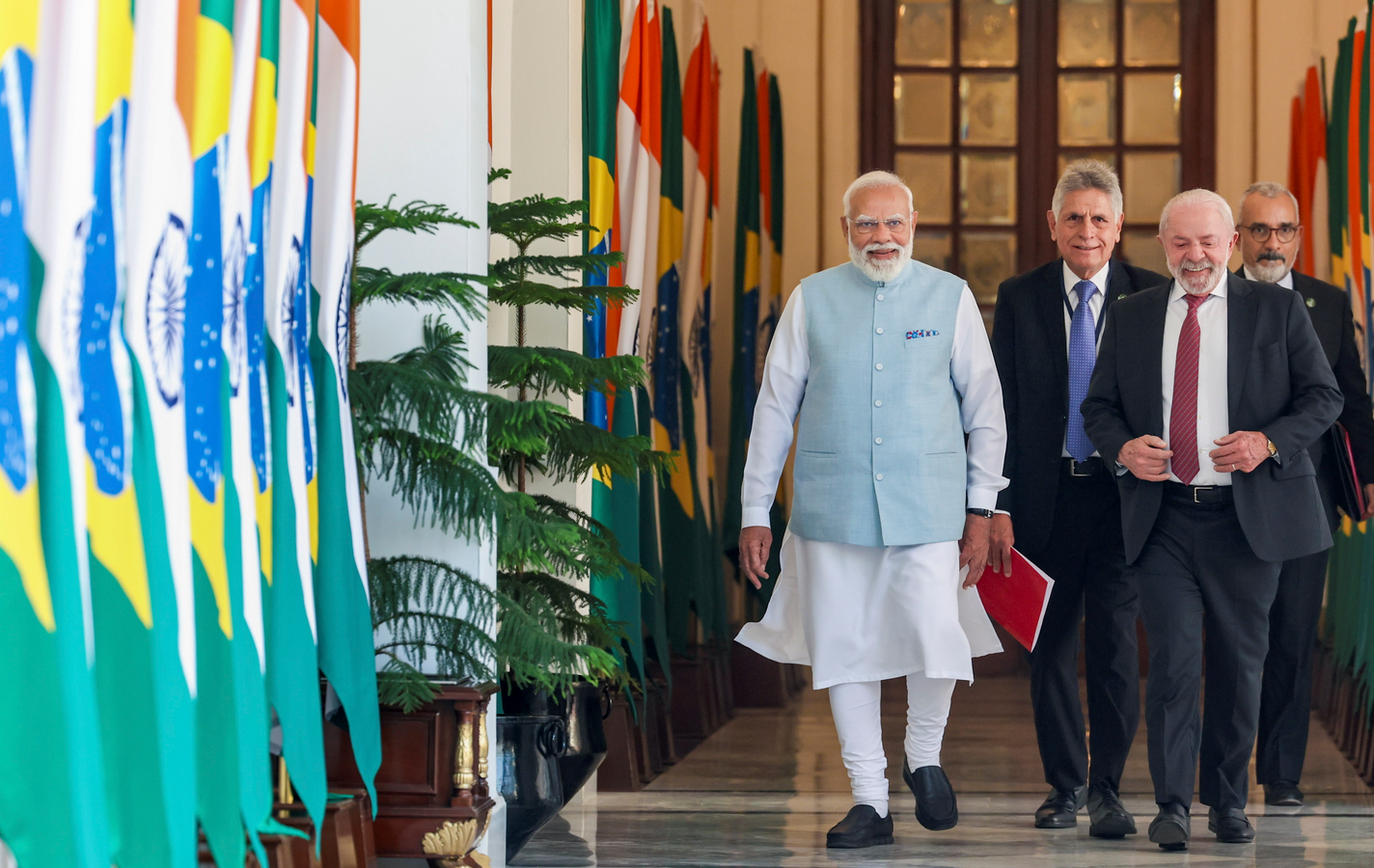
New Delhi, Feb 21 – India and Brazil on Saturday set an annual bilateral trade target of USD 30 billion by 2030, even as Prime Minister Narendra Modi and Brazilian President Luiz Inácio Lula da Silva discussed the implications of the US Supreme Court striking down Trump administration’s reciprocal tariffs.
Following extensive talks between Modi and Lula, the two sides signed nine agreements, including one on cooperation in areas of rare earth minerals and another on forging a futuristic digital partnership.
External Affairs Minister P Kumaran said in a press briefing that the two sides discussed US trade policy and the implications of the US Supreme Court’s judgment.
"Both leaders agreed that this is a significant development that both sides need to study its implications and wait for further developments from the US administration," he said.
"We will be focusing on how the administration responds to this judgment and whether further steps are taken, and we will also study its implications for our trade," he said.
US President Donald Trump has imposed a new 10 per cent global tariff after the US Supreme Court struck down the reciprocal tariffs.
Kumaran said Modi and Lula agreed that bilateral trade should be doubled to USD 30 billion by 2030.
In their talks, the two leaders vowed to strengthen bilateral ties in various sectors including defence, energy, healthcare, and digital public infrastructure, while emphasizing deeper India-Brazil strategic engagement to navigate the fragmented geopolitical environment.
Modi said India and Brazil are unanimous that terrorism and its supporters are "enemies" of humanity, even as he noted that both sides agreed that reforms of global institutions are essential to address the challenges facing the world.
Lula is in India on a five-day visit from February 18, primarily to attend the AI Impact Summit and hold talks with Modi.
"Brazil is India's largest trading partner in Latin America...Our trade is not just a figure, it's a reflection of trust," Modi said in his media statement in the presence of the Brazilian leader.
In 2024-25, India-Brazil trade volume reached USD 12 billion, with Indian exports amounting to USD 6.77 billion and imports from Brazil totaling USD 5.43 billion.
The prime minister said the agreement on critical minerals and rare earth is a major step towards building resilient supply chains.
Besides the pact on critical minerals, India and Brazil also finalized a joint declaration on digital partnership, and signed Memoranda of Understanding (MoUs) for cooperation in areas of mining, MSMEs, healthcare, and traditional knowledge system.
"Our cooperation in the field of defence is also continuously growing. This is a great example of mutual trust and strategic coordination. We will continue to strengthen this win-win partnership," he said.
Modi noted that the voice of the Global South becomes stronger and more confident when India and Brazil work together.
"The India-Brazil partnership on the global stage has been strong and influential. As democratic countries, we will continue to advance the priorities and aspirations of the Global South," he said.
"We believe that every problem must be resolved through dialogue and diplomacy. India and Brazil are unanimous that terrorism and its supporters are enemies of all humanity," he said.
In his remarks, Lula slammed the terrorist attacks in Kashmir, and said terrorism must not be linked to any religion or nationality.
The president said that the "turbulent global environment" requires India and Brazil to deepen our strategic ties and that dialogue between the two powers is an engagement of "superlatives".
"We are not just the two biggest democracies of the Global South. This is a meeting of a digital superpower with a renewable energy superpower. We are both mega diverse countries and we both defend multilateralism and peace," he said.
The Brazilian leader argued that there is no possibility of a fair and sustainable development in a conflict-ridden world and quoted Modi's remarks at last year’s BRICS summit that one can't run “21st-century software on 20th-century typewriters”.
"We emphasised our commitment to the UN reform, particularly of the UN Security Council so that it represents the interests of the Global South. Brazil and India are natural candidates to become permanent members of the Security Council," he said.
In his statement, Modi said India-Brazil relations have long benefited from President Lula’s vision and that his visit has given new energy to the strategic partnership between the two nations.
The prime minister also made a mention of the India-Mercosur trade agreement and said it will further strengthen economic ties.
"Our cooperation in technology and innovation is important for both countries, as well as for the entire Global South. I am pleased that we are working on establishing a Centre of Excellence for Digital Public Infrastructure in Brazil," he said.
"We are also prioritizing our cooperation in areas such as Artificial Intelligence, supercomputers, semiconductors, and blockchain. We both believe that technology must be inclusive and it must become a bridge for shared progress," he said.
Modi described India-Brazil energy cooperation as a strong pillar of the relationship.
"Along with hydrocarbons, we are also accelerating cooperation in many areas such as renewable energy, ethanol blending, sustainable aviation fuel. Brazil's active participation in the "Global Biofuel Alliance" reflects our shared commitment to a green future," he said.
In the talks, Brazil also proposed to co-chair the India-backed Coalition for Disaster Resilient Infrastructure (CDRI).
"I congratulate President Lula for this initiative. Brazil's extensive experience in this field will significantly contribute to further strengthening the CDRI," Modi said.