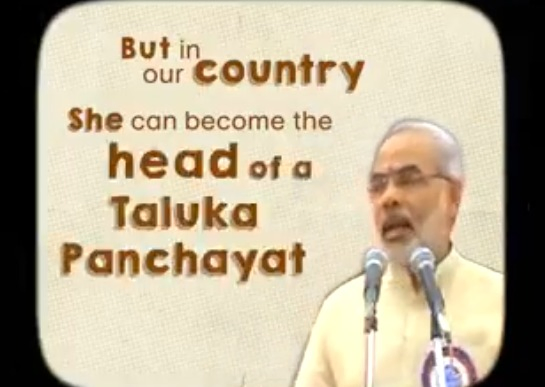
New Delhi, March 8 India granted women universal suffrage at the time of Independence in 1947, a step that came much earlier compared to many of the world’s oldest democracies, where women had to struggle for decades to secure voting rights. This historical milestone was highlighted in a video shared by the social media handle ‘Modi Archive’ on International Women’s Day.
According to the Modi Archive post on X, "While some of the world’s oldest democracies took over a century to grant women the right to vote, India gave women universal suffrage in 1947. This was before the legislation, the national mission, the policy frameworks, and the implementation of the Nari Shakti Vandan Adhiniyam, which reserved 33 per cent of Parliament’s seats for women."
The post noted that even in 2003, as the then Chief Minister of Gujarat, PM Modi had raised an important question about the role of women in public life.
"Twenty years ago, a Chief Minister was already asking: Why should women's power remain confined to the family? Why not the Gram Sabha, the district, or every room where decisions are made? The year was 2003. The day was Women’s Day. The leader was Narendra Modi," the post added.
The video clip shared by ‘Modi Archive’ features the then CM Modi addressing the status of women in India and challenging common narratives that portray women in Western countries as being far more empowered.
"There is a narrative spread in our country about different nations of the world, suggesting that women there are far ahead and can do anything they wish," he said, adding that many people in India who do not fully understand the strength and traditions of the country often get influenced by such narratives.
"Those who do not recognise the strength of this nation also get carried away by this perception and begin to believe that the status of women in India is extremely poor," he said.
Highlighting historical developments, PM Modi pointed out in the 2003 speech that women in several established democracies received the right to vote only after long struggles.
"Sisters, we became independent in 1947. With independence, women in our country naturally received the right to vote. The whole world was surprised by this," PM Modi said.
He further noted that in countries like the US, women had to fight long battles to secure their voting rights, even after more than a century of democratic governance.
In contrast, India not only granted voting rights to women at the time of Independence but also ensured their participation in grassroots governance. Women have been able to hold positions such as Sarpanch, as well as leadership roles in Taluka Panchayats and District Panchayats.
The post also referred to the more recent passage of the Nari Shakti Vandan Adhiniyam, which provides for 33 per cent reservation for women in Parliament and state Legislative Assemblies.
In his 2003 address, CM Modi emphasised that women’s strength has always played a vital role in India’s social fabric. However, he stressed that this strength should extend beyond the household and become a powerful force in public life.
“In India, women’s power is a great strength in social life. But in the coming days, this strength must be transformed into a broader social force,” he said.
He added that while women are an important source of strength within families, their capabilities should not remain limited to domestic roles. Instead, their participation in decision-making processes would help strengthen society.
PM Modi also spoke about empowering women through self-help groups and community initiatives, stating that such efforts could create a movement of women’s leadership across villages.
The aim, he said, was to build awareness and ensure that the benefits of social welfare and prosperity reach every section of society through the active participation of women in governance and public life.