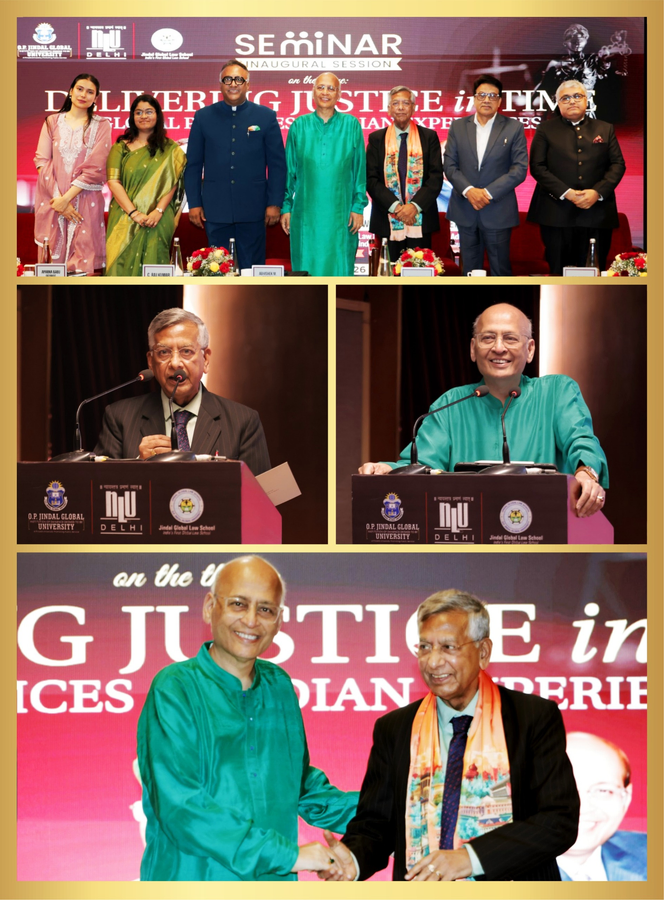
New Delhi, March 16 – R. Venkataramani, Attorney General for India, has called for a new framework for plea bargaining based on social, cultural, and economic theories and practices at the inaugural session of the seminar on “Delivering Justice in Time: Global Practices and Indian Experiences,” jointly organized by O.P. Jindal Global University and the National Law University Delhi.
“Plea bargaining is becoming universal. There is a need for a national protocol for plea bargaining, a protocol that can be developed and can, in a healthy way, advise, guide, and counsel both practitioners and victims of the justice system, so that the protocol can be implemented transparently and objectively. The legal and civil authorities should be prepared to play important roles. The Chief Justice of India has consented to have a strong internal discussion on this. Existing legal mechanisms will also be made ready to look at the issue from a new perspective, and there is a concession for the defense and the state's resource management. The state's resource management is not only relevant to the plea bargaining aspect. It is essentially a resource value for the state, like an economic principle that should apply throughout the entire justice system. This is why I have been thinking about a National Institute for Criminal Justice Administration, which will also have an index that we can use to track and measure performance. Those who practice in the trial court will find it helpful to see how people waste their resources on governments, institutions, lawyers, and judges, as well as time!” Venkataramani said.
“A Legal Health Index is important for our country. The Legal Health Index will probably identify factors that will include preventative and predictable procedures, the ease of obtaining justice, what roles each of us can play, and what kind of resource investment we require. Therefore, a Legal Health Index should be properly conceived, identified, and then implemented. And who should do that? I don't think it needs to be necessarily in the hands of governance institutions, but it is a role for law schools and universities in conceiving and maintaining the Legal Health Index. It is also important for the community to get involved and to offer a different point of view,” the Attorney General added.
In his keynote address, Dr. Abhishek M. Singhvi, Senior Advocate, Supreme Court of India & Member of Parliament, spoke about the large backlog of cases in India. “The paradox of India’s legal system is that it can produce some of the world’s most sophisticated jurisprudence, while simultaneously struggling with a massive backlog of cases. We need to address the ‘ABCD’ – the issues of access, backlog, cost, and delay – and the obvious step is to appoint more court judges. We need to fill judicial vacancies, adopt multi-track case management systems, resolve very old cases through dedicated mechanisms, strengthen mediation, and revive Gram Nyayalayas, and improve coordination across courts, police, and prisons. We need synergy and focus to deal with the high number of pending cases, which is also holistic. We need a curative and preventive approach, and a unconventional, bold new methodology to address the issue. The other extreme, which is a big failure, is arbitration. Arbitration has become pre-litigation litigation, which is just adding one more separate limb to the process, but the reality is that there are not enough trained mediators, and this needs to be addressed on a war footing. There is also the issue of human infrastructure. The criminal law justice system includes the criminal hearing judge, the police, and the prison staff, and all these have to be synergically coordinated.”
He also called for reconsidering the retirement age disparity between the High Courts and the Supreme Court and emphasized long-term consistency in reform implementation.
In his welcome address, Prof (Dr) C. Raj Kumar, Founding Vice Chancellor, O.P. Jindal Global University, emphasized that the rule of law depends not only on constitutional design or legal doctrine, but on the ability of institutions to deliver justice in a timely, fair, and effective manner.
“I highlight India’s pendency crisis – with over 5 crore pending cases – where there is a need for systemic reforms, and I propose five pillars for transforming justice delivery. These include strengthening judicial capacity; procedural reform and active case management; technology and artificial intelligence in courts; expansion of plea bargaining and pre-trial mechanisms; and data-driven justice governance.”
Dr. Raj Kumar lauded the collaboration between National Law University Delhi, Jindal Global Law School, and O.P. Jindal Global University. He expressed the intention to expand the seminar into a nationwide series of discussions across multiple cities and states to build collective consciousness and momentum around the urgent need for timely and effective justice delivery in India.
A message was also conveyed from the Minister of State for Law and Justice, Arjun Ram Meghwal, who was unable to attend due to official responsibilities, along with his keen interest in the outcomes of the seminar. It was noted that a comprehensive report of the deliberations would be shared with him for possible follow-up discussions.
Prof (Dr) G.S. Bajpai, Vice Chancellor, National Law University Delhi, reflected on the deeper meaning of the seminar’s theme: “Justice in Time.” He cautioned that speed alone does not equal justice. True legitimacy in the justice system, he noted, depends on fairness, transparency, and procedural integrity. He called for an empirical evaluation of the timelines introduced in India’s new criminal laws and emphasized the need to strengthen victim justice frameworks, continuous legal aid from early stages, and a coherent national sentencing policy.
The event led to a day-long seminar with several sessions, which included: Institutional & Procedural Reforms: Improving Efficiency In Court Systems; Technology & Timely Justice: Digital Courts, AI, And Data Governance; and Plea Bargaining & Pre-Trial Mechanisms: Efficiency Without Compromising Justice.
Senior lawyers, legal experts, and academics participated in the sessions, including Dr. Pinky Anand; Tanveer Ahmed Mir; Sanjiv Sen; Maninder Singh, Senior Advocates, Supreme Court of India, with Professor Shireen Moti, Associate Professor, Jindal Global Law School, and Dr. Garima Tiwari, Associate Professor, National Law University Delhi.
Other sessions included Dr. Aprajita Bhatt, Associate Professor, National Law University Delhi; Aryan Grover, Founder & CEO, Vetoai, Technologies Bharat Ltd.; Prof Paavni Jain, Assistant Director, Cyril Shroff Centre For AI, Law & Regulation, Jindal Global Law School; Geeta Luthra, Senior Advocate, Supreme Court of India; Parth Maniktala, Chief Legal Officer, Adalat AI.
The final session saw the participation of Prof (Dr) G.S. Bajpai, Vice Chancellor, National Law University Delhi, who delivered the keynote address. Other speakers included Vrinda Bhandari, Advocate, Supreme Court of India; Prof Vaibhav Chadha, Associate Professor, Jindal Global Law School; Prof (Dr) Khagesh Gautam, Professor, Jindal Global Law School; and Satvik Varma, Senior Advocate, Supreme Court of India, moderated by Priyanshi Singh, Academic Fellow, National Law University Delhi.
The introductory remarks were given by Prof Aparna Babu George, Assistant Professor, Jindal Global Law School, and the Vote of Thanks was delivered by Prof Dabiru Sridhar Patnaik, Registrar, O.P. Jindal Global University.