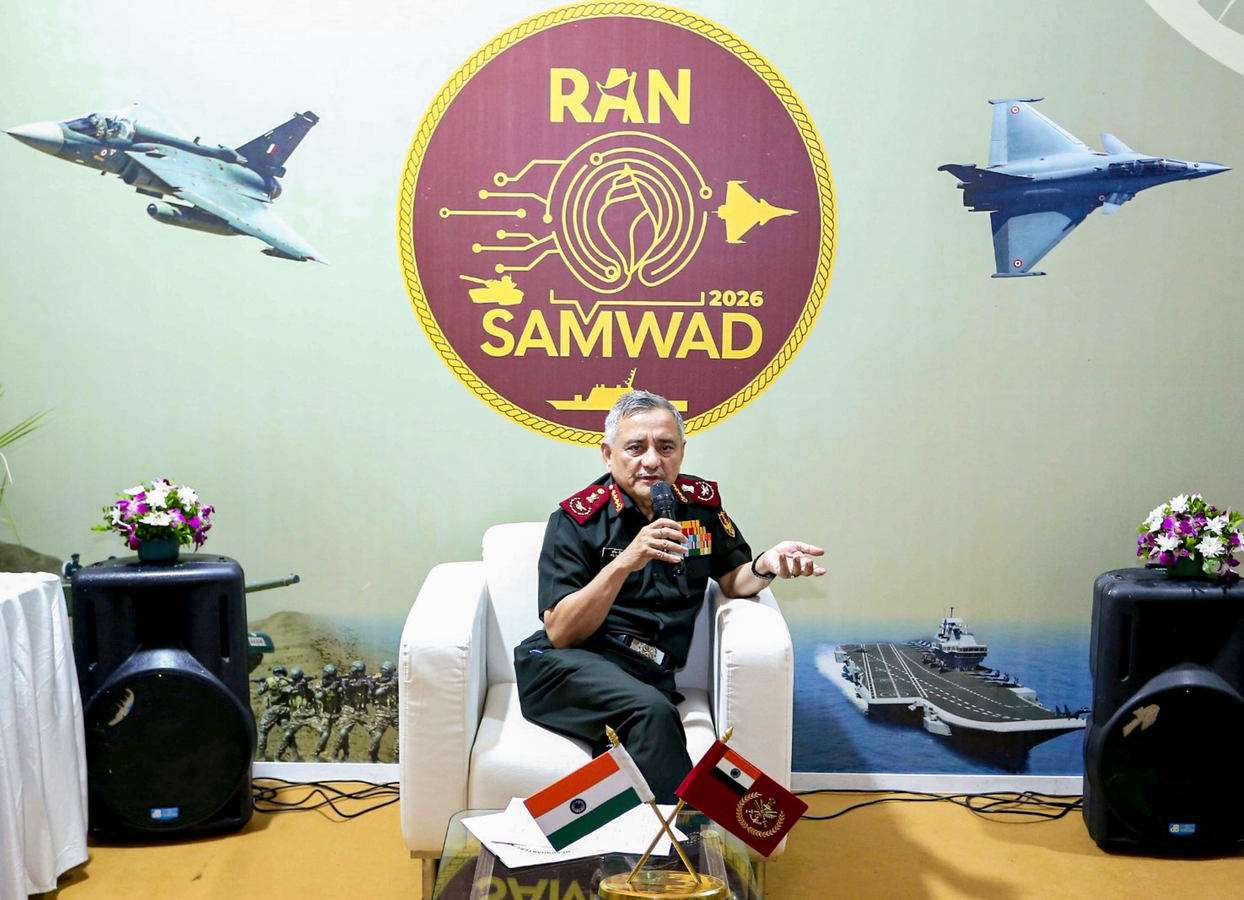
Bengaluru, April 10 Chief of Defence Staff General Anil Chauhan on Friday said there was a broad consensus among the three services on the concept of Integrated Theatre Commands (ITCs).
Integrated Theatre Commands in India are a major defence reform aimed at integrating the Army, Navy, and Air Force under a single unified commander for specific geographical regions.
He added that certain implementation aspects were still being worked out, underscoring the need to enhance efficiency in modern warfare.
Interacting with reporters at the end of the two-day ‘Ran Samvad’ seminar, he said the proposed structure was aimed at separating force generation from force application to deal with the increasing complexity of warfare.
“This whole idea of the greater command concept is to separate force generation from force application. Until now, both these responsibilities resided within a single service,” General Chauhan said.
He stressed that modern conflicts demanded structural reforms within the military.
“Warfare is becoming very, very complex, and equally complex is force generation,” he said.
He added that separating the two functions would improve efficiency in both processes.
General Chauhan said there was complete consensus among the Army, Navy, and Air Force on the concept of integrated commands, though some implementation issues remain.
“There are hundreds of connected questions, but I think these issues can be resolved as we implement this particular plan. And whatever we do is not really cast in stone; it is amenable to change,” he said.
He said the theatre command structure would involve the creation of joint headquarters integrating operations, intelligence, and logistics functions.
“We are going to converge a lot of capabilities and centralise them,” he noted, adding that regional commanders would continue to function under the new arrangement for operational and administrative roles.
Earlier, General Chauhan described ‘Ran Samvad’ as a key platform for shaping military thought and preparing the armed forces for future challenges.
“Ran Samvad is a landmark initiative on military matters, at least in South Asia,” he said.
He said ‘Ran Samvad’ promotes new dialogue on war and warfighting.
According to him, the initiative aims to make the armed forces future-ready in “thought, capability, and action,” while also promoting awareness of strategic issues among citizens.
“Thoughts, as you all know, are the backbone of any capability development. Original thought, I think, is at the cutting edge of combat,” he said.
Emphasising a whole-of-nation approach, General Chauhan said, “The armed forces may be the last instrument or resource, but they are not the only instrument. The whole nation has to get involved in this.”
On future warfare, General Chauhan said rapid technological changes made it difficult to predict long-term requirements.
“War and warfare are evolving so fast that it is very difficult to give a precise answer to what will be suitable for us in the long run. Each is producing a different kind of lesson for us,” he said.
He noted that decisions on specific platforms and capabilities must emerge from within the services.
On multi-domain operations, he described it as an evolving concept with multiple models.
Responding to queries on timelines, he said final decisions on the structure and location of theatre commands would be taken by the government.
“That is the prerogative of the Government of India. I have concluded my discussions with the service chiefs, and we have achieved consensus; now we are ready to take it forward,” he said.
He also highlighted the changing character of warfare, distinguishing between traditional and emerging domains.
“Warfare in older domains like land and maritime is slow, brutal, and gradual. Warfare in new domains—cyber, the electronic spectrum, and space—is smarter, faster, and unpredictable,” he said.
He emphasised that India must prepare for both traditional and emerging domains.
He described the ongoing transformation as a “multi-pronged initiative” involving the services and various government departments, and said its success would become more visible over time.