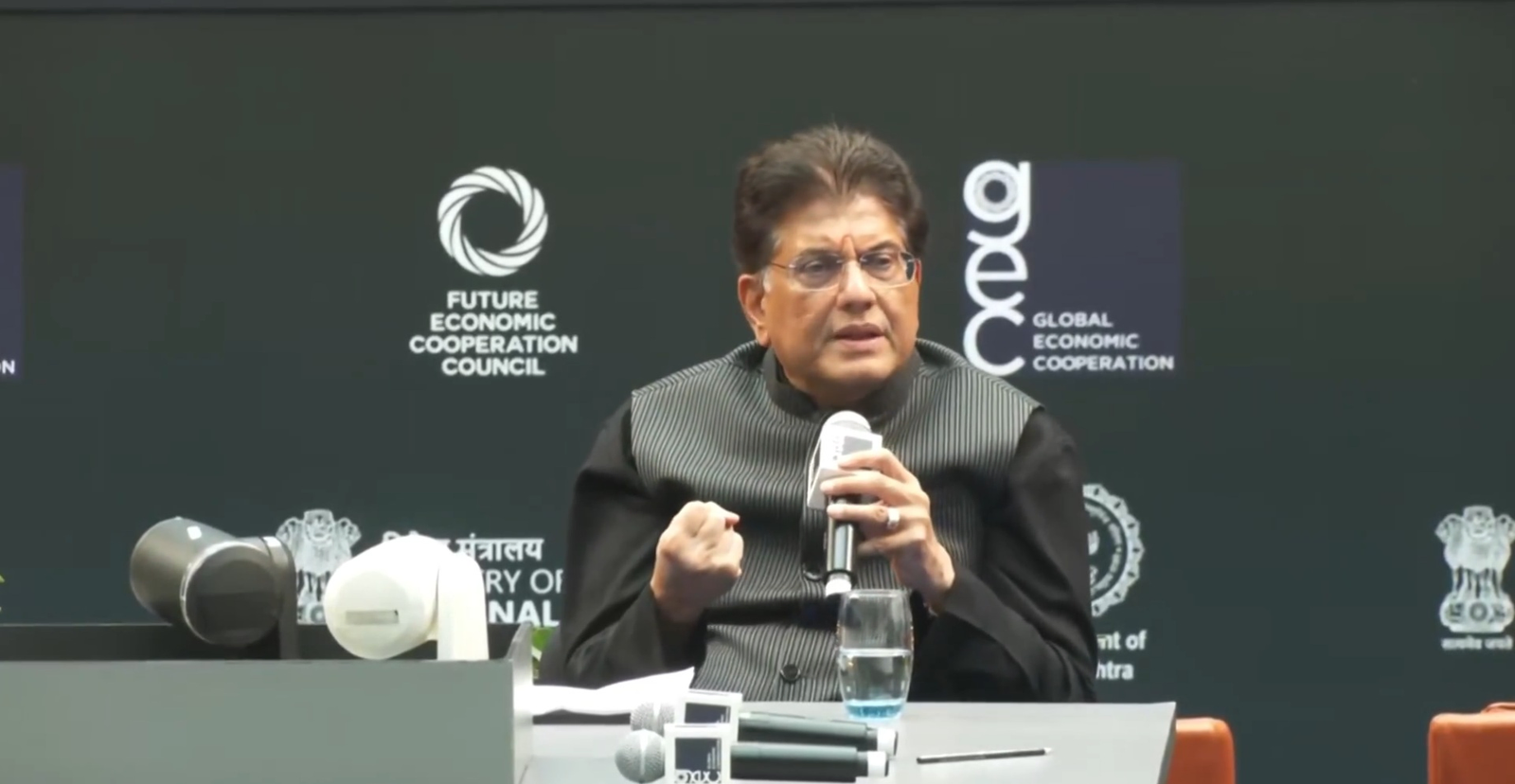
Mumbai, February 18 – Union Commerce and Industry Minister Piyush Goyal stated on Wednesday that India is expected to add approximately $26 trillion to its economy by 2047—a scale of growth that is unparalleled in history and unlikely to be replicated anywhere else in the world.
Addressing the Global Economic Cooperation (GEC) 2026 forum here, the minister said: "The era of economic isolation is over – this is why we are building alliances, deepening friendships, and concluding trade agreements from a position of strength – nine agreements in four years, with more to come."
"India's national interests guide every conversation – ensuring opportunities for farmers, MSMEs, women, and industries – while safeguarding sensitive sectors."
In his keynote address at the forum, Goyal highlighted India's approach to economic diplomacy and the country's emergence as a credible, indispensable partner in global trade and investment.
"A free trade agreement, for us, is an invitation to partner in India's future, to participate in a journey that will take India from the world's fourth-largest economy today to the third largest by 2027-28, and ultimately to a $30-35 trillion developed nation by 2047. The world wants to be part of this story. And India, open, trusted, and growing, is ready to welcome every partner who comes to the table in sincerity," he said.
The forum brings together senior ministerial and business delegations from major global economies, including France, the United Kingdom, the United Arab Emirates (UAE), the United States, Australia, Seychelles, Sri Lanka, and Singapore.
Noting that India now has agreements with 38 developed nations across 16 FTAs and 6 PTAs, Goyal attributed this success to a clear and disciplined national purpose.
"India has concluded nine agreements between 2022 and now, within roughly four years. These agreements were negotiated from a position of strength. Trust enables us to protect our defensive interests and advance our offensive interests simultaneously. Partner nations have accepted India's position because we have been honest and transparent about our objectives.”
“Our negotiations allow us to protect farmers, safeguard the growth of MSMEs, protect fishermen, and preserve jobs in India, while at the same time securing market access in textiles, footwear and leather, expanding pharmaceutical exports, enhancing farm and marine product exports, and attracting technology and investment," he observed.
GEC 2026 commences at a pivotal moment for the global economy. Against the backdrop of shifting trade architectures and an increasingly multipolar world, the forum aims to shape practical frameworks for resilient, inclusive, and future-ready economic cooperation.
Speaking on the occasion, Minister of External Affairs S. Jaishankar said: "The world has entered a volatile and uncertain era where long-standing assumptions are being questioned, and key dimensions are transforming simultaneously… As we move towards our goal of Viksit Bharat by 2047, we seek not only to contribute to global growth, but also to global stability, predictability, and trust."
Maharashtra Chief Minister Devendra Fadnavis said: "We meet at a time when global trade is undergoing a major upheaval, supply chains are reorganising, and strategic sectors — semiconductors, energy, food, rare earths, AI — are now embedded in national security doctrines. Let us shape an economic order that is resilient, inclusive, and strategically stable."