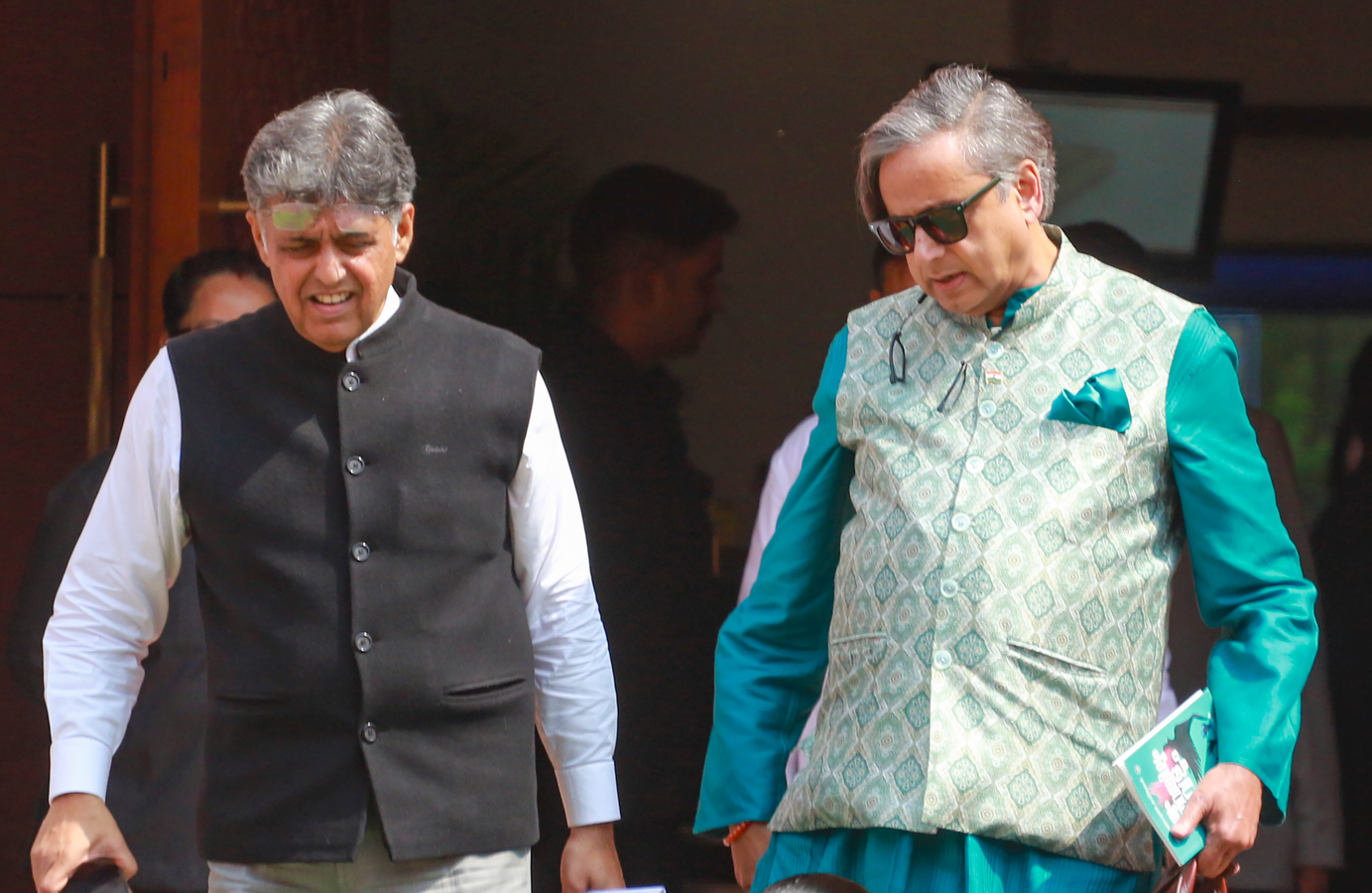
New Delhi, March 19 – Shashi Tharoor and Manish Tewari, both Members of Parliament from the Congress party, have publicly defended India's foreign policy in the context of the conflict in West Asia involving Iran, Israel, and the US. The two veteran politicians have expressed support for India's skillful management of the situation, emphasizing the importance of safeguarding its own interests in the region.
In an op-ed, Shashi Tharoor justified India's "silence" as responsible statecraft, rather than moral surrender, as claimed by many. Manish Tewari said that "it was not India's war" and justified India's stance on observing the developments from a distance.
Tharoor, who also heads the Standing Committee on External Affairs, referred to Jawaharlal Nehru's policy of non-alignment to counter claims (made by the Congress-led opposition) that India was taking sides by aligning with the powerful US-Israel axis.
"India's diplomacy has always been about balancing principle with pragmatism. Jawaharlal Nehru's policy of non-alignment was not a refusal to take moral positions, but a recognition that India's sovereignty and survival depended on avoiding entanglement in Cold War hostilities," Tharoor wrote in the article.
He further stated, "India practices 'multi-alignment' – engaging with diverse powers, sometimes in tension with one another, while keeping our national interest paramount."
He admitted that the war on Iran is unjustifiable under international law but opined that India's "silence" is not an endorsement of that war, but rather a recognition that our national interest requires prudence, not posturing.
"For a government to recognize geopolitical realities and weigh the consequences for India's economy and strategic position before taking a public stand is not 'moral surrender'. It is responsible statecraft," he further said.
Manish Tewari, speaking at an event recently, also backed the Central government on maintaining a safe distance from the hostilities, given the fact that India has always remained a marginal player in the region.
"It's important to understand that there is not one war happening in West Asia. There are multiple wars taking place… What is really happening between Israel-United States and Iran, taking a side, is not just about the Middle East dynamics on its own," Tewari said.
"Well, it's not our war. We've always been rather marginal players in the greater Middle East…" he added.
Further speaking about India's strategic autonomy, he said, "If we are circumspect, I think probably we are doing the right thing, because that is really what strategic autonomy is about, the ability to protect your interests and navigate."
The Modi government's alleged silence on the West Asia crisis and delay in condoling the killing of Iranian supreme leader Ayatollah Khamenei have invited widespread criticism from various quarters, particularly the opposition. Congress Parliament party (CPP) chairman Sonia Gandhi also penned an open letter lamenting the government's dilly-dallying in handling the situation in West Asia.
Now, the endorsement of India's stance on the Gulf crisis by two veteran Congressmen calls into question and "punctures" the apprehensions and concerns raised by the grand old party.
Notably, the two Congressmen had also defended the Modi government's diplomatic outreach after the Operation Sindoor, a move that put them at odds with their own party's leadership.