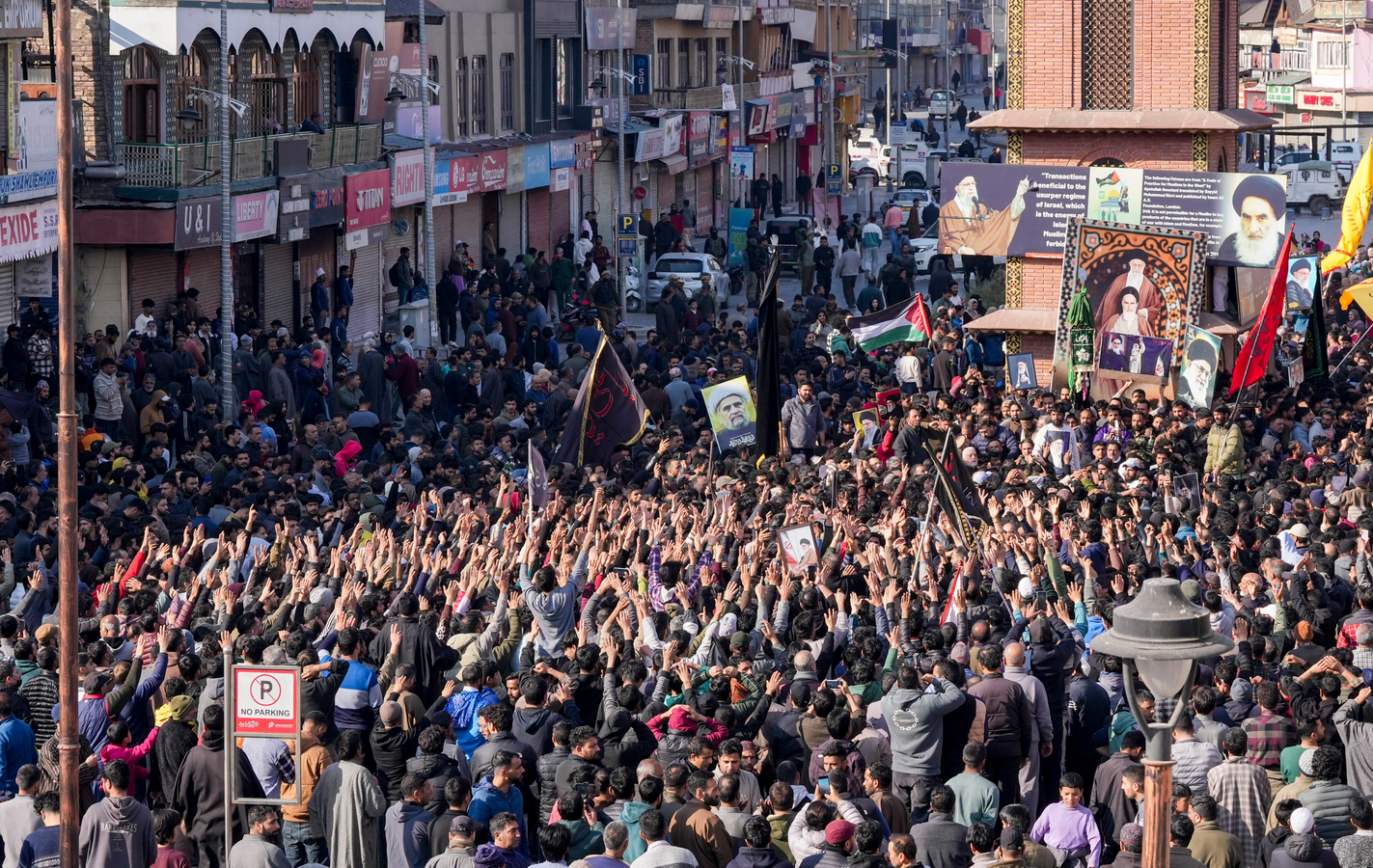
In a strong criticism of the Modi government, Congress leader Sonia Gandhi stated on Tuesday that the government's silence on the targeted assassination of Iran's Supreme Leader Ayatollah Ali Khamenei is not neutral, but an abdication of responsibility, and raises serious questions about India's foreign policy.
Gandhi also demanded that when Parliament reconvenes, the government should openly and honestly discuss the breakdown of international order.
In her article published in The Indian Express, Gandhi said that India needs to rediscover its moral strength and articulate it clearly and firmly.
"On March 1, Iran confirmed that its Supreme Leader, Ayatollah Seyed Ali Hosseini Khamenei, had been assassinated in targeted strikes carried out the previous day by the United States and Israel. This killing of a sitting head of state during ongoing negotiations represents a serious breach in international relations," Gandhi said.
However, she emphasized that New Delhi's silence is equally concerning.
The Indian government has refrained from condemning the assassination or Iran's sovereignty.
"Initially, the Prime Minister (Narendra Modi) focused on condemning Iran's retaliatory strike on the UAE without addressing the events that preceded it. Later, he made general statements about his 'deep concern' and talked about 'dialogue and diplomacy,' which is precisely what was happening before the massive, unprovoked attacks launched by Israel and the US," Gandhi said.
Gandhi argued that this silence raises serious doubts about the direction and credibility of India's foreign policy.
She pointed out that the assassination was carried out without a formal declaration of war and during an ongoing diplomatic process.
"If such acts pass without principled objection from the world's largest democracy, the erosion of international norms becomes easier to accept," she said.
Gandhi further emphasized that India's high-profile political endorsement without moral clarity is a visible departure.
"The consequences of this event extend beyond geopolitics. The ripple effects are visible across continents. And India's stance is signaling tacit endorsement of this tragedy," she claimed.
Gandhi pointed out that the Congress has unequivocally condemned the bombings and targeted assassinations in Iran, describing them as a dangerous escalation with grave regional and global consequences.
"We have extended condolences to the Iranian people and to Shia communities worldwide, reiterating that India's foreign policy is anchored in the peaceful settlement of disputes, as reflected in Article 51 of the Constitution of India. These principles – sovereign equality, non-intervention, and the promotion of peace – have historically been integral to India's diplomatic identity. The present reticence, therefore, appears not merely tactical, but discordant with our stated principles," she said.
Gandhi recalled that in April 2001, then Prime Minister Atal Bihari Vajpayee, during a visit to Tehran, warmly reaffirmed India's close ties with Iran.
"His acknowledgement of those long-standing relations seems to hold no relevance for our current government," she said.
Gandhi also noted that India's ties with Israel have expanded in recent years, across defence, agriculture, and technology. This, she argued, allows India to urge restraint.
"But such space depends on credibility. Credibility, in turn, rests on the perception that India speaks from principle rather than expediency."
She argued that this is not merely a moral proposition, but a strategic necessity. "Nearly 10 million Indians live and work across the Gulf. In past crises – from the Gulf War to Yemen to Iraq and Syria – India's ability to safeguard its citizens has rested on its credibility as an independent actor, not as a proxy," she argued.
Gandhi questioned why countries in the Global South should trust India to defend their territorial integrity if it appears hesitant to do so today.
"The appropriate forum for resolving this dissonance is Parliament. When it reconvenes, this disturbing silence over the breakdown of international order must be debated openly and without evasion," Gandhi said.
She emphasized that the targeted killing of a foreign head of state, the erosion of international norms, and the widening instability in West Asia are not peripheral matters; they directly impact India's strategic interests and moral commitments.
"A clear articulation of India's position is overdue. Democratic accountability demands no less, and strategic clarity requires it," Gandhi said.
Gandhi concluded by saying that India has long aspired to be more than a regional power and has sought to serve as the conscience of the world.
"That stature was built on a willingness to speak for sovereignty, peace, non-violence, and justice even when doing so was inconvenient."
She emphasized that at this moment, India needs to rediscover that moral strength and articulate it with clarity and commitment.