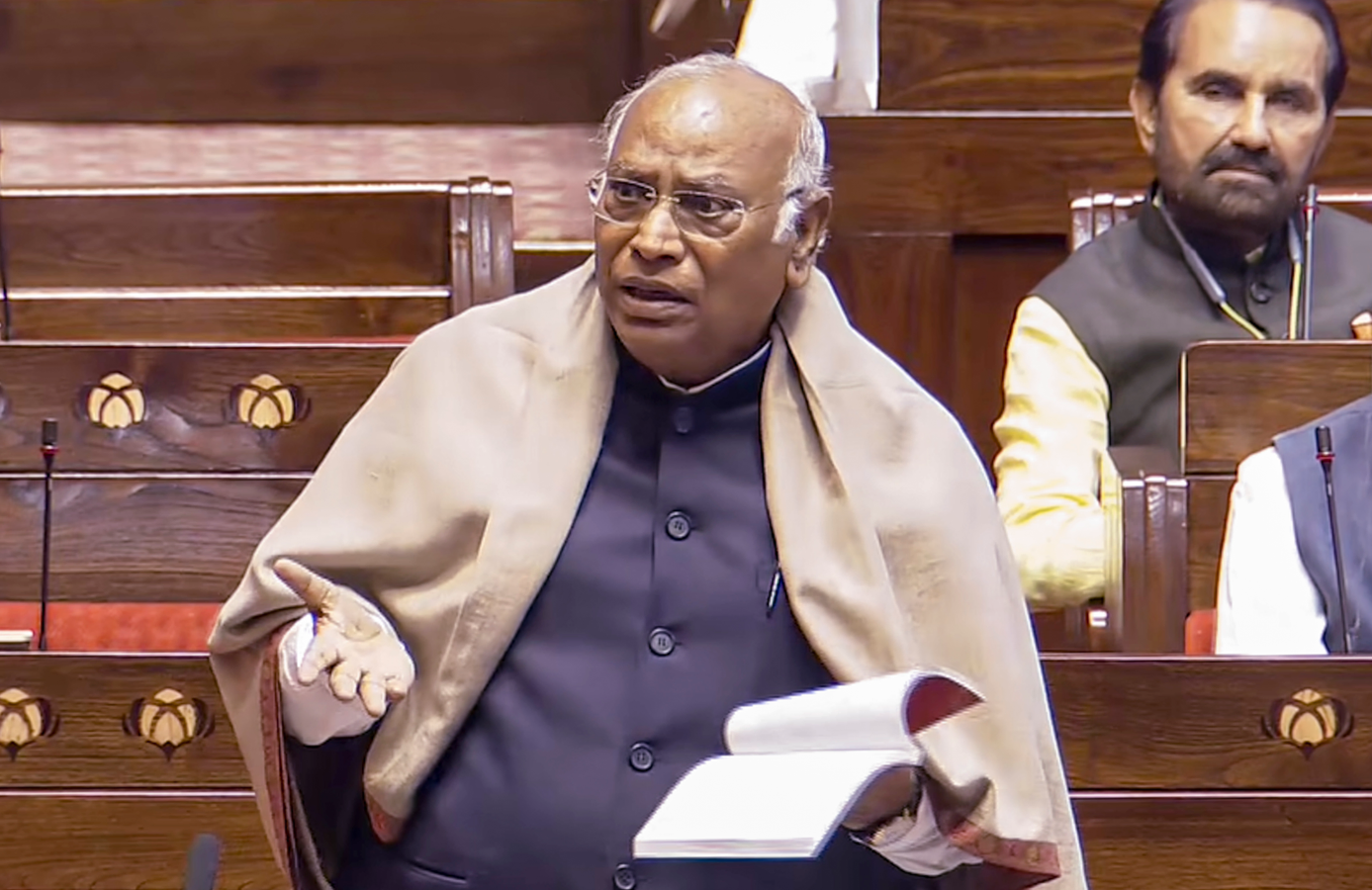
New Delhi, March 24 Congress President Mallikarjun Kharge on Tuesday termed Prime Minister Narendra Modi's statement in the Rajya Sabha on the West Asia crisis as "an exercise in obfuscation" and said it came "too late" and raises more questions than answers.
Kharge also criticized Modi for his reference to COVID-19 in his statement in the Upper House, asking "is the Prime Minister now suggesting that 140 crore Indians must once again fend for themselves as the country stares at an escalating energy crisis"?
In a post on X, the leader of the opposition in the Rajya Sabha said, "The 20-minute statement by Prime Minister Modi in the Rajya Sabha was, at best, an exercise in obfuscation."
Kharge posed three "fundamental" questions to the Prime Minister and demanded clear answers.
"First, through his inconsistent and shifting diplomatic posture, the Prime Minister appears to have altered the balance of India’s strategic autonomy—long a cornerstone of our foreign policy across successive governments. Following his recent visit to Israel, India has faced visible diplomatic consequences.
"Why did the Prime Minister fail to take Parliament and the nation into confidence about this apparent shift, and what concrete steps have been taken to restore India’s strategic autonomy?" he asked.
The Congress chief said that nearly 37-40 Indian-flagged ships carrying around 1,100 sailors remain stranded in the Strait of Hormuz, with cargo valued at approximately Rs 10,000 crore.
"Despite the Prime Minister personally speaking to the Iranian President twice, and the External Affairs Minister engaging multiple times with his Iranian counterpart, why has India failed to secure safe passage for its own vessels? Why are countries like China, Russia, Japan, along with other 'friendly nations', being granted safe transit, while Indian ships remain stuck?" he asked.
Kharge said the Prime Minister has claimed in Parliament that India has diversified its energy imports from 27 to 41 countries.
"If so, which countries are currently supplying LNG, LPG, and crude oil to India, and in what quantities? More importantly, if diversification has been achieved, why are citizens still facing shortages, long queues, black marketing, and sharp price rises across the country?" he questioned.
Noting that it has now been 25 days since the conflict began, he said India is facing a deepening energy crisis—one for which the government should have been far better prepared.
The Congress chief said PM Modi has now likened the situation to being 'Covid-like'. The nation cannot forget the tragic suffering during the pandemic, when over 40 lakh lives were lost and countless citizens were left struggling for basic necessities like oxygen, he noted.
"Is the Prime Minister now suggesting that 140 crore Indians must once again fend for themselves as the country stares at an escalating energy crisis, along with looming food, fertilizer, MSME, and inflationary pressures?" he said.
"Prime Minister Modi’s statement comes too late and raises more questions than it answers!!" Kharge said in his post.
Prime Minister Modi on Tuesday announced the constitution of seven empowered groups to deal with potential long-term impacts of the West Asia war and urged states to work with the Centre in a 'Team India' approach to ward off the crisis.
Flagging "serious side effects" of the war, he recalled the national response to Covid-19 when empowered groups of experts had helped address challenges, and said the seven empowered groups will deal with the consequences of war and evolve strategies on fuel, fertilizers, gas, supply chains and inflation.
In his statement in the Rajya Sabha, Modi reiterated the Indian position of dialogue and diplomacy as the only solutions to restoration of peace in West Asia and said India was in constant touch with all parties, including Iran, Israel and the United States, to stress de-escalation.