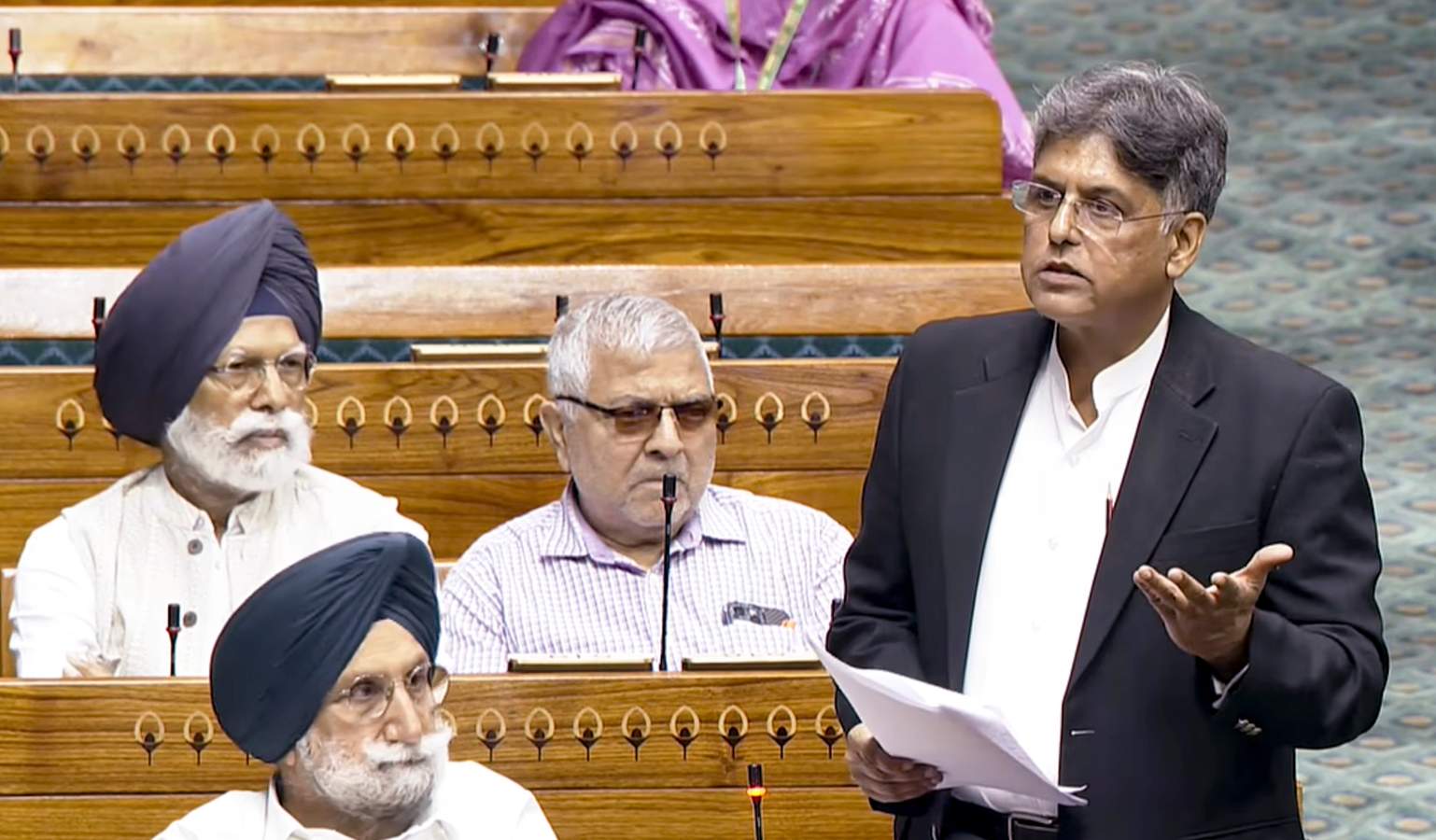
New Delhi, March 24 – The opposition on Tuesday accused the government of ceding strategic autonomy to the United States, while the ruling alliance praised the measures taken for the overall development of the country and its people.
Participating in the debate on the 2026 Finance Bill in the Lok Sabha, Congress MP Manish Tewari claimed that there has been a decline in foreign direct investment (FDI) and foreign portfolio investment (FPI) in the country, and the economy is not performing well.
He alleged that the rupee has depreciated significantly, and there have been no measures taken to prevent this.
Referring to the proposed trade agreement with the US, the Chandigarh MP claimed that it would open the Indian market to US agricultural products.
Tewari alleged that India has "agreed" to not buy Russian oil due to US pressure, which amounts to giving up strategic autonomy.
However, he ironically pointed out that the same US is now encouraging countries to buy not only Russian oil but also Iranian oil.
The Congress MP also asked the government what the impact of the ongoing war in West Asia would be on India, and what the situation would be in the country after April 30, when the second phase of the Bengal elections ends.
BJP member Naveen Jindal accused the opposition of criticizing the government without any factual basis.
The Kurukshetra MP claimed that the opposition is only engaged in protests and disruptions, without realizing that the welfare programs undertaken by the government would also benefit their constituents.
The 2026 Budget will benefit all sections of society and boost agriculture and industry, Jindal said, adding that the government always works for the welfare of farmers.
The NDA government, which has been in power for 11 years, has faced numerous challenges – including the Covid-19 pandemic, geopolitical tensions, and war – but has overcome every crisis and returned to the path of progress, Jindal said.
India has become the fastest-growing economy due to the government's consistent efforts, he said.
JD-U MP and a member of the ruling alliance, Ramprit Mandal, praised the NDA government for its all-around development efforts for the country and its welfare schemes for the poor and marginalized sections of society.
Mandal, who represents Jhanjharpur in Bihar, called for special measures to promote industrialization in the eastern state.
"When Bihar develops, the country develops too," he said.
Pushpendra Saroj of the Samajwadi Party alleged that the government has failed to boost the economy, and asked about the funds allocated to Uttar Pradesh for schemes like MGNREGA, Jal Jeevan Mission, and the Namami Ganga project.
The MP from Kaushambi in Uttar Pradesh claimed that India was once respected globally for its independent foreign policy, but now the country has strained relations with many nations.
He also claimed that there is a perception that India's foreign policy has collapsed and the country is now "dependent" on the US.
"The reality is, we are not just dependent, we have surrendered to the US," he said.
Joining the debate, Congress MP from Telangana, Vamsi Krishna Gaddam, called for tax relief for Dalit business founders and employee-linked incentives to encourage employers to recruit Dalit staff.
Multiple MPs raised concerns about the increasing wealth gap in India and the fact that a large percentage of taxes continue to come from the poor rather than the rich.
Maharashtra Congress MP Kirsan Namdeo accused the government of disinvesting from public sector enterprises set up by the Congress.
Samajwadi Party's Priya Saroj accused the Centre of using funds meant for people to pay off debts.
The MP from UP's Machhlishah also criticised the reduction in corporate taxes and asked where the funds are sourced from now.
Chandra Shekhar of the Aazad Samaj Party (Kanshi Ram) listed "multiple problems" with the Indian economy, from demonetisation and unemployment to the LPG crisis and issues faced by MSMEs.
"What does the Finance Bill do to address these problems?" the MP from UP's Nagina asked.
Lavu Sri Krishna Devarayalu of the TDP, an NDA ally, claimed that the economy thrived in the past five years despite challenges, making India one of the fastest-growing economies with 7 per cent GST growth.
However, some bottlenecks in the taxation system need to be addressed, the MP from Narasaraopet in Andhra Pradesh said.
Offering some criticism of the Budget, he said that the utilization of funds matters more than budgetary allocations, and asked the finance ministry to advance the AI target to two years – with 1 million graphics processing units (GPUs) by 2028 – to ensure balance of payments and self-reliance.
Although funds are allocated to the semiconductor industry, which could potentially prevent the "brain drain" by bringing back Indian professionals to the country, they are not being spent, the TDP lawmaker claimed.