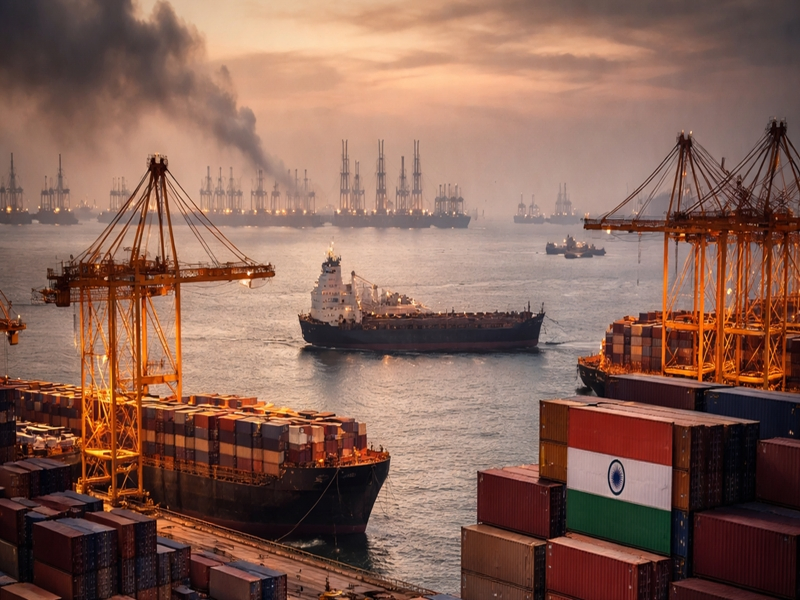
Washington, March 22: India’s economic momentum is facing a fresh challenge as the ongoing US-Israeli conflict with Iran disrupts its deep-rooted ties with the Gulf, a key pillar of trade, energy supplies, and remittances, according to a report in The New York Times.
Just weeks ago, India appeared well-positioned among major economies, with strong growth, stable inflation, and robust reserves. However, its growing economic integration with the Gulf – long seen as an advantage – is now emerging as a vulnerability, the daily said.
The report said the conflict has created a "perfect storm" for India, with the Middle East accounting for about 40 per cent of its oil imports and 80 per cent of its gas supplies. Rising energy prices are already affecting the economy, threatening the balance between growth and inflation.
India also relies heavily on the Gulf as an export market. Disruptions to air routes, shipping, and business operations risk affecting trade flows. Commercial hubs such as Dubai play a central role in distributing Indian goods globally, it said.
The impact could also extend to remittances. India remains the world’s largest recipient of funds from overseas workers, with roughly 40 per cent coming from the Middle East. Any decline in earnings of Indian workers in the region could further weaken the rupee, the prominent American daily said.
Citing a recent assessment, the report noted that Goldman Sachs warned that India's "positive growth story" now faces a "new challenge," driven by higher energy costs, slower exports, and weaker remittance inflows. India's stock markets have already declined by about 10 per cent in the past month.
The Strait of Hormuz, a critical shipping corridor near Iran that carries about one-fifth of global oil supply, remains central to India's energy security. Any prolonged disruption could strain public finances. Shortages of cooking gas are already affecting households, reported The New York Times.
India imports nearly 90 per cent of its crude oil, making it highly sensitive to global price spikes. Analysts cited in the report warned that the country's ability to absorb a prolonged energy shock would be tested.
Economist Rathin Roy said India would need to "carefully monitor its balance of payments," as import costs rise even as exports face disruption. Though foreign exchange reserves remain strong, they could come under pressure if the crisis persists.
Around 10 million Indians live and work across Gulf countries. Many send a significant share of their earnings home, contributing to remittances of nearly $130 billion annually, a figure close to India’s oil import bill.