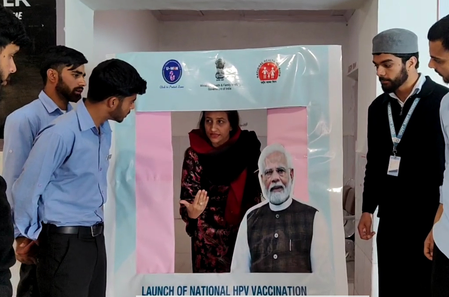
Poonch, February 27 – In a significant step towards strengthening preventive healthcare and safeguarding the future of India’s daughters, Prime Minister Narendra Modi is set to launch the National HPV vaccination campaign to protect women from cervical cancer on Saturday (February 28) from Ajmer, Rajasthan.
As the program prepares for nationwide rollout, many states across the country are set to launch dedicated immunization programs at their respective health centers.
In Poonch district of Jammu and Kashmir, all preparations have been completed at the Raja Sukhdev Singh District Hospital, under the supervision of Deputy CMO Dr Ruby Naz Bhatti.
Dr Ruby Naz Bhatti also spoke to
Dr Bhatti said, “This vaccine has been made available free of cost to our daughters and girls. Previously, this vaccine was available in the private sector. I spent thousands of rupees to get two doses for my two daughters. Now, it will be administered free of cost to girls aged 14-15 across the country."
She also said, "We are deeply grateful to Prime Minister Narendra Modi for deciding to launch this vaccination campaign to protect our daughters from cervical cancer."
Appealing to the public at large, Dr Bhatti said that everyone should vaccinate their 14-15-year-old daughters to protect them from cervical cancer, as it causes the most deaths in India after breast cancer.
“The HPV vaccine is completely safe. She also urged people not to pay attention to any rumours,” she added.
Dr Ruby Naz Bhatti explained that cervical cancer has become very common and is the second leading cause of death among women in India.
She also appealed to the people of her area not to be afraid of this vaccine or panic, and get their daughters vaccinated for their safety.
Dr Bhatti said that various misleading videos are being shared on social media, urging parents not to get distracted by them.
Notably, HPV comprises a group of more than 200 related viruses, and at least 14 of them are considered high risk, because they can lead to cancer. HPV spreads primarily through intimate skin-to-skin contact, and it does not require sex for transmission, which in a way makes both boys and girls prone to HPV infection.