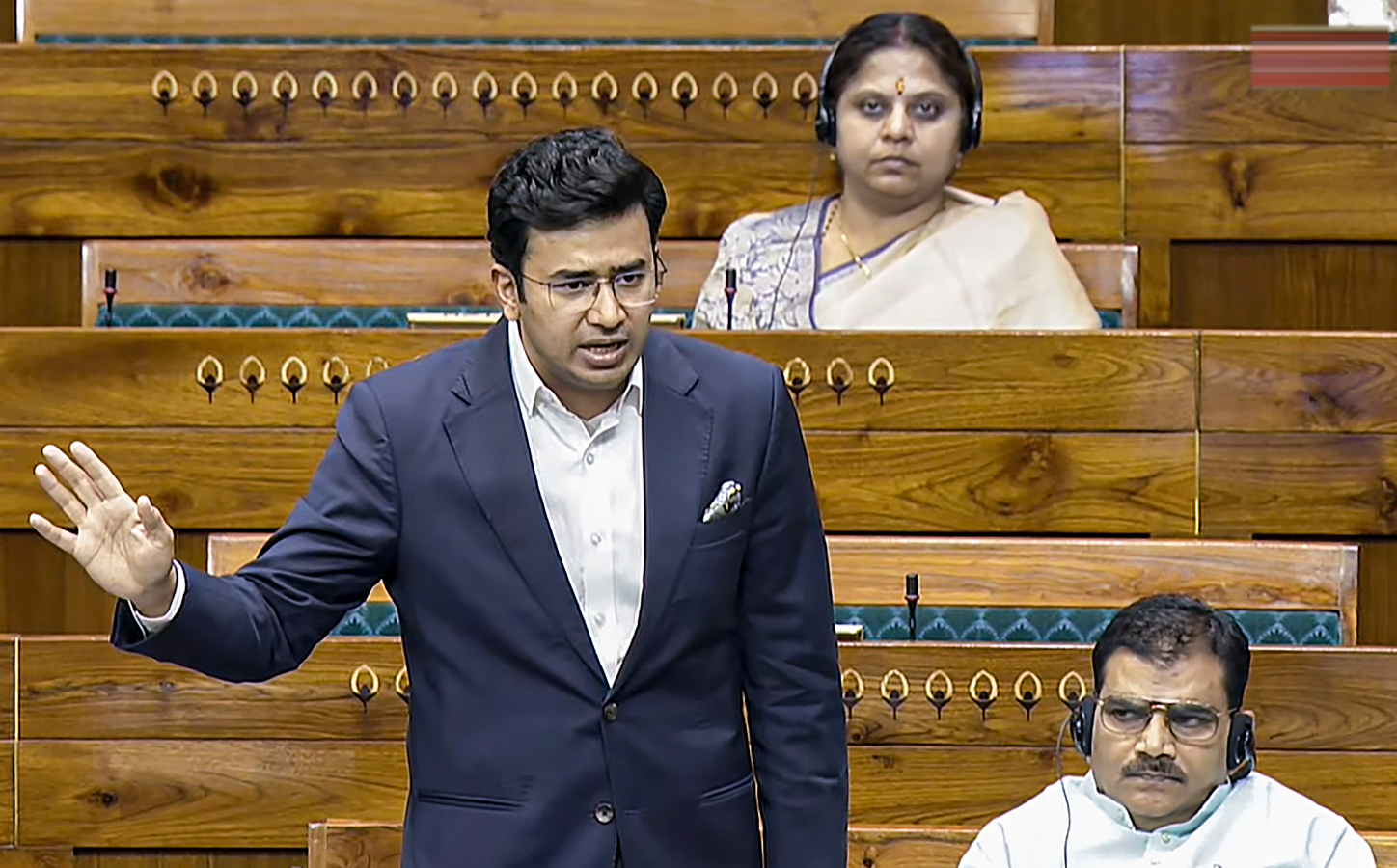
New Delhi, April 1 – Members of the ruling party and opposition engaged in heated exchanges in the Lok Sabha on Wednesday regarding the second edition of the Jan Vishwas bill. The BJP framed it as the largest decriminalization exercise in India's history, aimed at simplifying business and the Congress alleged that the proposed legislation would promote corruption and weaken the rule of law.
Commerce and Industry Minister Piyush Goyal, while introducing the Jan Vishwas (Amendment of Provisions) Bill, 2026, for consideration and passage in the Lok Sabha, stated that the bill seeks to simplify business and daily life by decriminalizing minor offenses.
"It proposes amendments to 79 central Acts administered by 23 ministries," he said.
Congress's Chamala Kiran Kumar Reddy initiated the debate, arguing that the proposed legislation is "hypocritical" as it aims to decriminalize multiple laws but actually "normalizes corruption, fraud, and corporate non-compliance."
"This bill doesn't build public trust, it undermines it. It bluntly asks us to trade justice for revenue and administrative convenience," Reddy said.
"The biggest concern is the threat this bill poses to women's safety, especially given the need for stronger protection for all women in the country," said the MP from Telangana's Bhongir.
"Currently, section 145 of the Railways Act, dealing with drunken and disorderly behavior on trains, carries only a 24-hour imprisonment sentence, which is woefully inadequate," he said.
"This is not reform, this is administrative surrender, and I strongly oppose it," Reddy asserted.
He argued that this reform aims to dismantle the fear of law.
Bharatiya Janata Party (BJP) MP Tejasvi Surya supported the bill, stating that it will decriminalize some procedural and minor offenses, facilitating ease of doing business and entrepreneurship in the country.
He thanked Prime Minister Narendra Modi, highlighting this as the largest decriminalization exercise in India's history.
"The government is decriminalizing over 1,000 offenses in one legislation. This is a model that the rest of the world can follow," Surya said.
He criticized the Congress, saying that its "70 years of colonial mindset" targeted all sections of society with criminal prosecution.
"Today, all these minor offenses are being decriminalized, and an era of trust-based empowerment is being introduced," said the Bangalore South MP.
Surya cited the example of Infosys founder N R Narayana Murthy, who had to travel to Delhi 40-50 times to import a computer.
"This was how entrepreneurship was stifled," Surya alleged, adding that the spirit of entrepreneurship was curtailed during the Congress rule.
He then recounted an anecdote about industrialist J R D Tata and India's first prime minister, Jawaharlal Nehru.
"When J R D Tata met Pandit Nehru, he communicated to the prime minister that Indian entrepreneurs were not making a profit. The prime minister then told him, 'do not bring the word profit before me, profit is a dirty word.' If our wealth creators are not respected, if industrialists are subjected to this kind of prosecution and imprisonment threat, how will the country move forward?" the BJP MP asked.
"The Congress's mindset, from calling profit a dirty word during Nehru's time to Rahul Gandhi today attacking industrialists and wealth creators, remains unchanged," Surya said.
He praised Modi for this forward-looking reform.
"Franklin Roosevelt is still gratefully remembered by Americans for the structural reforms he created in the country, Ronald Reagan is respected with gratitude for the new institutions in America that have stood their ground over the years, Margaret Thatcher is respected in Britain because she navigated the country in the most difficult of economic times. Deng Xiaoping is remembered by the Chinese because he opened up their economy and modernized it. Lee Kuan Ye is remembered gratefully by Singaporeans because he modernized an old port town.
"Narendra Modi will be remembered in the coming days as somebody who did for India what Roosevelt, Reagan, Lee and Thatcher together did for their respective countries. This is the foundation of a Viksit Bharat," Surya said.
Samajwadi Party (SP) MP Harendra Singh Malik raised concerns over the bill and said it would weaken accountability in crime.
"While the government is stating that the bill is changing colonial laws of punishment, it is actually replacing jail time for offenses with small fines," he claimed.
The BJP-led government introduced the second edition of the Jan Vishwas bill last week. A total of 784 provisions are proposed to be amended under the bill, of which 717 are being decriminalized to foster ease of doing business and 67 are proposed to be changed to facilitate ease of living.
Goyal, on March 18 last year, introduced the Jan Vishwas (Amendment of Provisions) Bill, 2025, in the Lok Sabha and it was referred to the select committee.
This exercise builds on the success of the Jan Vishwas (Amendment of Provisions) Act, 2023, the first consolidated legislation to systematically decriminalize minor offences across multiple Acts.
The 2023 Act, notified on August 11, 2023, decriminalized 183 provisions in 42 central Acts administered by 19 ministries and departments.