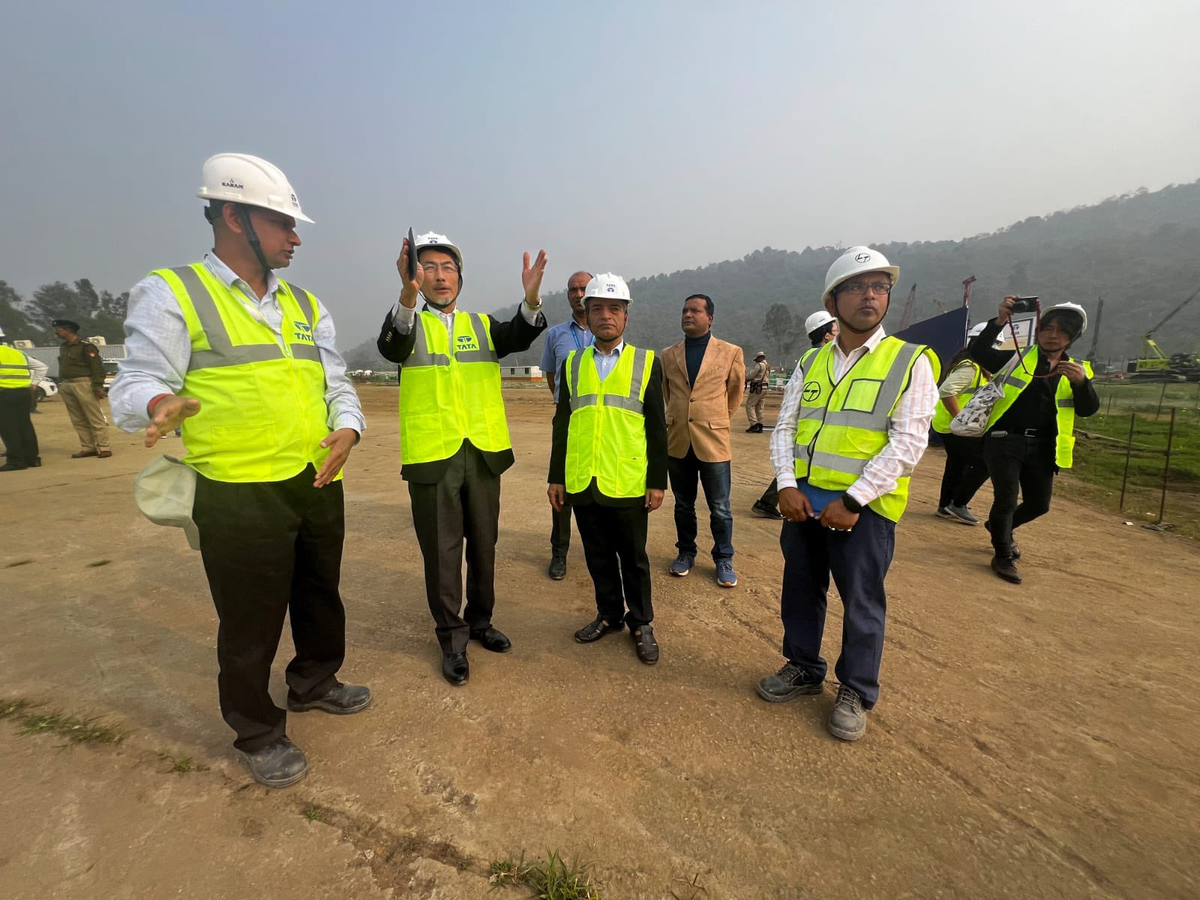
New Delhi/Tokyo, March 24. Northeast India has emerged as a crucial nexus where India's 'Act East Policy' aligns with Japan's 'Free and Open Indo-Pacific' (FOIP), enabling coordinated efforts to counter assertive regional influences through deeper maritime and land connectivity, a report highlighted on Tuesday.
It added that the Quadrilateral Security Dialogue (Quad) — comprising India, Japan, the US, and Australia — facilitates intelligence sharing, technology access, and infrastructure financing alternatives, with both India and Japan rejecting participation in China’s Belt and Road Initiative (BRI).
"Japan's deepening involvement in Northeast India's connectivity projects exemplifies a mutually beneficial partnership that bolsters regional development and counters geopolitical challenges in the Indo-Pacific. This collaboration aligns seamlessly with India’s Act East Policy and Japan’s Free and Open Indo-Pacific (FOIP) vision, fostering economic growth while enhancing strategic resilience," a report in 'India Narrative' mentioned.
According to the report, placing connectivity at the centre of its engagement, Japan has invested over Rs 23,529 crore across 20 projects in Northeast India by early 2026.
"Key efforts include the North East Road Network Connectivity Improvement Project, where the Japan International Cooperation Agency (JICA) provided JPY 34,537 million (INR 1,946 crore) for Phase 3(II), funding the Dhubri-Phulbari Bridge — the longest river bridge in India — linking Assam and Meghalaya across the Brahmaputra. Additional investments cover 750 km of roads, national highway upgrades like NH-208 in Tripura (JPY 23,129 million or INR 1,492 crore), and the Gelephu-Dalu Corridor, integrating Bhutan, India, and Bangladesh to boost intra-regional links," it detailed.
"These projects aim to connect Northeast India to the Bay of Bengal and Indian Ocean, unlocking trade potential and socio-economic opportunities. Japan’s Official Development Assistance (ODA), totalling over $2 billion by 2021 and continuing to grow, addresses infrastructure deficits in this strategically vital region. This not only accelerates India’s regional integration but also positions Japan as a reliable partner in sustainable development," it further mentioned.
The report noted that Japan's investments in Northeast India diversify its security approach beyond dependence on the US, while simultaneously enhancing India’s regional leadership.
"Shared concerns over supply chain vulnerabilities have spurred the Supply Chain Resilience Initiative (SCRI) and Mineral Security Partnership, prioritising critical minerals, pharmaceuticals, and ICT. In 2026, this synergy promotes a rules-based order, freedom of navigation, and stability amid East Asian tensions," it added.
Emphasising the evolving scope of bilateral cooperation between India and Japan, the report said that expediting Northeast corridors like Gelephu-Dalu, alongside co-production of defence technology, and expansion of green hydrogen initiatives would strengthen ties.
"With people-to-people exchanges targeting 500,000 mobilities, including 50,000 Indian workers, cultural bonds via Buddhism strengthen resilience. This pro-growth, pro-stability model positions India and Japan as Indo-Pacific anchors, driving shared prosperity," it noted.