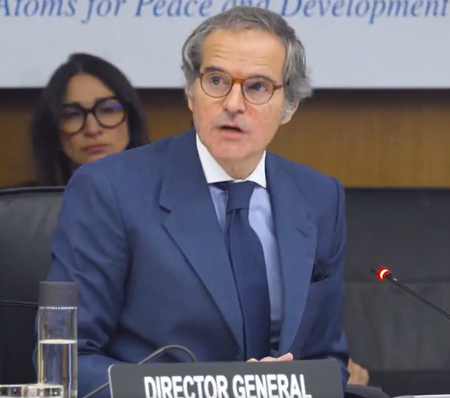
New Delhi, April 9 – Rafael Mariano Grossi, the Director General of the International Atomic Energy Agency (IAEA), has warmly praised India's achievement in reaching criticality of the Prototype Fast Breeder Reactor at Kalpakkam in Tamil Nadu.
This landmark achievement marks a significant advancement in the country's indigenous nuclear programme and its pursuit of long-term energy sustainability.
In a post on his official X account on Wednesday, Grossi described the development as "impressive progress by India in achieving criticality of the Prototype Fast Breeder Reactor at Kalpakkam, a key step forward in fuel sustainability and the future of nuclear energy".
He reaffirmed the IAEA's commitment to India, saying that the organisation "will continue to support the safe and secure development of India's nuclear programme".
Grossi concluded his message on X by congratulating Prime Minister Narendra Modi.
Criticality in a fast breeder reactor is a crucial technical milestone where the nuclear chain reaction becomes self-sustaining, enabling the reactor to produce more fuel than it consumes.
The Kalpakkam facility is a cornerstone of India's three-stage nuclear power strategy, designed to harness the country's abundant thorium reserves and achieve greater fuel efficiency while reducing dependence on imported uranium.
This international recognition from the head of the global nuclear watchdog highlights India's growing expertise in advanced reactor technology and its strong emphasis on safety and security standards.
The achievement is expected to strengthen India's position in the global nuclear energy sector and open new avenues for collaboration with the IAEA on research, training, and technology development.
Experts view the Prototype Fast Breeder Reactor as a vital bridge toward commercial fast breeder operations, which will play a pivotal role in meeting India's rising energy demands through clean, reliable, and sustainable sources.
The development aligns with the Union government's broader vision of expanding nuclear capacity to support economic growth and environmental goals.
Grossi's message has been received positively across scientific and policy circles in India, boosting morale among nuclear scientists and engineers, who have worked tirelessly on this indigenous project.
With the IAEA's continued partnership assured, India is well-positioned to accelerate its nuclear expansion plans while maintaining the highest standards of safety and non-proliferation.
The Kalpakkam milestone comes at a time when the world is looking for scalable, low-carbon energy solutions, and India's progress is seen as a model for responsible nuclear development in emerging economies.
Officials indicated that further updates on the reactor's operational performance and integration into the national grid would be shared in due course.