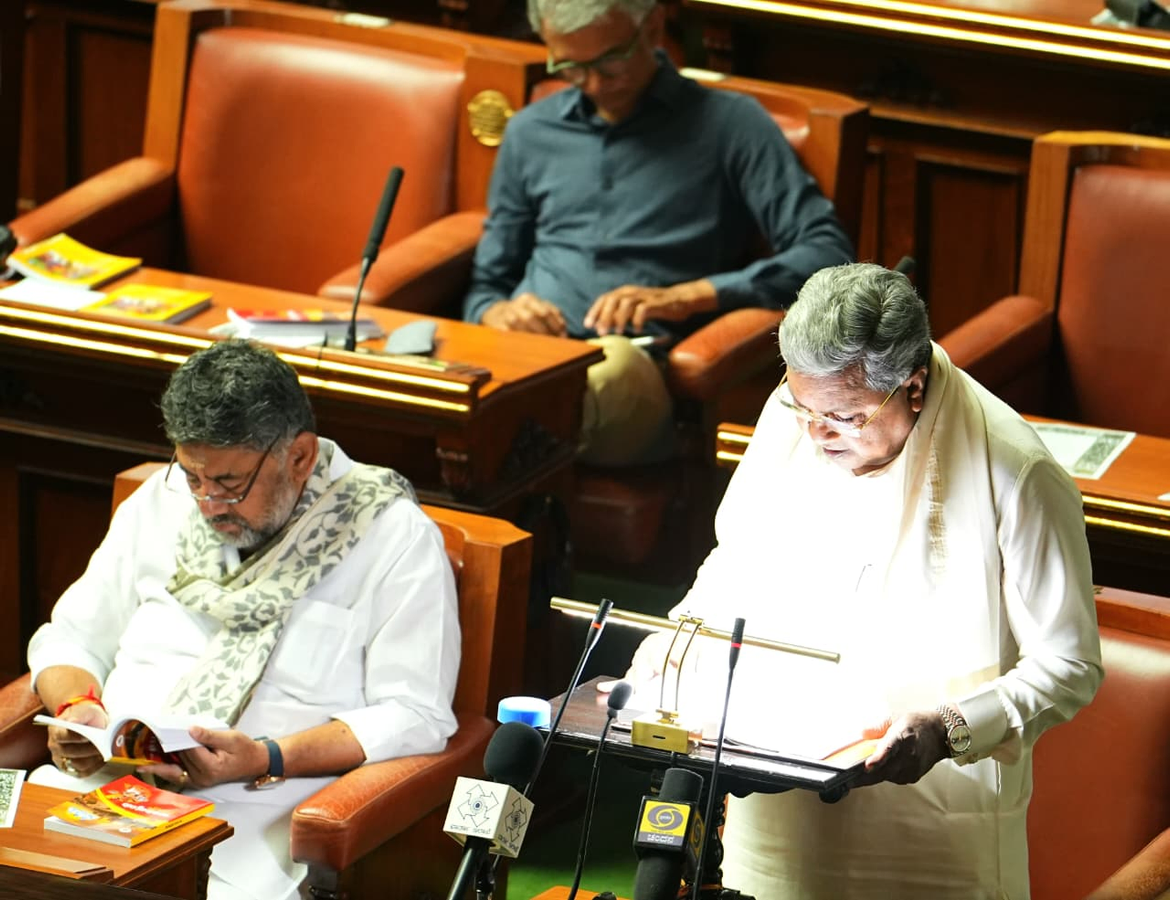
On March 6 in Bengaluru, Karnataka Chief Minister Siddaramaiah stated that the Supreme Court dismissing petitions filed by Tamil Nadu against the controversial Mekedatu project marked a significant legal victory for the state, and that the government would soon proceed with the next steps for the long-standing project.
During the presentation of the state budget for 2026–27 in the Legislative Assembly, CM Siddaramaiah announced that a revised Detailed Project Report (DPR) for the Mekedatu project would be prepared shortly and submitted to the Central Government for approval, including permission for the use of forest land.
It is worth noting that the Mekedatu Project is a proposed Rs 9,000-crore balancing reservoir and drinking water project on the Cauvery river in Karnataka’s Ramanagara district. It aims to supply 4.75 TMC of drinking water to Bengaluru and generate 400 MW of power.
CM Siddaramaiah also announced progress in the Yettinahole Integrated Drinking Water Project and stated that the first phase of lift irrigation works under the project had been successfully completed and inaugurated, and that the second phase, involving the completion of the remaining 18.73 km of canal works, would be undertaken soon. In addition, a balancing reservoir with a capacity of 1.2 TMC would be constructed near Vaderahalli in Koratagere taluk to effectively store and utilize surplus water.
It is worth noting that the Yettinahole Project is an ambitious Rs 23,251 crore Karnataka government initiative to divert 24.01 TMC of water from west-flowing streams (Yettinahole, Kadumanehole, Kerihole, Hongadahalla) in the Western Ghats to drought-prone districts, including Kolar and Chikkaballapur located close to Bengaluru.
CM Siddaramaiah also criticised the Centre for failing to act on its budget announcement regarding the Bhadra Upper Bank Project. Although the Union Government had announced an allocation of Rs 5,300 crore for the project in its 2023–24 Budget speech, no steps had been taken so far, CM Siddaramaiah said, and added that despite this, the Karnataka government had spent ₹11,343 crore on the project from its own resources.
CM Siddaramaiah said that the land dispute at Abbinahole village in Ajjampura taluk, which had remained unresolved for nearly six years, had now been settled. As a result, the 135-km-long Chitradurga branch canal and its feeder works would be completed by 2027, enabling water to be supplied to 157 tanks.
It is worth noting that the Upper Bhadra Project is a major, ongoing lift irrigation scheme in central Karnataka aimed at irrigating 2,25,515 hectares and filling 367 tanks in drought-prone districts (Chikmagalur, Chitradurga, Tumkur, Davangere). With a revised cost of over ₹21,000 crore, it is the first in Karnataka to receive national project status, featuring a 29.9 TMC lift from the Bhadra reservoir.
Highlighting irrigation initiatives in North Karnataka, CM Siddaramaiah said that under the ambitious Upper Krishna Project (UKP) Stage-III, the height of the Almatti dam would be increased from 519.6 metres to 524.256 metres.
The government had approved revised negotiated compensation rates for land acquisition required for the project and related canal networks. Compensation had been fixed at Rs 30 lakh per acre for dry land and Rs 40 lakh per acre for irrigated land, CM Siddaramaiah said, adding that the process of land acquisition through negotiated settlements would begin this year.
It is worth noting that the Karnataka government is proceeding to increase the Almatti Dam height from 519.6 metres to 524.256 metres, increasing storage from 123 TMC to 300 TMC. This Phase-3 project aims to irrigate 5.94 lakh hectares, but faces strong opposition from Maharashtra and Telangana due to fears of flooding and reduced downstream water flow.
CM Siddaramaiah also announced that the replacement of 33 deteriorated gates of the Tungabhadra dam would be completed before the monsoon. To address the reduction in storage capacity caused by silt accumulation in the reservoir, the government was considering several options, including the construction of a balancing reservoir near Navali in Koppal district.
CM Siddaramaiah said consultations would be held with neighbouring Andhra Pradesh and Telangana, and efforts would be made to implement a suitable alternative with the consent of the Tungabhadra Board.
Regarding the Kalasa-Banduri Nala projects in the Mahadayi basin, CM Siddaramaiah said that the state had been making continuous efforts for the past two years to secure forest clearance from the Union Ministry of Environment and the National Board for Wildlife, but approval had not yet been granted.
He said that contracts for the projects had already been awarded and work would begin immediately once forest clearance was obtained from the Centre. The delay in approvals was increasing the financial burden on the state government, CM Siddaramaiah added.
It is worth noting that the Kalasa-Banduri Project is a long-standing initiative by the Karnataka government to divert water from the Mahadayi River's tributaries (Kalasa and Banduri) into the Malaprabha River basin to supply drinking water to the arid districts of Belagavi, Dharwad, Bagalkot, and Gadag.