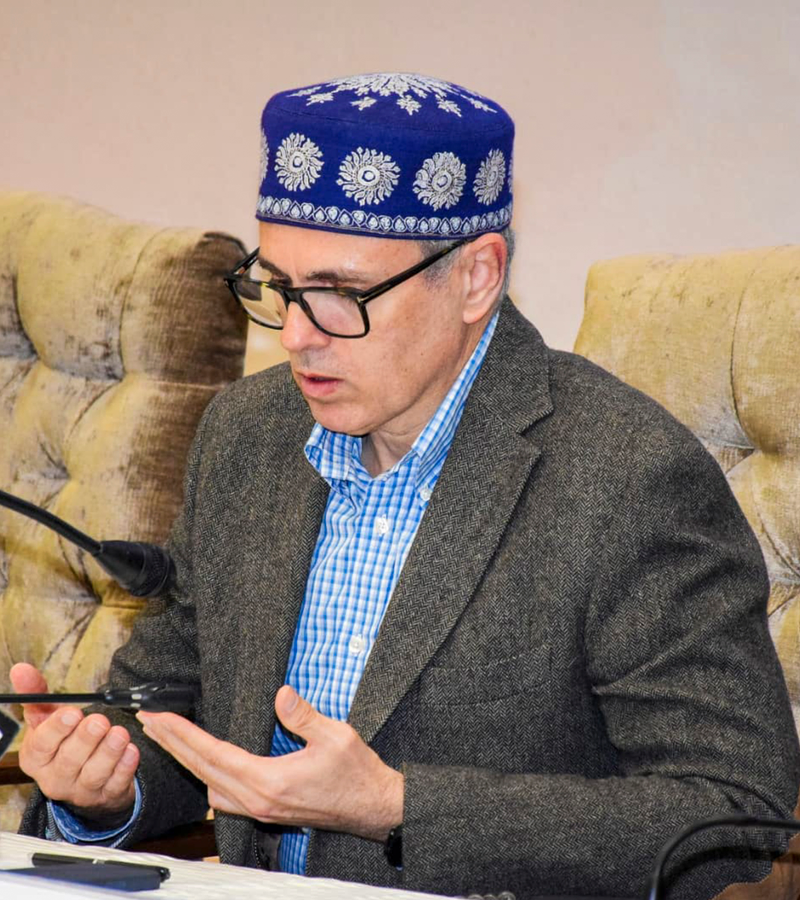
Srinagar, March 4 Jammu and Kashmir Chief Minister Omar Abdullah held a high-level meeting with religious leaders and civil society members on Wednesday to address the unrest in the Union territory following recent military strikes in West Asia, in which Iran's Supreme Leader Ayatollah Ali Khamenei was killed.
The meeting focused on maintaining regional stability, and the Chief Minister's Office (CMO) said in a post on X, "Chief Minister today interacted with religious leaders and members of civil society in Srinagar in light of recent developments in West Asia. The participants expressed concern over the situation and conveyed their condolences over the loss of lives in Iran."
During the meeting, Abdullah emphasized the importance of maintaining peace and harmony in Jammu and Kashmir. While acknowledging the people's grief, he urged that "expressions of grief and mourning remain peaceful and responsible." The meeting concluded with a 'Fatiha' (special prayer) for the late Ayatollah and others killed in the strikes.
Speaking to reporters afterward, Abdullah thanked the community leaders for issuing a joint appeal for harmony. "I am thankful to all civil society and religious leaders that a common appeal was issued... to maintain peace and brotherhood, and we express our grief and anger peacefully," he said.
The Kashmir Valley has been witnessing widespread protests over the US-Israel action on Iran, prompting authorities to impose restrictions in Srinagar and reduce internet bandwidth.
Abdullah noted that civil society representatives requested a "soft approach" from the government.
When asked about a case registered against National Conference MP Aga Syed Ruhullah Mehdi, the chief minister refused to comment on individual cases. "I will not talk about individual FIRs here, but the issue of collective FIRs was discussed in the meeting and we will take it forward," he said.
Mehdi and former Srinagar mayor Junaid Azim Mattu have been booked for allegedly circulating "false, fabricated and misleading content" on social media platforms.
On the issue of Kashmiri students stranded in Iran, Abdullah said that while some students did not wish to return, another group faced academic risks. Their medical colleges allegedly informed them that they would lose an academic year if they left.
"I think it will be a huge injustice with the students. I will take it up with the Government of India and request them to take it up with the Government of Iran via their ambassador so that those students are allowed to leave. When the situation improves, they will return and their year will not be lost," he said.
On the restrictions imposed in the valley, the chief minister said these would be eased as the situation improves.
"It is our endeavour that no innocent blood is spilled and no one gets injured in law and order disturbances. We want the situation to remain stable and for that, the government has received the support of the civil society," he added.
Strict restrictions, which included curbs on the movement and assembly of the people, remained in place in many areas of Kashmir for the third consecutive day on Wednesday, following massive protests across the valley, officials said.
As a precautionary measure, the government shut educational institutions until Saturday.
They said that strict restrictions were being enforced, especially in the parts having a large Shia population and those areas which have witnessed massive protests over the last three days.
A large number of police and paramilitary CRPF personnel were deployed across the city and barricades were placed at important intersections leading into the city, the officials said.
Such large-scale protests have not taken place in Kashmir in the past several years.