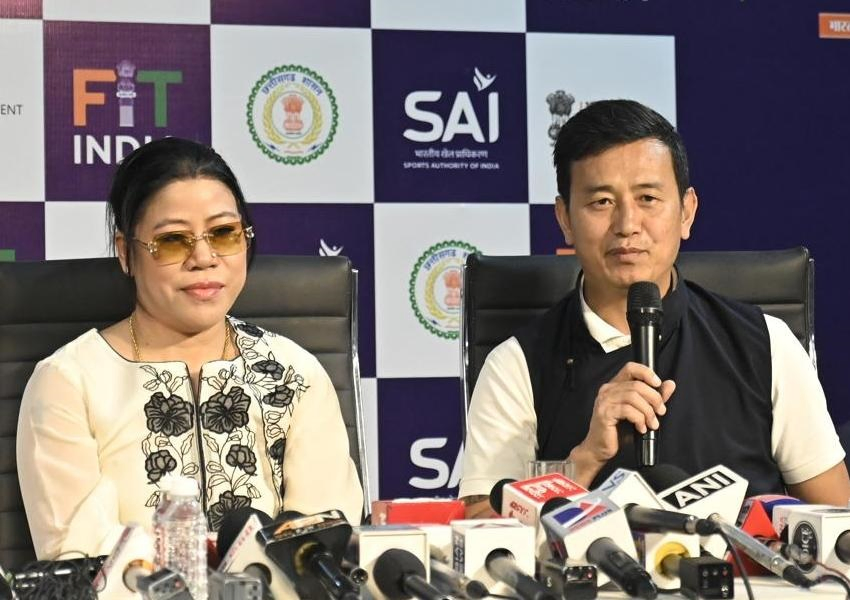
Raipur, April 3 – Six-time World Championship medallist Mary Kom and former India football captain Bhaichung Bhutia emphasized the importance of grassroots investment and structured development pathways while addressing reporters at the Khelo India Tribal Games 2026 in Raipur on Friday.
Both the legendary athletes maintained that Indian families need to discourage children from spending excessive time on screens and instead encourage them to participate in sports.
Bhutia, one of Indian football’s most iconic figures, stressed that while initiatives like Khelo India Tribal Games (KIBG) are a strong starting point, long-term success depends on strengthening the foundation of sports in the country. Reflecting on his own journey, he pointed to the role played by the Sports Authority of India (SAI) in nurturing young athletes at a time when sporting infrastructure was still evolving.
“I have been a product of SAI since the first batch of SAI products in 1986. Investing at the grassroots level is essential, but we tend to overlook that and only focus on the top level,” Bhutia said, emphasizing the need for sustained attention at the base of the sporting pyramid.
He pointed out that talent exists in abundance, particularly in tribal regions, but requires the right ecosystem to flourish.
“Tribal communities naturally have immense sporting talent, and we’ve seen this very clearly, particularly from the Northeast, where so many athletes have represented India brilliantly and brought us to the world stage. Providing young people with a platform is very important. I believe that in the future, many more people from tribal communities will emerge, and this is just the beginning. Over the years, we will see a lot more talent emerging from tribal backgrounds,” he said.
Bhutia also reflected on how environment and access play a defining role in shaping athletes, recalling his own early days.
“See, when I talk about where I come from, I always say this everywhere: when you're from the Northeast, you do two things: football or music. That was my environment. Growing up, no other sport was played by the other kids around me. Football was the culture in Sikkim, in every village, every town.”
Echoing his views, Mary Kom praised the Khelo India Tribal Games (KITG) as a transformative initiative that can bridge long-standing gaps in access and awareness.
“First of all, I want to congratulate the Chhattisgarh Government. The Khelo India Tribal Games began here in Chhattisgarh, and I'm very happy about it. I was invited to support this initiative, and I do so wholeheartedly because our tribal communities have enormous potential. In the past, they didn't have these kinds of platforms, and there wasn't enough awareness either. That's perhaps why many talented children couldn't advance further,” the 2012 London Olympics bronze medallist boxer said.
The star boxer from Manipur also highlighted how government-backed programmes have begun to change the landscape. “But today, thanks to Prime Minister Narendra Modi ji's Khelo India and Fit India programmes, children are slowly taking the initiative, participating, and representing the country. This is a tremendous thing for India's sporting future,” she said.
Mary Kom reiterated that while opportunities have improved, discipline and perseverance remain key to success, urging young athletes to maximise the support now available.