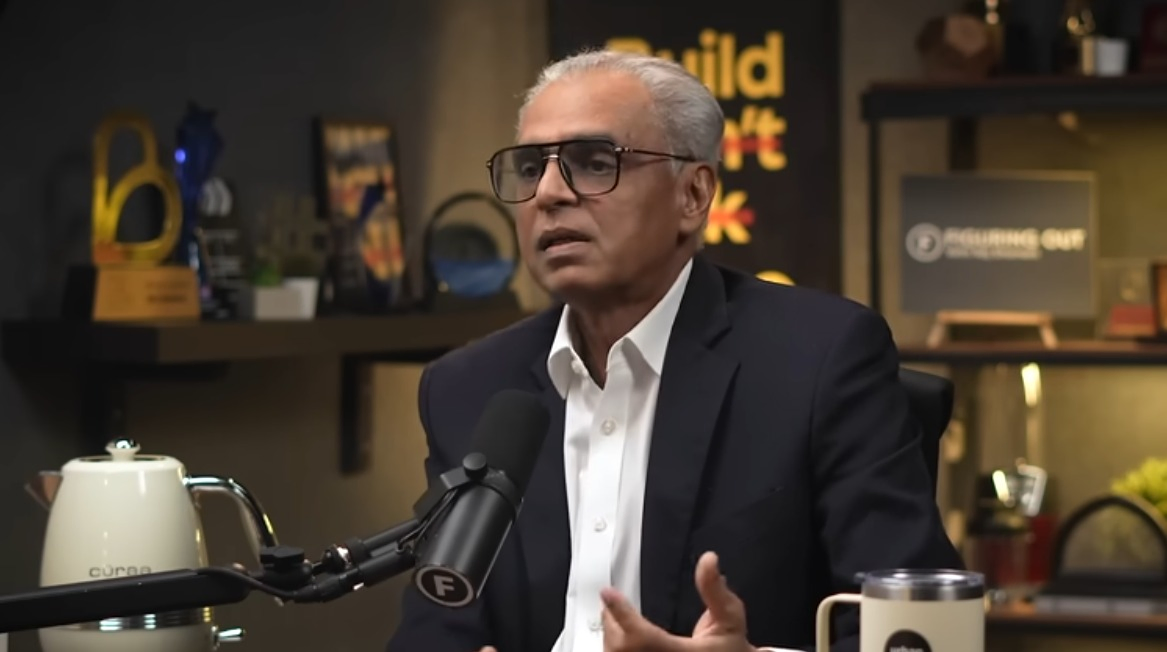
New Delhi, April 3 – India’s former Permanent Representative to the United Nations, Syed Akbaruddin, recalled a crucial moment when doubts loomed over India’s chances at the International Court of Justice (ICJ), but a firm decision by Prime Minister Narendra Modi turned the course of events.
Speaking on the YouTube channel of Indian podcaster and entrepreneur Raj Shamani, Akbaruddin shared insights into India’s legal battle in the case of Kulbhushan Jadhav. He said that despite widespread scepticism, the Prime Minister made a decisive call to pursue the matter at the ICJ.
“This was about Kulbhushan Jadhav. Because we took it to the ICJ, because we found a small opening that we could use internationally to stop his execution. We decided to contest. But we were too late. And again, I was one of those who said we were not going to win. The Prime Minister said, ‘I know that you don’t think that way, but this decision has been made. Now, if the Prime Minister of India says the decision has been made, I am here to implement it,’" he said.
He further highlighted how diplomatic momentum began to build even before India formally announced its candidature at the ICJ.
“The first vote we got was before we formally announced our candidacy, and I think the Prime Minister met with the Uzbek President somewhere. So, the Uzbek Ambassador came to me and said, ‘I need to meet you urgently.’ And I said, ‘Okay, what’s going on?’ He said, ‘I have a request; I’m going to vote for you. But I haven’t announced the candidate.’ So, that was very encouraging because it showed that someone was willing to support us, based on the talks between our Prime Minister and their President. And that told us that we had to push because it was a serious matter, and everyone was involved. So, for the first time, we won," Akbaruddin said.
Jadhav, an Indian national on death row in Pakistan, was accused of carrying out espionage and sabotage activities against Pakistan at the behest of India's intelligence agency. India has denied the allegations.
Pakistan claims the former Indian Navy officer was arrested on March 3, 2016, in Balochistan. The Indian side, however, maintains that he was kidnapped from Iran, where he was running a business in the port city of Chabahar after a premature retirement from service.
The execution was stayed by Pakistan after India filed an appeal against the judgment at the International Court of Justice (ICJ) on May 18, 2017. The court pronounced its verdict in the case on July 17, 2019, rejecting India's appeal for Jadhav's release, while ordering Pakistan to suspend the execution.
The ICJ ruled that Pakistan will have to review the entire process of trial and conviction of Jadhav and provide India with consular access.
Following the order, Islamabad granted consular access to Jadhav. On September 2, 2019, Indian Charge d' Affairs Gaurav Ahluwalia met Jadhav at a Pakistani sub-jail.
Almost a month after his arrest, Pakistan released a video of Jadhav "confessing" to being a spy. However, the Ministry of External Affairs rejected the video, saying it was doctored and fake.
In the video, Jadhav said he had been directing various activities in Karachi and Balochistan and that he was still with the Indian Navy.