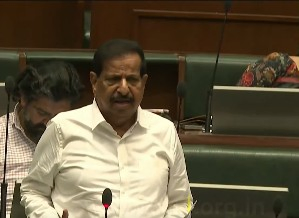
Mumbai, March 12 – Maharashtra Forest Minister Ganesh Naik stated in the state Assembly on Thursday that the state government would urgently seek permission from the Union Wildlife department to pump water from Lonar Lake in Buldhana district, where rising water levels have submerged several temples and restricted access for devotees.
Lonar Lake is a Ramsar site and a National Geo-heritage site.
A meeting will be held on Friday to obtain the necessary approval from the Union Wildlife department, Minister Naik said, in response to a calling attention motion raised by Shiv Sena-UBT member Siddharth Kharat in the state Assembly.
Minister Naik stated that the lake water has turned pink and is saline in nature, adding that the state government is closely monitoring its condition.
Kharat said that although Rs 41 lakh has been sanctioned for pumping out water from the lake, the work has been stalled due to a lack of coordination between the wildlife and archaeology departments.
As a result, six temples in the area, including Gaymukh, Ramgaya, Paphreshwar, and Kamlaja Devi Temple, have been submerged.
Minister Naik told the House that heavy rainfall this year opened several natural springs around the crater lake, causing the Lonar water level to rise by 20 to 25 feet.
Consequently, devotees are currently unable to access the temples located in the vicinity.
According to government sources, Lonar Lake's water level has risen by 15–25 feet (nearly 4–7+ metre) since 2022–2025, driven by heavy rainfall, increased underground spring activity, and agricultural runoff.
This surge threatens the unique, highly alkaline ecosystem and has partially submerged ancient, historic temples like Kamalja Devi.
The rise is attributed to heavy rainfall (including more than 100 mm in three hours in 2025) and, significantly, increased, consistent flow from four main freshwater springs around the crater.
Additionally, deep borewells (600–700 feet) for agriculture have disturbed the groundwater table, forcing more water into the lake.
Discussions will be held with officials, including the Divisional Commissioner and District Collector, to expedite permission from the Union Wildlife department so that the water can be pumped out at the earliest, Minister Naik said.
Minister Naik also told that Rs 434 crore has been allocated for development works in the area, of which Rs 168 crore has already been spent.
During the discussion, Kharat also raised the issue of the absence of elected representatives in the Lonar Lake conservation committee.