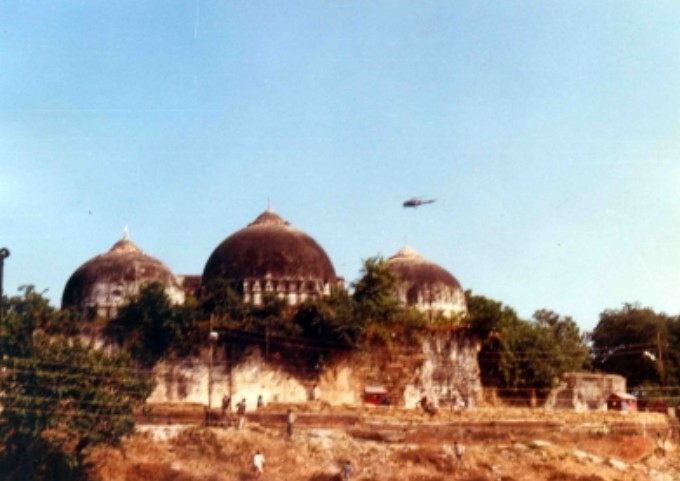
Ayodhya, April 11 – Nripendra Misra, Chairman of the Ram Mandir Construction Committee and former Principal Secretary to the late Uttar Pradesh Chief Minister Kalyan Singh, reflected on the events surrounding the 1992 demolition of the Babri Masjid, stating on Saturday that key decisions in such situations are largely driven by political leadership rather than bureaucratic officials.
Recalling the developments of that period, Misra said that in 1992, despite reports indicating a breakdown of law and order in Ayodhya, then Chief Minister Kalyan Singh had issued clear instructions that police should not open fire on 'karsevaks' (religious activists).
He also referred to his tenure serving under different political administrations, including that of former Chief Minister Mulayam Singh Yadav, noting the contrast in approaches adopted by the two leaders during moments of crisis.
Speaking to reporters on Saturday, Misra said, "Decisions of this kind are not made at the level of the Principal Secretary. About 90 per cent of such decisions are political in nature, and around 10 per cent involve inputs from the Home Secretary, the Chief Secretary, and the Director General of Police."
"I served as a Principal Secretary to both former Chief Ministers Mulayam Singh Yadav and Kalyan Singh. You would also be aware that when the report was presented to Kalyan Singh, stating that law and order in Ayodhya had collapsed, he gave the written order that no firing would take place in the sacred city," he added.
These remarks come in the context of the earlier Ayodhya firing, when police opened fire on karsevaks on October 30 and November 2, 1990, during the tenure of Mulayam Singh Yadav as the Uttar Pradesh Chief Minister.
At that time, large numbers of Lord Ram devotees had gathered in Ayodhya as part of the Vishva Hindu Parishad's Kar Seva.
Police firing on the unarmed karsevaks reportedly resulted in the deaths of more than 28 people.
Former Chief Minister Mulayam Singh Yadav later said that the action was taken on his orders and justified it as necessary to protect the Babri Masjid and maintain national unity.
In contrast, during the demolition of the Babri Masjid on December 6, 1992, Kalyan Singh, who was then the Chief Minister of Uttar Pradesh, directed that no firing should take place on karsevaks despite the volatile situation.
He is reported to have said that "Karsevaks will not be shot at for a building", and later resigned from the Chief Minister's post, taking moral responsibility for the events that unfolded.
Former Chief Minister Kalyan Singh's resignation came on the evening of December 6, 1992, following the Babri Masjid demolition.
Nripendra Misra's observations underline the differing administrative and political responses during two of the most significant and contentious episodes in Ayodhya's history, while emphasizing the dominant role of political decision-making in matters of law and order.