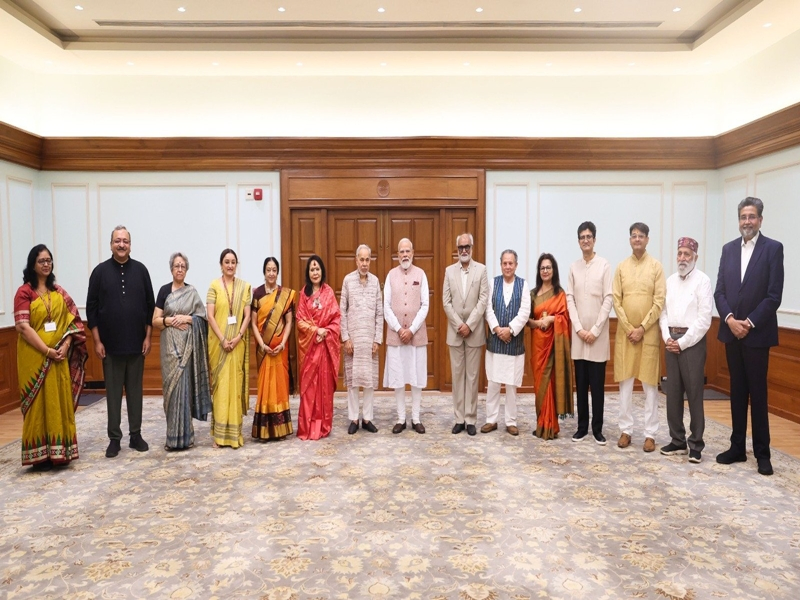
New Delhi, March 19 – Prime Minister Narendra Modi met the trustees of the Indira Gandhi National Centre for the Arts (IGNCA) in the national capital on Thursday and discussed ways to further popularize India's culture and support artists and scholars in preserving and promoting the country's rich heritage.
"Met the IGNCA trustees and discussed various aspects related to further popularizing India's diverse culture. We also explored ways to involve more people in this endeavor, strengthen outreach through digital and grassroots initiatives, and support artists and scholars in preserving and promoting our rich heritage," the Prime Minister wrote on the social media platform X after the meeting.
"A proud milestone in India's cultural reassertion. Culture is no longer exclusive. It is for everyone. Hon'ble Prime Minister Shri @narendramodi met the trustees of the Indira Gandhi National Centre for the Arts today, appreciating its journey as a model of cultural democratization and civilizational outreach across Bharat," the IGNCA posted on the same platform.
The IGNCA was established in 1987 as an autonomous institution under the Ministry of Culture, serving as a centre for research, academic pursuit, and dissemination in the field of the arts.
According to the Centre, the field of arts encompasses a wide range of subjects – from archaeology and anthropology to the visual and performing arts – bringing them together in a complementary and non-demarcated framework.
Its board of trustees comprises 18 members, with veteran journalist Ram Bahadur Rai serving as its President and also Chairman of the Executive Committee, drawn from among the trustees.
Other members of the Executive Committee include Sonal Mansingh, Bharat Gupt, and Member Secretary Sachchidanand Joshi. The Member Secretary is the executive head of both academic and administrative divisions.
The IGNCA has six functional units – Kala Nidhi, a multi-form library; Kala Kosa, devoted mainly to the study and publication of fundamental texts in Indian languages; Janapada Sampada, engaged in lifestyle studies; Kaladarsana, the executive unit that transforms research and studies into visible forms through exhibitions; Cultural Informatics, which applies technology tools for cultural preservation and propagation; and Sutradhara, the administrative section that supports and coordinates all activities.