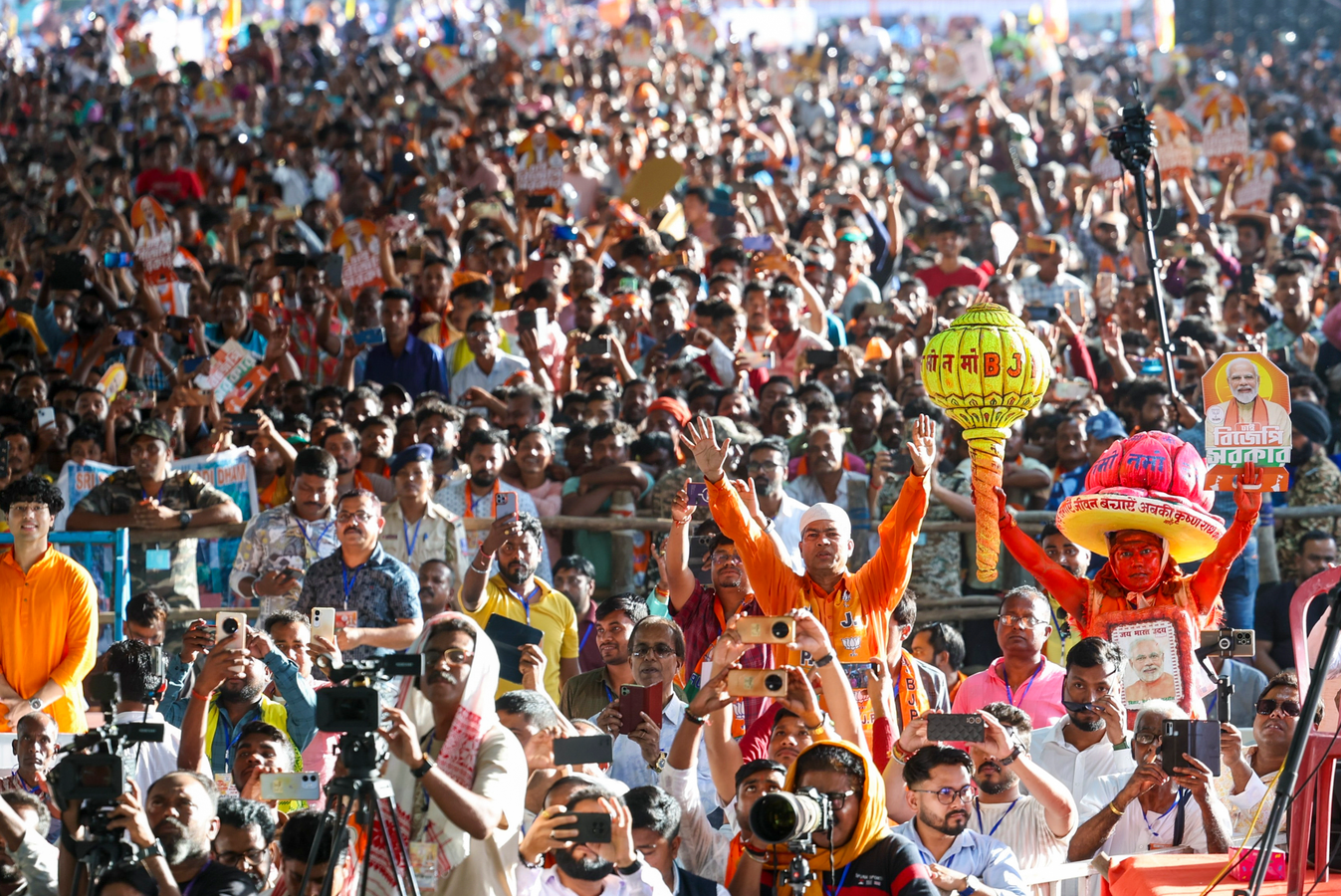
In Cooch Behar, on April 5, Prime Minister Narendra Modi highlighted the BJP's campaign against lawlessness in West Bengal, focusing on the incident in Malda where judicial officers were held hostage. He accused the TMC of "sponsored lawlessness" and portrayed the assembly elections as a battle between the "fear" spread by the ruling party and the BJP's "trust."
Addressing his first rally in Bengal after the election schedule was announced, Modi used the Malda incident to emphasize the BJP's twin campaign planks of restoring law and order and addressing demographic changes. He also raised concerns about issues such as Sandeshkhali, infiltration, corruption, and unemployment to attack the Mamata Banerjee government.
Modi framed the upcoming election as a fight for Bengal's future, warning that "every act of intimidation will be accounted for" once the results are declared on May 4.
Speaking with certainty despite allegations of intimidation, Modi said he had "full faith" in the Election Commission and predicted a free and fair election in Bengal.
"The TMC's wrongdoings have reached a critical point. The people want change. Today's rally reflects the mood of Bengal. Bengal wants a BJP government," Modi stated.
He further accused the ruling party of "staining democracy with blood" and neglecting constitutional institutions.
Modi also referred to the incident in Malda, where seven judicial officers, including three women, were held hostage by a mob during hearings on names marked "under adjudication" in the draft electoral rolls prepared during the Special Intensive Revision (SIR) exercise.
"What kind of government is this? What kind of system is this where even judges and the constitutional process are not safe? How can such people ensure the safety of Bengal's common people?" Modi questioned.
He accused the TMC of engaging in "sponsored lawlessness" and attempting to "strangle constitutional institutions."
He claimed that the situation had become so grave that even the Supreme Court had to intervene.
Modi also framed the contest in binary terms.
"On one side, there is the 'fear' of the TMC, and on the other side, you have the BJP's 'trust'. On one side is the fear of TMC's cut money and corruption, and on the other side is the BJP which accelerates development," he said.
The PM also contrasted the fear of infiltration and settling foreigners in Bengal with the BJP's confidence in stopping infiltration and driving infiltrators out.
Seeking to consolidate Hindu refugee and Matua votes in the border districts, Modi accused the TMC of opposing the SIR and the Citizenship Amendment Act to protect infiltrators.
"The TMC is opposing SIR and CAA to protect infiltrators. It does not want Hindu refugees to get citizenship and that is why it is opposing CAA. During 15 years of TMC rule, there has been a dangerous change in demography in Bengal's border areas. These infiltrators get direct protection from the TMC syndicate. In this politics of appeasement, Bengal's identity is being changed," he alleged.
Modi also referred to the "Lal Ishtihar" issued before the 1905 communal riots in undivided Bengal and alleged that the ruling party was playing a "dangerous game of appeasement".
"You must have seen that the TMC recently released its manifesto. They did not even give it a Bengali name. Instead, they are calling it an 'Ishtihar'. Just think how they are trying to change Bengal's identity," he said.
Modi promised that after May 4, every alleged act of corruption and violence under the TMC would be accounted for.
"After May 4, the law will take its course. Every one of their sins will be accounted for. Chun chun ke hisab hoga. No matter how powerful the criminal may be, justice will be done this time," he said.
Once India's showpiece state in trade, industry, art and culture, Bengal had lost its sheen under the successive "eclipses" of the Congress, the Left and now the TMC, Modi claimed, alleging that a state whose average citizen once earned more than the national average had now slipped below it.
"Earlier, people in Bengal earned more than the national average. Today their income is below the national average. Other states are moving ahead, but the TMC has pushed Bengal backwards. Factories are leaving Bengal. Earlier, people came here for jobs. This government has turned Bengal into a centre of migration," he alleged.
The TMC dismissed Modi's remarks as “desperate election rhetoric”, alleging that the BJP was distorting the Malda incident and trying to communalise the campaign.
Polling for the 294-member West Bengal Assembly will be held in two phases on April 23 and April 29, with counting scheduled for May 4.