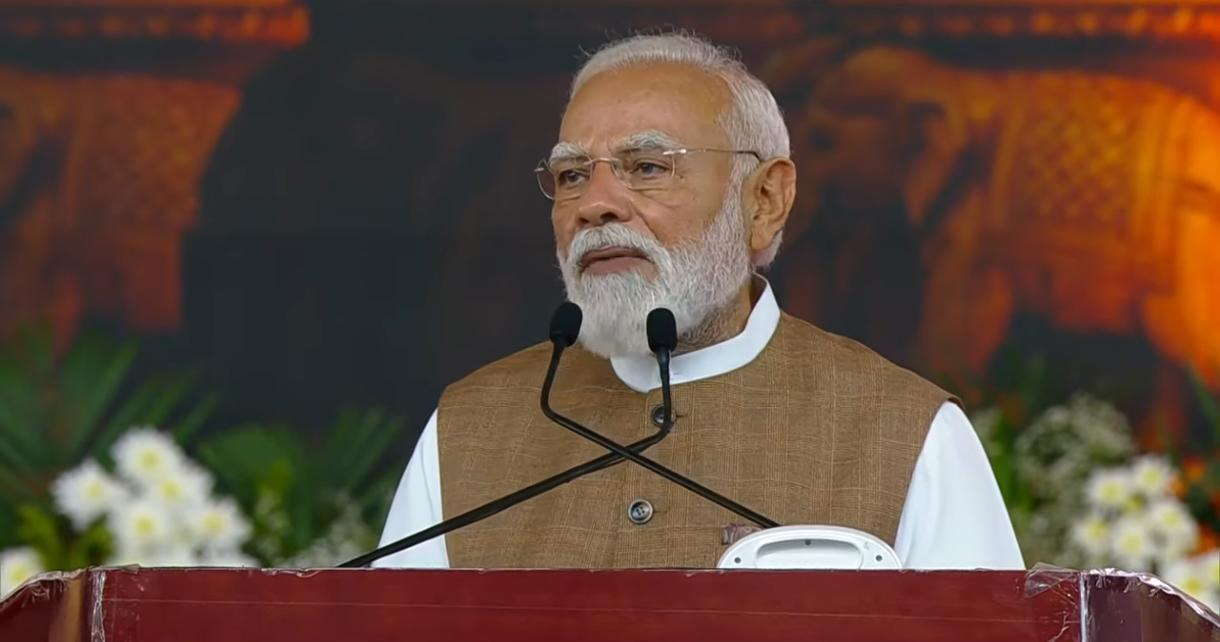
Gandhinagar, March 31 – Prime Minister Narendra Modi said on Tuesday that previous governments had neglected India’s manuscript heritage due to a “colonial mindset,” as he inaugurated the Samrat Samprati Museum at Koba Tirth in Gandhinagar on the occasion of Mahavir Jayanti.
Addressing the gathering, PM Modi said that after independence, it was the nation’s responsibility to identify and preserve ancient manuscripts, but this had not been done.
“Due to a colonial mindset, no attention was paid in this direction. The mistake of neglecting manuscripts by previous governments is now being corrected,” he said.
He said that the Centre had launched the Gyan Bharatam Mission to conserve manuscripts through digitization, chemical treatment, and scientific research, adding that people were also contributing by uploading manuscripts as part of a national survey effort.
The Prime Minister said that the museum, located within the Mahavir Jain Aradhana Kendra campus, would serve as a centre for Jain worship as well as cultural and heritage preservation.
He said that artefacts of the Jain community, some dating back around 1,000 years, had been preserved for future generations.
“Koba Tirth is a place of peace and the penance of saints. For a long time, traditions of dedication, study, spiritual practice, and discipline have continued here,” he said, describing the site as a confluence of Indian civilisation through the preservation of values, nurturing of cultural ethos, and promotion of knowledge.
Referring to history, PM Modi said that while many civilizations had produced thinkers and ideals, several rulers abandoned those values when faced with power.
“Some rulers adopted violence as a tool, whereas Samrat Samprati promoted non-violence while in power,” he said, adding that such history had been preserved in the museum.
He said that the museum’s design reflects India’s diversity and unity, with traditions such as the Vedas, Puranas, and Ayurveda represented, and added that its message was relevant in a volatile global environment.
The Prime Minister credited Jain saints, including Acharya Padmasagarsurishwarji, for dedicating their lives to collecting manuscripts from across the country.
According to officials, the museum showcases the historical, cultural, and spiritual legacy of Jainism and enables visitors to understand its evolution chronologically.
The museum features seven galleries displaying rare artefacts, including stone and metal idols, Tirth Patta, Yantra Patta, miniature paintings, silver chariots, coins, and ancient manuscripts, integrated with digital and audio-visual installations for visitors and researchers.
Housing more than 2,000 artefacts and over 3,00,000 manuscripts, the museum has been developed as a major repository of India’s cultural heritage.
PM Modi also referred to other projects, including a maritime museum at Lothal and a museum at Vadnagar, and said that such initiatives were now being undertaken beyond “political narratives and vote-bank considerations”.