New York, April 1 – More than half a century after humanity’s journey to the moon, four astronauts are scheduled to launch on Wednesday on a mission that will take them around the celestial body in preparation for journeys beyond, deep into space.
“Fifty-three years ago, humanity left the moon and did not return. Now we go back,” declared NASA Associate Administrator Amit Kshatriya, clearing the mission.
NASA’s Artemis II rocket, carrying the Orion spacecraft with four astronauts, is set to launch at 6:24 pm local time on Wednesday (3:54 am Thursday in India) from NASA’s Kennedy Space Centre in Florida on a 10-day mission that will take them tantalizingly close to the moon, but they will not land there.
Kshatriya said at a news conference that the mission, which had been delayed last month due to possible rocket problems, was now fully ready for flight.
“I have complete confidence in this team and the NASA workforce,” he said.
The last time humans ventured that far into space was in December 1972, when astronauts on the Apollo 17 mission landed on the moon.
Artemis II’s goal is to test the rocket and the space capsule in preparation for a planned moon landing in 2028 by Artemis IV with a crew.
Therefore, the four astronauts will not set foot on the moon and will only fly around the far side of the moon.
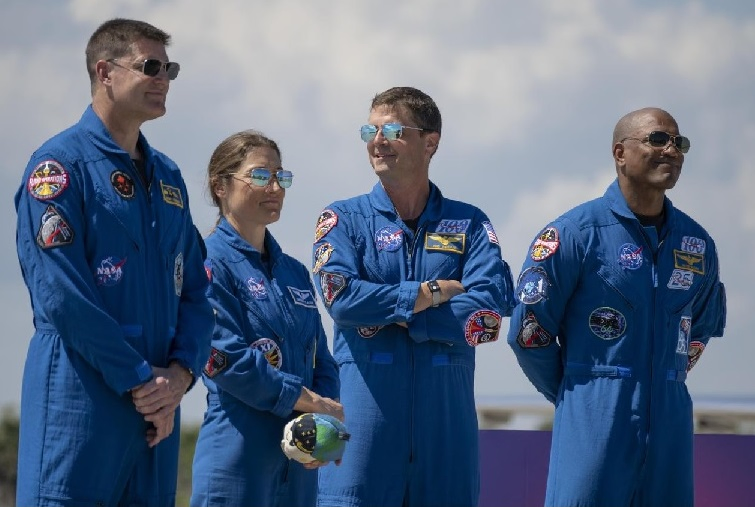
The crew consists of a diverse group, including African American pilot Victor Glover, woman Mission Specialist Christina Koch, and Canadian Space Agency Mission Specialist Jeremy Hansen.
NASA’s Reid Wiseman commands the mission.
“It is our strong hope that this mission marks the beginning of an era where everyone, every person on Earth, can look at the moon and think of it as also a destination,” Koch said.
During the 10-day mission, the spacecraft is to fly on a figure-8 pattern, looping around the Earth and the moon, which is 7,400 kilometers away.
The first orbit around the Earth is to test the Orion space module with the crew onboard, while during the next orbit, the manual controls and the ability of the Orion to dock will be tested.
Next, it will head towards the moon, looping around it, before returning home on April 10, going partway around the Earth and splashing down in the Pacific Ocean, near San Diego, California.
The US plans to eventually set up a base on the moon as it prepares for human missions to Mars.