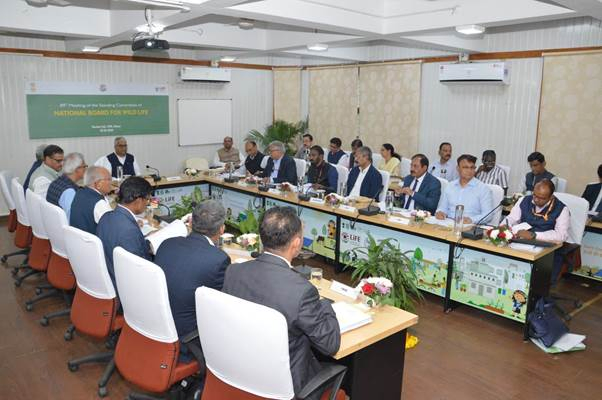
Bhopal, February 28 Union Minister for Environment, Forests, and Climate Change Bhupender Yadav chaired the 89th meeting of the Standing Committee of the National Board for Wildlife and the Central Zoo Authority (NZA) in Bhopal, Madhya Pradesh, on Friday.
The committee considered proposals related to wildlife conservation and development projects located in and around Protected Areas, Wildlife Sanctuaries, Tiger Reserves, and Eco-Sensitive Zones under the Wildlife (Protection) Act of 1972, according to a statement from the Press Information Bureau (PIB).
"The proposals were examined in light of ecological sensitivity, statutory requirements, and prescribed mitigation measures. A total of 58 new proposals across sectors such as communication infrastructure, optical fiber cables, power transmission lines, road projects, drinking water supply, thermal power, defense, irrigation, and other infrastructure were discussed," the statement said.
The committee also deliberated on policy issues, including maintaining environmental flows in the Chambal River for the conservation of aquatic fauna such as dolphins and gharials, the status of villages within Tiger Reserves, the importance of grasslands for wildlife management, and the challenges related to the human-leopard interface, the statement informed.
It emphasized the involvement of scientific and technical institutions, including the Wildlife Institute of India and the Indian Council of Forestry Research and Education, as well as the Central Water Commission, to support conservation policies through research and inter-sectoral coordination.
The Standing Committee of the National Board for Wildlife is a statutory body constituted under the Wildlife (Protection) Act of 1972 to advise the government on the conservation of wildlife and forests while ensuring sustainable development around Protected Areas.
Yadav also chaired the 44th meeting of the Central Zoo Authority at the Indian Institute of Forest Management, during which key achievements in 2025-26 and strategic priorities for 2026-27 were presented.
A status report on the establishment of the National Referral Centre for Wildlife in Junagadh and its regional centers was also presented to the authority.
An annual calendar for observing important days was presented to promote empathy among zoo visitors and awareness on conservation and ecological balance.
Among the decisions taken was the authority setting a target to complete the second cycle of Management Effectiveness Evaluation of large and medium zoos by May 2026.
The scope of a committee examining corporate social responsibility (CSR) contributions for zoos was expanded to recommend the identification of prominent personalities for promoting zoos, ex-situ conservation, conservation education, and zoo self-sustainability.
The authority decided to explore collaboration with the Zoological Survey of India and institutions under the NIRANTAR vertical to promote zoos and conservation education.
It also decided to seek suggestions from Members of Parliament from constituencies with recognized zoos to strengthen them under the National Zoo Policy.
Schools that have organized zoo visits for students will be identified, and their managements will be requested to hold dedicated classes to gather suggestions for strengthening zoos.