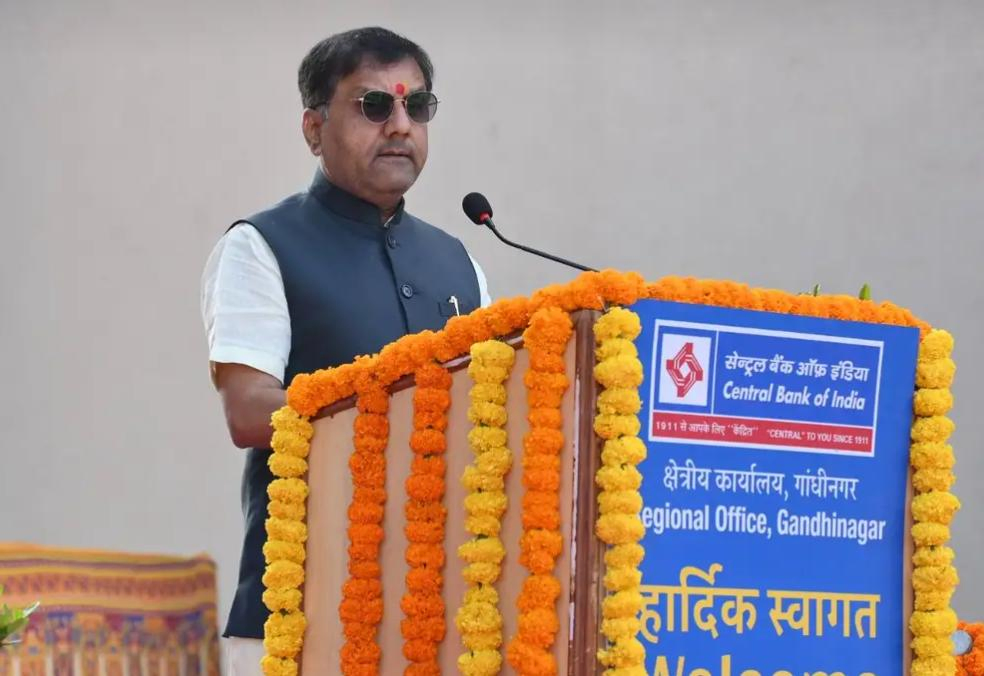
Gandhinagar, March 13 – Gujarat Education Minister Pradyuman Vaja, on Friday, cited historical letters of former Prime Minister late Jawaharlal Nehru in the state Assembly while speaking on a private resolution on 'Somnath Swabhiman Parv', stating that the correspondence reflected Nehru's opposition to the reconstruction and consecration of the Somnath Temple.
Referring to the letters, Minister Vaja told the House that Nehru had written to then President Rajendra Prasad on March 2, 1951, urging him not to attend the temple's consecration ceremony, describing it as "Hindu revivalism".
He also referred to another letter written to Kanhaiyalal Munshi in which Nehru described the construction of Somnath as "an improper expenditure" and "a construction carried out at the wrong time".
Minister Vaja made these remarks while presenting historical facts during the discussion on a private resolution related to the Somnath Temple, which was later unanimously adopted by the state Assembly.
The Minister said that the Somnath temple represents more than just a place of worship.
"Somnath is not merely a temple but a living symbol of the faith of India and the identity of Gujarat," he added while outlining the historical and cultural significance of the shrine.
Referring to the completion of 1,000 years since the invasion of the temple in 1026, the Minister said: "A week-long 'Somnath Swabhiman Parv' was organised from January 8 to 15 under the guidance of Prime Minister Narendra Modi."
The programme included 72 hours of uninterrupted 'Omkar' chanting, devotional songs and cultural events, with lakhs of devotees visiting the temple.
Recalling the role of former Home Minister late Vallabhbhai Patel in the reconstruction of the Somnath temple after Independence, Minister Vaja said Patel had taken a historic pledge in November 1947 by holding sea water in his hands to rebuild Somnath with its shikhar.
He also noted the contribution of Kanhaiyalal Munshi in the reconstruction effort.
"Today, under the vision of Prime Minister Narendra Modi, the Somnath pilgrimage site has undergone a complete transformation," Minister Vaja said, adding that facilities such as a modern railway station, a multi-modal transport hub, a sea-view pathway and a digital museum have been developed for the pilgrims.
He also referred to the 'Somnath–Sasan–Diu' tourist circuit and the work of Somnath Sanskrit University in advancing spiritual and educational activities.
According to the Minister, the celebrations will be expanded through year-long programmes across the country until January 11, 2027, under the Union Ministry of Culture.
These will include cluster-based programmes involving states that host the 12 Jyotirlingas, cultural presentations and digital broadcasts to connect people across the country with the heritage of Somnath.
The state government also plans to organise 'Somnath Swabhiman Sankalp' programmes at the district and taluka levels.
The private resolution was introduced by Kheralu BJP MLA Sardarbhai Chaudhari, who said the word Somnath evokes pride and represents the spiritual heritage of India.
"Somnath is the first among the twelve Jyotirlingas. Despite repeated invasions on the temple, its reconstruction stands as a living symbol of unbroken faith," he added.
Several BJP MLAs expressed their views during the discussion before the private resolution was unanimously passed by the state Assembly.