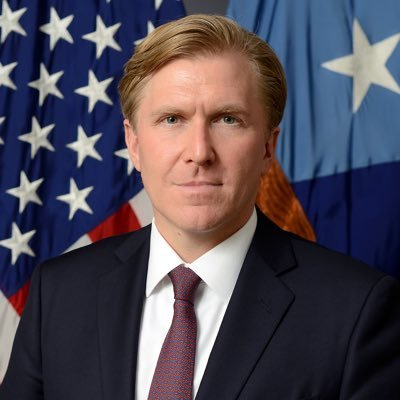
Washington, March 4 – The Trump administration’s new defense doctrine prioritizes deterring China in the Indo-Pacific while encouraging US allies to take greater responsibility for their own defense, Pentagon policy chief Elbridge Colby told the Senate Armed Services Committee.
Testifying before lawmakers on the 2026 National Defense Strategy (NDS), Colby said the administration’s military planning centers on maintaining a favorable balance of power in Asia while ensuring allies increase their defense spending and capabilities.
“The strategy focuses our military efforts on ensuring the preservation of a favorable balance of power in the Indo-Pacific, the world’s largest market area,” Colby said.
He said the United States does not seek confrontation with China but aims to prevent Beijing from dominating the region.
“We do not seek to strangle China nor compel a change in its form of government,” Colby said. “Rather, we seek to prevent China from becoming the hegemon of the Indo-Pacific.”
Colby told the committee that deterring Chinese military expansion along the “first island chain” — the strategic arc stretching from Japan through Taiwan to the Philippines — is the Pentagon’s central operational focus.
“Meeting this standard of an effective denial defense along the first island chain is the primary focus of the US armed forces,” he said.
According to Colby, ensuring the ability to block Chinese aggression in that region will allow Washington to preserve stability in Asia while maintaining flexibility to respond to other crises around the world.
“Our interests there are real and significant because of the scale of that market,” he said, referring to the Indo-Pacific economy.
The strategy also emphasizes strengthening cooperation with regional partners and allies who share concerns about China’s expanding military power.
“It is critical to emphasize that our strategy is well aligned with the interests of our allies in the Indo-Pacific,” Colby said, adding that many countries in the region want to preserve their autonomy and resist domination by any single power.
The Pentagon official also stressed that the new strategy is built on the idea of burden sharing, with allies expected to assume greater responsibility for regional security.
“The American military, while without peer, is not infinite in its application and resources,” Colby said.
He argued that wealthy allies in Europe and Asia must increase defense spending and play a larger role in deterring threats.
“Many of our allies have functionally demilitarized since the end of the Cold War,” he said. “This is untenable and unreasonable.”
The strategy urges NATO allies in Europe to lead conventional defense against Russia while encouraging partners such as South Korea to take primary responsibility for deterring North Korea.
Colby also highlighted the need to expand US defense manufacturing to sustain long-term competition with China and other adversaries.
“The NDS calls for nothing short of a national mobilization of our industrial capacity,” he said.
Such an effort, he added, would allow the United States to rapidly produce advanced weapons systems for both its own forces and allied militaries.
“We must be able to arm our own forces and those of our allies and partners with the best weaponry quickly at scale,” Colby said.
While the strategy places China at the centre of US defence planning, Colby told senators that Washington will still address threats in other regions, including Russia, Iran, and North Korea.
“We recognise clearly that there are other very real threats around the world,” he said.
However, he emphasised that the United States must avoid overstretching its military commitments.
“We cannot do everything everywhere all the time,” Colby said.
For countries across the Indo-Pacific, including India, the strategy’s emphasis on maintaining a balance of power reflects Washington’s long-term objective of working with regional partners to prevent any single power from dominating Asia.