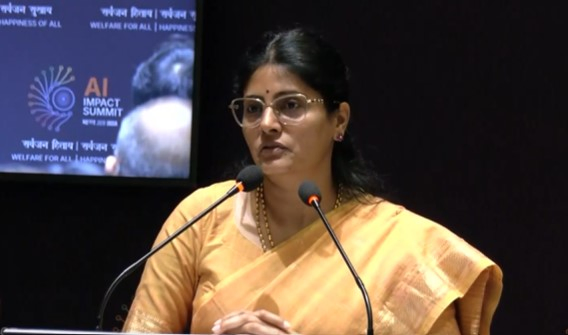
New Delhi, February 18 Artificial Intelligence (AI) presents a strategic opportunity to transform India's healthcare landscape and accelerate progress towards universal health coverage, said Dr. V K Paul, Member (Health), NITI Aayog, on Tuesday.
Addressing a session during the India AI Impact Summit 2026 at Bharat Mandapam, Dr. Paul noted that given India's scale, diversity, and dual burden of communicable and non-communicable diseases, technology-driven, evidence-based interventions are essential to strengthen service delivery and improve health outcomes.
He said that integrating AI with India's growing digital public health infrastructure will ensure interoperability, real-time analytics, and more efficient resource allocation across the health system.
"Artificial Intelligence presents a strategic opportunity to transform India's healthcare landscape and accelerate progress towards universal health coverage," he said.
Paul highlighted that AI can significantly enhance primary healthcare, enable early diagnosis, strengthen disease surveillance, and support data-driven policy formulation.
He further emphasized the importance of robust regulatory frameworks, ethical safeguards, and continuous validation to maintain safety and public trust.
Paul called for sustained collaboration between government, academia, and industry to develop scalable, affordable, and indigenous AI solutions capable of delivering measurable impact at population scale.
Speaking at the session, Roy Jakobs, Chief Executive Officer of Royal Philips, said that AI will have its greatest impact in the field of healthcare.
He observed that health systems across the globe are under immense pressure due to rising demand, workforce shortages, and increasing complexity of care, making the integration of AI not just an opportunity but a necessity.
He emphasized that AI alone cannot transform healthcare; it must be supported by robust data governance, seamless data handling, and strong clinical integration.
"Technology must align with clinical needs and workflows," he noted, underlining that meaningful AI deployment requires quality data, interoperability, and clearly defined use cases.
He further stressed that healthcare runs on trust, and therefore, AI systems must be transparent, explainable, and continuously validated to maintain clinical confidence and patient safety.
Commending India's digital health initiatives, he noted that programmes such as Ayushman Bharat Yojana are laying the groundwork for interoperable data systems and continuity of care at population scale – precisely the kind of foundation AI requires to deliver meaningful and sustainable impact.
He also remarked that solutions built in India are increasingly being deployed globally, demonstrating that technologies designed for scale, diversity, and complexity tend to be resilient and adaptable worldwide.
Reaffirming Royal Philips' commitment to collaborative innovation, Jakobs expressed confidence that partnerships between government and industry will accelerate AI-driven transformation and improve health outcomes globally.