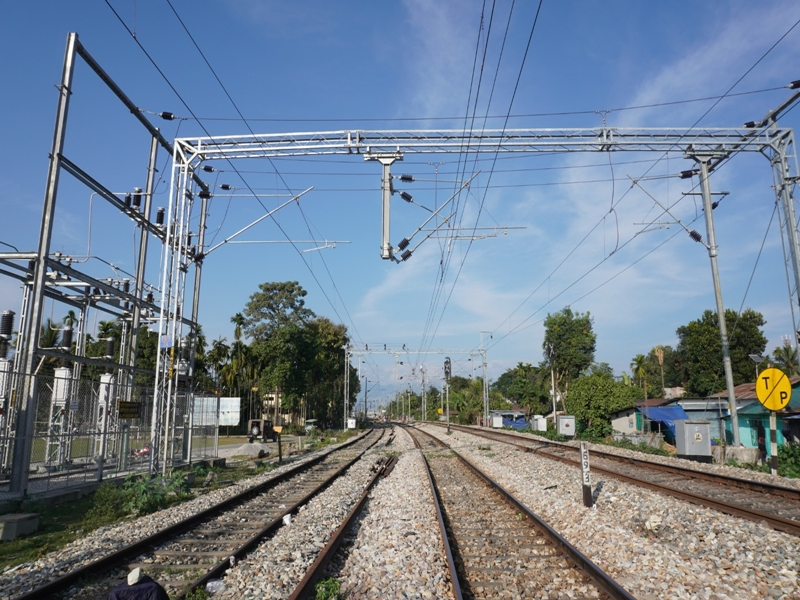
Guwahati, March 28 – The Northeast Frontier Railway (NFR) has achieved significant milestones in railway electrification during the 2025–26 financial year, covering key sections across Assam, West Bengal, Bihar, Tripura, and Arunachal Pradesh, officials said on Saturday.
NFR Chief Public Relations Officer Kapinjal Kishore Sharma said these achievements mark a major step towards sustainable, energy-efficient, and modern rail operations in the region, further strengthening connectivity and reducing dependence on conventional fuel-based systems.
He said the electrification drive is part of Indian Railways’ broader vision to achieve 100 per cent electrification, improve operational efficiency, and enhance train handling capacity across its network.
According to Sharma, during FY 2025–26, the NFR successfully completed electrification over 1,342.18 route kilometers (RKM) and 1,828.42 track kilometers (TKM) across its jurisdiction, covering important sections in Assam, West Bengal, Bihar, Tripura, and Arunachal Pradesh.
This extensive progress has significantly strengthened rail connectivity in the Northeast and adjoining areas, while paving the way for seamless electric traction operations, he noted.
Division-wise, substantial progress has been achieved across all divisions of the NFR.
The Tinsukia (TSK) Division in Assam emerged as the top performer, contributing 663.59 RKM and 855.48 TKM electrified, accounting for nearly half of the total electrification carried out during the year. Major sections electrified in the TSK Division include key routes such as Mariani–Simaluguri, Simaluguri–Dibrugarh, Duliajan–New Tinsukia, and North Lakhimpur–Dhamalgaon, which are crucial for both passenger and freight movement in Upper Assam.
The Rangiya (RNY) Division in Assam recorded the second-highest progress with 348.92 RKM and 535.43 TKM, covering strategically important sections such as Rangapara–Harmuty and Harmuty–Naharlagun, thereby strengthening connectivity to Arunachal Pradesh.
The Lumding (LMG) Division electrified 124.70 RKM and 197.38 TKM, including the vital Agartala–Sabroom section in Tripura, which plays a key role in enhancing connectivity in the southern part of the Northeast.
The Katihar (KIR) Division in Bihar achieved electrification of 108.62 RKM and 130.83 TKM, while the Alipurduar (APDJ) Division in West Bengal contributed 96.36 RKM and 109.30 TKM, covering important sections in Bihar and north Bengal, respectively.
The NFR CPRO said the electrification of these sections will lead to faster train operations by reducing dependence on fossil fuels, lowering maintenance costs, and enhancing environmental sustainability. It will also improve line capacity, punctuality, and reliability of train services across the region.
With these achievements, Northeast Frontier Railway has cumulatively electrified approximately 4,170.19 route kilometers and 6,690.38 track kilometers so far.
NFR remains committed to completing electrification works across the entire zone, contributing to Indian Railways’ mission of achieving 100 per cent electrification of its broad-gauge network, Sharma said.
The Northeast Frontier Railway, headquartered at Maligaon near Guwahati, operates across the Northeastern states as well as in seven districts of West Bengal and five districts of north Bihar.