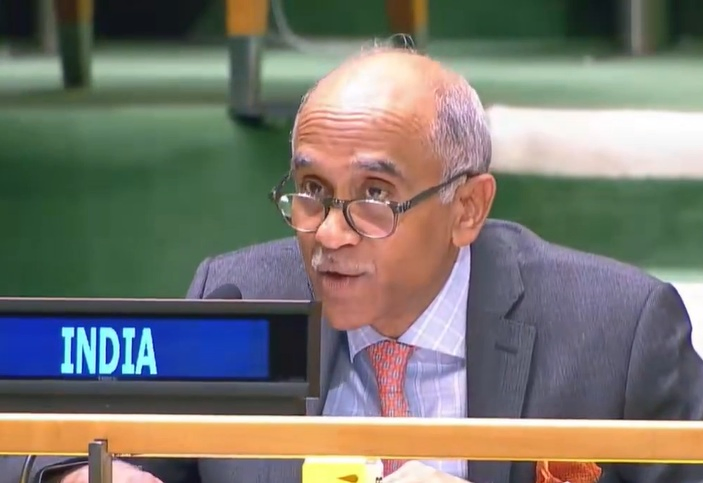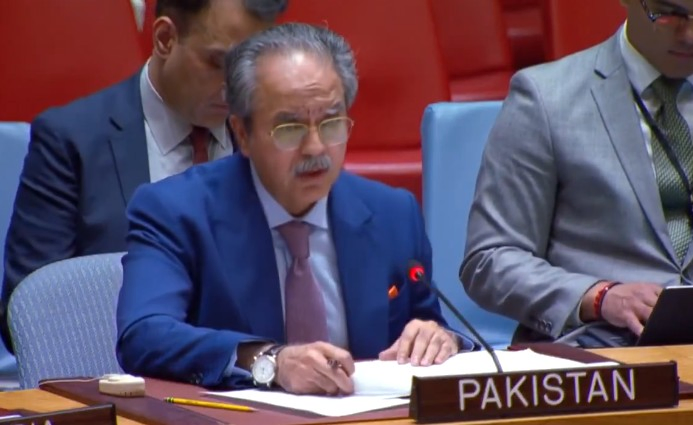
United Nations, March 17 India called out Pakistan for its habit of "fabricating imaginative" tales of Islamophobia in neighboring countries, questioning how Islamabad's own brutal repression of Ahmadis or air-bombing campaigns during Ramadan against Afghanistan can be characterized.
"India's western neighbor is an excellent example of fabricating imaginative tales of Islamophobia in their neighborhood," India's Permanent Representative to the UN, Ambassador Parvathaneni Harish, said.
"One wonders what would be termed the brutal repression of Ahmadis in this country, or the large-scale expulsion of helpless Afghans or air-bombing campaigns during this holy month of Ramadan?" Harish said.
Harish was addressing the UN General Assembly on the occasion of the International Day to Combat Islamophobia on Monday.
In a strong retort, he also said that the Organisation of Islamic Cooperation, which "our western neighbor has systematically attempted to use against India," has repeatedly made false and baseless allegations against my country.
He stressed that it is important for the UN to take note of the rising trend and dangers of weaponizing religious identity and instrumentalizing it to serve narrow political ends by state and non-state actors alike.
Highlighting that India is home to more than 200 million Muslims, one of the largest populations of the community in the world, he said that Muslims in India, including those in Jammu and Kashmir, elect their own representatives to speak for them.
“The only ‘phobia’ evident here appears to be directed against the multicultural and peaceful coexistence that all communities in India enjoy, including Muslim communities,” he said.
“Such narratives run counter to India’s fundamental ethos and reflect instead the sectarianism and terrorist mentality that this country has perpetuated since its inception. That is the real issue at hand,” he said.
Harish said that history bears repeated witness to how the politicization of religion does not solve and resolve grievances; however well-intentioned, they risk lending legitimacy to precisely this kind of selective, polarising narratives that breed further division.
“The United Nations was conceived as an institution that transcends religion, culture, and politics. Its credibility rests on universality and impartiality. We, therefore, urge caution against frameworks that exclusively focus on one faith, without addressing the broader phenomenon of religiophobia in all its manifestations,” he said.
India noted that the 1981 Declaration on the Elimination of All Forms of Intolerance and of Discrimination Based on Religion or Belief remains a very balanced and enduring instrument that enshrines the rights of all religious followers without privileging any.
India also strongly condemned violence and hatred in the name of religion, regardless of the religion in question. As a nation where followers of virtually every major world religion coexist peacefully and a nation that has given birth to four major world religions, namely Hinduism, Buddhism, Jainism and Sikhism, India, more than any other country, is acutely aware of the need for a world free from religious discrimination.
“The philosophy of 'Sarva Dharma Sambhava' implying equal respect for all religions has been the civilizational way of life for India and one that inspired the secular ethos of the Indian Constitution,” he said.
Harish noted that the United Nations' greatest contribution to peace and human dignity lies in its efforts to maintain international peace and security, bringing everlasting peace in conflict situations, its development work and humanitarian action, and its promotion of universal human rights - work that is conducted without regard to the faith of those it serves.
"Global public goods, like sunshine, should be available to one and all, irrespective of affiliations. The UN has built its credibility through tireless work on conflict resolution, poverty alleviation, and protection of civilians. We urge the UN to remain anchored to this founding spirit,” he said.
India reaffirmed its commitment to a world free from religious hatred and violence in all its forms. “We urge the UN to channel its time and limited resources towards building inclusive societies grounded in equality, dignity, and the rule of law - for every individual of every faith,” Harish said.