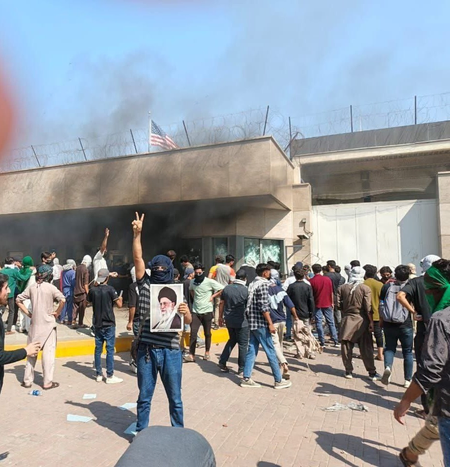
New Delhi, March 25 – For Pakistan’s Army Chief, Field Marshal Asim Munir, countering the pro-Iran Shia mobilization within the country is increasingly becoming a challenge. For Pakistan, countering this mobilization is important because it poses a significant threat. However, the dilemma the establishment faces is that it cannot use its official machinery to directly address the Shia mobilization.
Pakistan has chosen to mediate between Iran and the United States, and therefore, it needs to remain neutral. Any direct action against the Shia mobilization would infuriate Iran, which is something that Islamabad wants to avoid.
An official stated that Pakistan has now brought back its proxies to deal with this problem. The Pakistan Army chief has ordered hardline Sunni elements and leaders from the Sipah-e-Sabah (SeS) and Jamaat-ud-Dawah (JuD) to confront the Shias who are mobilizing in large numbers in support of Iran. These groups have, in the past, supported the Pakistani establishment. When it comes to countering protesters who were seeking justice for former Pakistan Prime Minister Imran Khan, it was these elements who took to the streets.
The members of the SeS and JuD have the backing of the army and ISI and have been given a free hand to engage in street violence against those who are questioning the establishment, an official said.
The SeS is a banned Sunni Deobandi Islamist organization and a former political party that was founded in 1985. This organization was created solely to oppose Shia influence in Pakistan. The SeS has a history of being involved in sectarian conflicts, including violence with the Shia organization, Shipah-e-Muhammad, Pakistan.
The JuD, on the other hand, is the charity wing of the Lashkar-e-Taiba. The JuD follows the Ahl-i Hadith interpretation of Islam, which is similar to Wahhabism and Salafism.
An Intelligence Bureau official said that by involving the SeS and JuD, the Pakistan army chief would aim to suppress the Shia mobilization. Since these groups have no accountability, the violence would not be blamed on the state, but on two individual organizations. This helps in the deniability factor, when Pakistan speaks with Iran, the official added.
Such violence will undoubtedly be scrutinized internationally and by foreign intelligence agencies. The establishment would, however, try to deflect blame by putting the blame on the SeS and JuD, while stating that it has nothing to do with them.
Another official said that both groups have been given immunity by the establishment. This means that they can choose to act as they please.
Another official said that with such a plan in place, one could anticipate street violence and bloody clashes with the Shias in Pakistan.
By trying to mediate between Iran and the US, Pakistan wants to position itself as a powerful actor. Pakistan also wants to claim geopolitical relevance by offering to mediate between the two warring nations.
Field Marshal Asim Munir has taken on this task and has been engaging directly with Iranian President Masood Pezeshkian. He has also been leveraging his relations with some of the Gulf nations and the US.
With Pakistan wanting geopolitical relevance, it cannot afford to officially crush the mobilization that is taking place in support of Iran. If Pakistan ends up angering Iran at this juncture, then Tehran may not come to the table. This would hurt Pakistan’s ambitions of playing mediator and reclaiming geopolitical importance, another official said.
The JuD and the SeS have readily accepted what the Pakistan army chief has said, as they have done in the past. Officials say that both these outfits have had an agenda against the Shias for a long time, and hence the offer made by Field Marshal Munir is more than welcome for them.