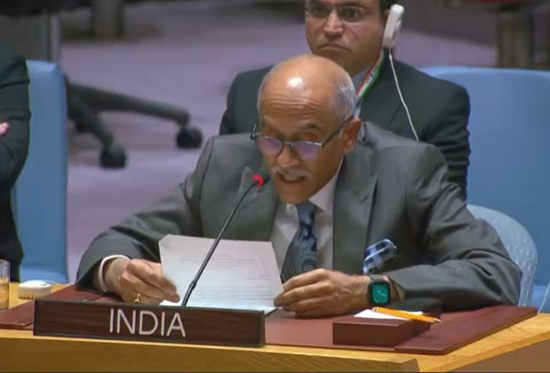
United Nations, March 10. India has condemned Pakistan's air attacks on Afghanistan and has criticized its hypocrisy in conducting them during the month of Ramadan, killing mostly women and children while preaching "Islamic solidarity."
"It is hypocritical to advocate for high principles of international law and Islamic solidarity on one hand, while ruthlessly carrying out air strikes during the holy month of Ramadan," India's Permanent Representative, P Harish, told the Security Council on Monday.
"As of March 6, 2026, the attacks have killed 185 innocent civilians, of whom around 55 percent are women and children," he said.
"India strongly condemns the airstrikes on Afghan territory, which are flagrant violations of international law and the UN Charter and the principle of state sovereignty," he said.
Speaking at a Council briefing on Afghanistan, Harish did not name Pakistan, but the carefully worded remarks were clearly directed at that country.
Pakistan has claimed that it was attacking Afghanistan because it was allowing terrorists to operate from its territory.
Harish, however, pointed out that it was Islamabad that was using terrorist groups as proxies to attack neighboring countries.
"Terrorism remains a global scourge that affects humanity, and only coordinated efforts by the international community will ensure that ISIL [Islamic State], Al Qaida, and their affiliates, including the Lashkar-e-Tayyiba and Jaish-e-Mohammed, along with proxies such as The Resistance Front, and those who facilitate their operations, no longer engage in cross-border terrorism," he said.
In the most recent border incident, The Resistance Front carried out a religiously motivated terrorist attack in Pahalgam in April, killing 26 people.
Secretary-General Antonio Guterres' Deputy Special Representative for Afghanistan, Georgette Gagnon, said, "The conflict with Pakistan has had significant human and economic costs."
She said that Pakistan, having closed its border with Afghanistan, the only trade route was through Iran, which has been disrupted by the war, and the prices of basic commodities have begun to rise, "putting further strain on Afghanistan's already fragile economy."
"Instability in the region, on both of Afghanistan's longest borders, undermines Afghanistan's stability," she said.