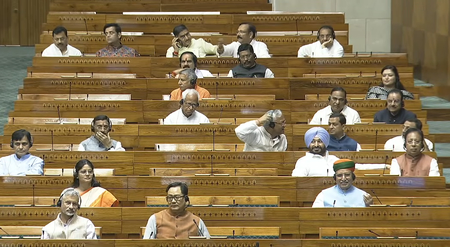
New Delhi, March 16 – The slow pace of expenditure and utilization of funds by several states during 2025-26 for the creation of court halls and residential units has come under scrutiny by a parliamentary standing committee, which presented its report in both houses on Monday, an official said.
The Department-related parliamentary standing committee on Personnel, Public Grievances, Law and Justice, chaired by Brij Lal, MP, Rajya Sabha, noted in the report that the Centrally Sponsored Scheme (CSS) for Development of Infrastructure Facilities for Judiciary should be monitored more closely to ensure timely utilization of funds and completion of projects.
The committee, in its 162nd Report on the Demands for Grants (2026-27) of the Department of Justice (Ministry of Law & Justice), also emphasised the need for gender-sensitive court design, including provision of separate and adequate facilities for women lawyers, litigants and staff, as well as dedicated child-care and crèche facilities within court complexes.
The house panel also stressed the need to upgrade court infrastructure nationwide, the official said in a statement.
The committee noted that the Centrally Sponsored Scheme (CSS) for Development of Infrastructure Facilities for Judiciary has played a significant role in augmenting judicial infrastructure across the states and union territories, as reflected in the cumulative release of central assistance and the creation of court halls and residential units.
“However, the committee expresses concern over the slow pace of expenditure and utilization of funds in several states during 2025-26, despite substantial releases made under the scheme,” said the report.
“The committee, therefore, recommends that the department, in coordination with state governments and high court level monitoring committees, strengthen monitoring and review mechanisms to ensure timely utilization of funds and completion of projects,” it said.
The house panel also recommended that the department take proactive measures to address procedural and system-related bottlenecks, including capacity-building for the effective implementation of the SNA-SPARSH framework, so that the objectives of the scheme are achieved.
The committee further recommended that deficiencies in digital infrastructure and the non-availability of proper network connectivity in courts be urgently addressed.
It said that such facilities should be uniformly extended to high courts and subordinate courts, rather than remaining confined to the supreme court of India.