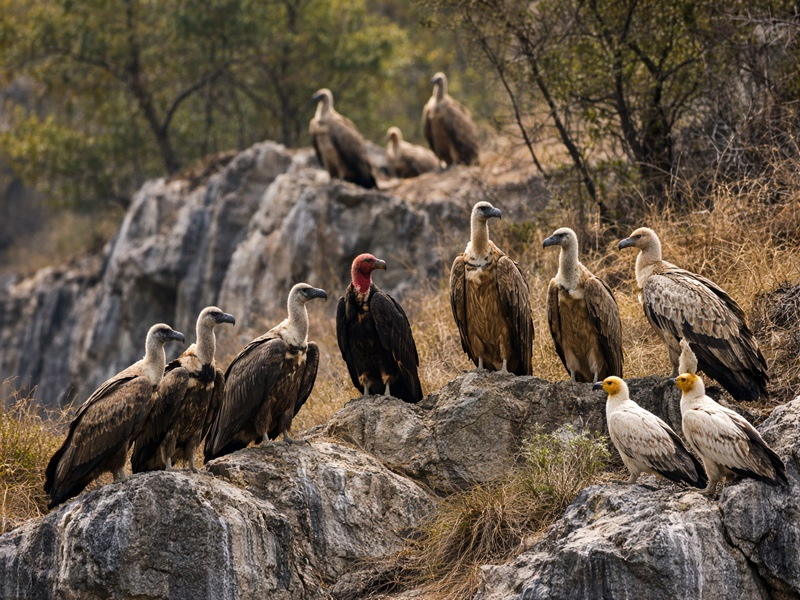
Bhopal, February 22 – The first phase of the vulture census in Madhya Pradesh has recorded 1,127 vultures in the South Panna forest division and 735 in Shivpuri district, indicating stable populations and continued conservation success, forest officials said on Sunday.
Officials said the census in the South Panna division was carried out by forest personnel and volunteers, who documented vultures across multiple forest ranges and cliff habitats known for nesting.
In Shivpuri district, forest officials recorded 735 vultures across various forest areas, reflecting stable population trends and safe habitat conditions. The district includes important conservation zones such as Madhav National Park, which was recently declared the state’s ninth tiger reserve.
According to forest officials, several vulture species were identified during the survey, including the Indian Long-billed Vulture, Red-headed Vulture, Egyptian Vulture, Eurasian Griffon, and Himalayan Griffon. These include both resident and migratory species that inhabit cliffs, forested areas, and open landscapes in the region.
Officials said Madhya Pradesh remains one of India’s key strongholds for vulture conservation, supported by favourable habitat conditions, availability of food sources, and ongoing protection measures.
The census forms part of a broader state and national monitoring programme aimed at tracking vulture populations, which had declined sharply in previous decades due to poisoning caused by veterinary drugs such as diclofenac and other environmental threats.
Recent data indicate a steady rise in the state’s vulture population. According to forest department figures, 12,981 vultures were recorded during the first phase of the 2025 census, compared to 10,845 in 2024 and 8,397 in 2019. The population has nearly doubled from around 7,000 recorded in the initial census conducted in 2016.
Forest officials attributed the increase to sustained conservation efforts, including the ban on diclofenac, habitat protection, establishment of breeding centres, and increased community participation.
They said the first phase of the census, typically conducted during winter months, focuses on counting vultures and assessing their distribution, while subsequent phases evaluate breeding activity and long-term population trends.
Officials said the findings from the current census will help guide future conservation planning and strengthen ongoing protection measures.