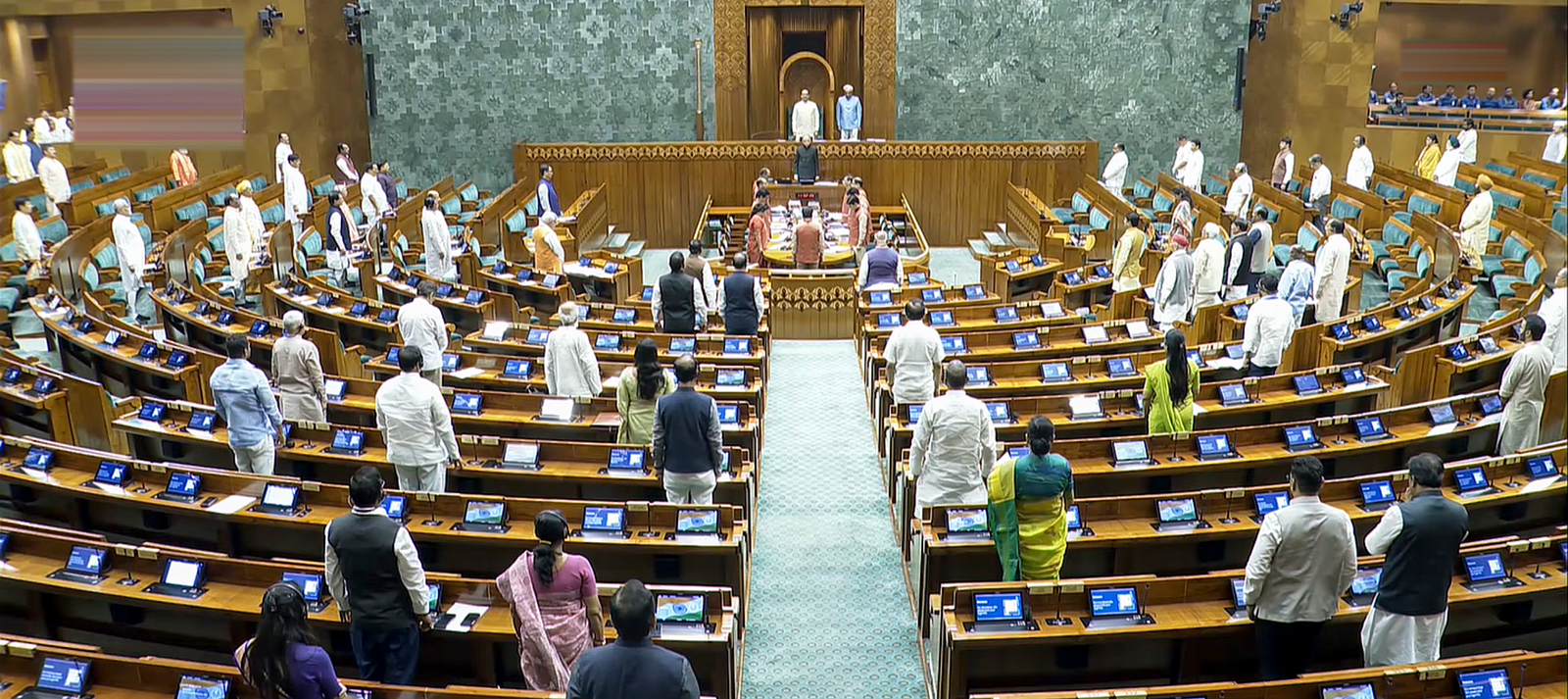
New Delhi, April 2 The second half of the parliamentary budget session, which saw the passage of key legislation despite opposition protests, was extended in an unusual manner with the government reconvening both houses on April 16.
The Lok Sabha and Rajya Sabha were adjourned on Thursday and will reconvene on April 16 for three days to discuss key legislation aimed at implementing women's reservation, including increasing the number of seats in the Lok Sabha from the current 543 to 816.
The second half of the budget session, which began on March 9, was scheduled to end on April 2, but both houses were not adjourned indefinitely after the conclusion of business.
Parliamentary Affairs Minister Kiren Rijiju informed the Rajya Sabha that some "key legislations" would be taken up during the extended session, and that the houses would not be adjourned indefinitely.
The second part of the session saw the passage of the Finance Bill 2026-27 and the Demands for Grants for various ministries, along with the Appropriation Bill, thus completing the budgetary process in Parliament.
Finance Minister Nirmala Sitharaman addressed the discussion on the Finance Bill in both houses and answered questions raised by members.
The session began in the shadow of the West Asia crisis, following the US-Israel attack on Iran on February 28, with the opposition demanding a discussion on the issue.
However, Prime Minister Narendra Modi, External Affairs Minister S Jaishankar, and Petroleum and Natural Gas Minister Hardeep Singh Puri gave statements on the West Asia conflict and its impact on India. The opposition created uproar, claiming that their questions were not addressed.
The opposition also staged several protests both inside and outside Parliament regarding the shortage of oil and LPG, even as the government accused them of spreading rumors to create unrest among the public.
Both the Lok Sabha and Rajya Sabha witnessed high productivity during the budget session, with 100 and 79 percent respectively, according to PRS Legislative Research.
While the Lok Sabha spent over 50 percent of its time on financial matters and 20 percent on other legislation, the Rajya Sabha spent around 35 percent on financial matters and 17 percent on legislation, in addition to 50 percent on non-legislative matters.
The opposition staged walkouts in both houses during the passage of crucial bills, claiming that they were dissatisfied with the government's response.
As many as seven bills were introduced in both houses, of which five were passed during the second part of the session.
These included the Central Armed Police Forces (General Administration) Bill, 2026, the Andhra Pradesh Reorganisation (Amendment) Bill, 2026, the Transgender Persons (Protection of Rights) Amendment Bill, 2026, the Jan Vishwas (Amendment of Provisions) Bill, 2026, and the Insolvency and Bankruptcy Code (Amendment) Bill, 2025.
The Opposition raised concerns about the Central Armed Police Forces (General Administration) Bill, demanding that the bill be sent to a parliamentary committee for further scrutiny, as it went against a Supreme Court ruling restricting the number of IPS officers in central armed forces.
The legislation aims to create a unified legal framework governing personnel across different Central Armed Police Forces (CAPFs), replacing the current patchwork of separate service-rule regimes for the five central forces.
The Andhra Pradesh Reorganisation (Amendment) Bill, 2026, saw Parliament approving Amaravati as the new capital of Andhra Pradesh after amending the original 2014 act.
The Transgender bill sought to amend a law on the protection and rights of transgender persons, proposing to exclude social orientations from the scope of the statute, even as the Rajya Sabha gave its approval, with opposition members pressing for sending it to a select committee.
The bill also provides for graded punishment based on the severity of harm inflicted on such individuals.
The Opposition also created uproar in both houses regarding the Transgender Bill, stating that the rights of gays and lesbians have not been taken care of by the government and termed the bill as discriminatory.
The Jan Vishwas (Amendment of Provisions) Bill sought to amend 784 provisions in 79 central laws to decriminalize and rationalize minor offences, further improving the business environment and preventing harassment of individuals.
The Insolvency and Bankruptcy Code (Amendment) Bill aimed to provide faster resolution of stressed firms and reduce case backlogs. Finance Minister Sitharaman emphasized that the intent is not to liquidate companies, but to help them operate with appropriate safeguards.
However, the Foreign Contribution (Regulation) Amendment Bill, 2026, was not taken up by the government during the session, following strong objections from the opposition. The Corporate Laws (Amendment) Bill, 2026, was sent to the Parliamentary Committee for further scrutiny.
The session also saw the revocation of the suspension of eight opposition MPs, after the Lok Sabha passed a motion in this regard. They were suspended during the first part of the budget session, when they created uproar in the Lok Sabha for preventing Leader of Opposition Rahul Gandhi from speaking in the house.