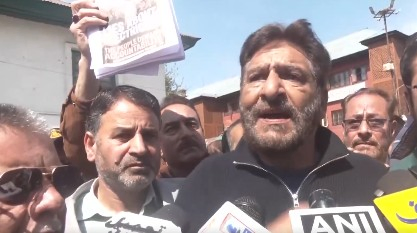
Srinagar, March 28: Leaders and workers of the opposition People's Democratic Party (PDP) staged a protest in Srinagar, Jammu and Kashmir, on Saturday over taxes, utility charges, and the issue of electricity amnesty.
Raising anti-government slogans, the PDP leaders and workers protested to highlight what they described as growing public distress over taxes and utility charges.
Carrying placards, the protesters gathered in different parts of the city, accusing the authorities of imposing a heavy financial burden on residents already struggling with limited incomes.
The protest came amid increasing complaints about electricity bills, water charges, and municipal taxes, with the opposition party seeking relief measures for the public.
PDP leader Iqbal Tramboo, addressing reporters during the protest, said that March 31 has become a "black day" for the people of Kashmir due to mounting financial pressures.
"People are under immense tax pressure. They are receiving hefty electricity bills, water fees are being demanded, and employees are without salaries," Tramboo said.
The Jammu and Kashmir government had announced a one-time amnesty for outstanding electricity dues of consumers. The amnesty ends on March 31.
People from different sections of society, especially the weaker sections, have demanded that the deadline for amnesty in case of outstanding electricity dues should be extended beyond March 31. So far, there has been no official word on whether or not the amnesty on outstanding electricity dues would be extended beyond March 31.
Those demanding an extension in the deadline for paying outstanding electricity dues are expecting the government to make an announcement in the Jammu and Kashmir legislative Assembly, which is currently in its budget session.
In addition to the demand for an extension in the deadline for paying electricity dues, people from non-metered rural areas are saying that the authorities have arbitrarily increased their monthly flat rates, and recoveries are being made at the enhanced rates, despite the fact that there has been no increase in electricity consumption in these areas that would warrant an increase in the flat rates.