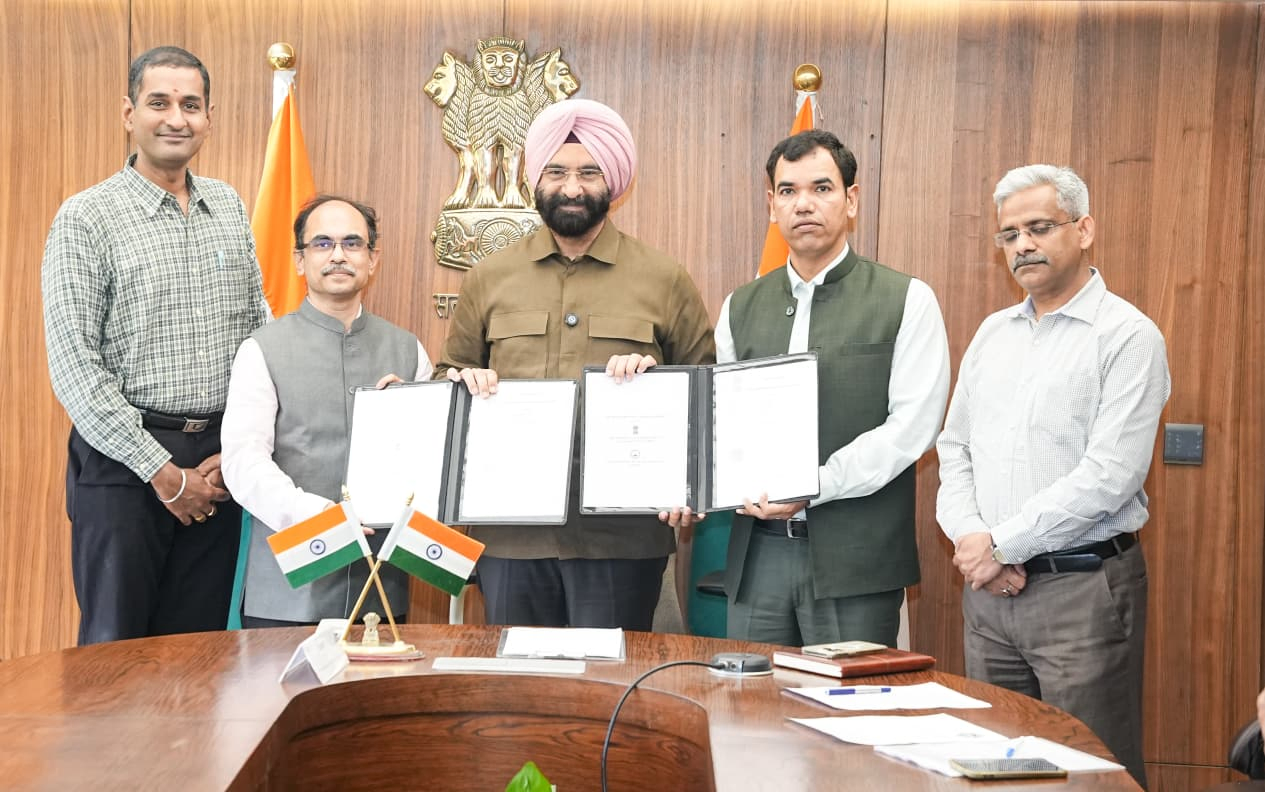
New Delhi, March 13 – The Delhi government signed a Memorandum of Understanding (MoU) with the Indian Institute of Technology Madras (IIT Madras) on Friday to launch a pilot study on photocatalytic "smog-eating" surfaces, an official said.
Entitled "Comprehensive Study on the Effectiveness of Photocatalytic Smog-Eating Surfaces, Specifically Utilizing Titanium Dioxide (TiO₂) or Similar Safe Photocatalysts for Abatement of Air Pollution in Delhi," the project targets key pollutants such as Nitrogen Dioxide (NO₂) and Volatile Organic Compounds (VOCs) that fuel urban smog.
The MoU signing ceremony was attended by Manjinder Singh Sirsa, along with Prof. Somnath C. Roy from IIT Madras's Department of Physics, who serves as Principal Investigator.
Senior officials from the Department of Environment and the Delhi Pollution Control Committee (DPCC) were also present.
"Through this IIT Madras study, we aim to find the best, long-lasting, and affordable ways to apply 'smog-eating' coatings to roads, buildings, and city surfaces. If the study can provide evidence-based findings that such coatings or materials can reduce Nitrogen Dioxide and other pollutants, it can be beneficial," said Sirsa.
Sirsa added, "Delhi's population is growing with urbanization from nearby areas, rapidly expanding our infrastructure. Our focus, under CM Rekha Gupta, remains on achieving cleaner air for the people, without blanket bans. Therefore, we must use science to protect our air, to protect our weather and health without hindering this vital growth."
Photocatalytic materials like TiO₂ activate under sunlight to trigger reactions that convert harmful pollutants into benign compounds.
The six-month study will assess optimal integration methods, including mixing into concrete and asphalt, surface coatings on infrastructure, and innovative panels on rooftops or streetlights.
The study will also investigate the development and deployment of photocatalytic pollutant-removal panels made using Titanium Dioxide-based materials. These panels may potentially be installed on rooftops, similar to solar panels, or mounted on street-light poles to enable pollutant removal directly from the ambient air.
"We are working diligently to support innovators, as seen in our innovation challenge that has now reached its trial run phase. This study exemplifies that commitment," Sirsa highlighted.
Prof. Somnath C. Roy highlighted the rigorous approach: "The study will begin with lab testing in a smog chamber at IIT Madras to precisely measure pollutant abatement.
Following this, our team will conduct real-time field assessments in Delhi's urban environment on surfaces like concrete, asphalt, metal panels, glass, and roads to evaluate durability and efficiency under actual conditions."