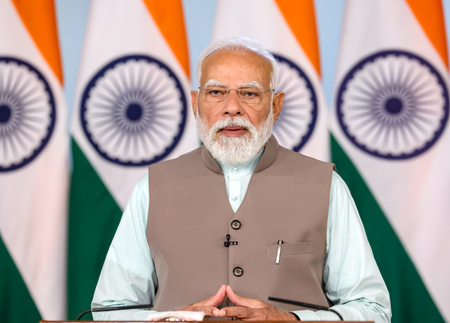
New Delhi, April 1 – Prime Minister Narendra Modi emphasized the importance of the National Education Policy (NEP), 2020, on Wednesday, highlighting India's continued focus on fostering curiosity and holistic development, with a strong emphasis on foundational literacy and joyful learning. He urged people to read an article written by Union Education Minister Dharmendra Pradhan.
"The first day of school is not just a beginning, but also a shared national responsibility for students. Under NEP 2020, India continues to foster curiosity and holistic development, with a strong focus on foundational literacy and joyful learning," the Prime Minister said on his official X account, adding, "Read this article by Union Minister @dpradhanbjp to learn in detail."
The NEP 2020 is India's comprehensive framework for transforming its education system to be more inclusive, equitable, and aligned with 21st-century skills.
In his opinion piece, published in The Indian Express, Union Minister Pradhan emphasized that NEP places curiosity, understanding, and holistic development at the centre of learning, "moving beyond rote memorisation."
He stated that every academic year is a meaningful step towards realising this vision.
"The first day of school is rarely uneventful. It is filled with a mix of hesitation and joy at the start of a new experience. Young hands hold big emotions, and curious eyes capture a whole new world," he shared, underscoring, "The early years must focus on play, exploration, and discovery, and define the beginning of a lifelong journey."
Therefore, integrating pre-school learning into formal schooling ensures that children enter Grade I with stronger foundational skills.
At the heart of these early years, Union Minister Pradhan asserted, lies a strong national commitment to foundational literacy and numeracy.
The article said that education must nurture the "whole child" – mind, body, and heart; and that arts, sports, nutrition, and physical activity are integral.
Union Minister Pradhan also stated that education is framed as a collective duty involving governments, schools, teachers, parents, and communities.
"Through the NIPUN Bharat Mission (National Initiative for Proficiency in Reading with Understanding and Numeracy), India has set a clear goal: Every child should be able to read with understanding and perform basic arithmetic by the end of Grade II. The focus shifts from memorising answers to understanding concepts. Classrooms must inspire children to ask questions, not just reproduce answers," he asserted.
The Union Minister also stressed measures like mandatory physical education, "oil boards," and "sugar boards" to combat obesity, and on strengthening Pradhan Mantri Poshan Shakti Nirman (PM-POSHAN) for better nutrition.
Additionally, Union Minister Pradhan said that technology is a learning enabler, but raises concerns about screen time and mental health. Therefore, socio-emotional learning is integrated into curricula.
He added that teachers are central to implementing reforms, fostering multilingual learning, and respecting mother tongues.
However, "Education does not begin or end at the school gate," he said, saying that the home is the first classroom, and parents are the first teachers.
"What children experience at home shapes how they learn in school. Homes are the first classrooms. Parents shape learning through reading habits, nutrition, sleep, and active engagement with schools," he shared.
Union Minister Pradhan also stressed that the ultimate goal is an inclusive, innovative, and future-ready education system that nurtures confidence, kindness, and joy in every child – preparing them as leaders for a "Viksit Bharat" by 2047.