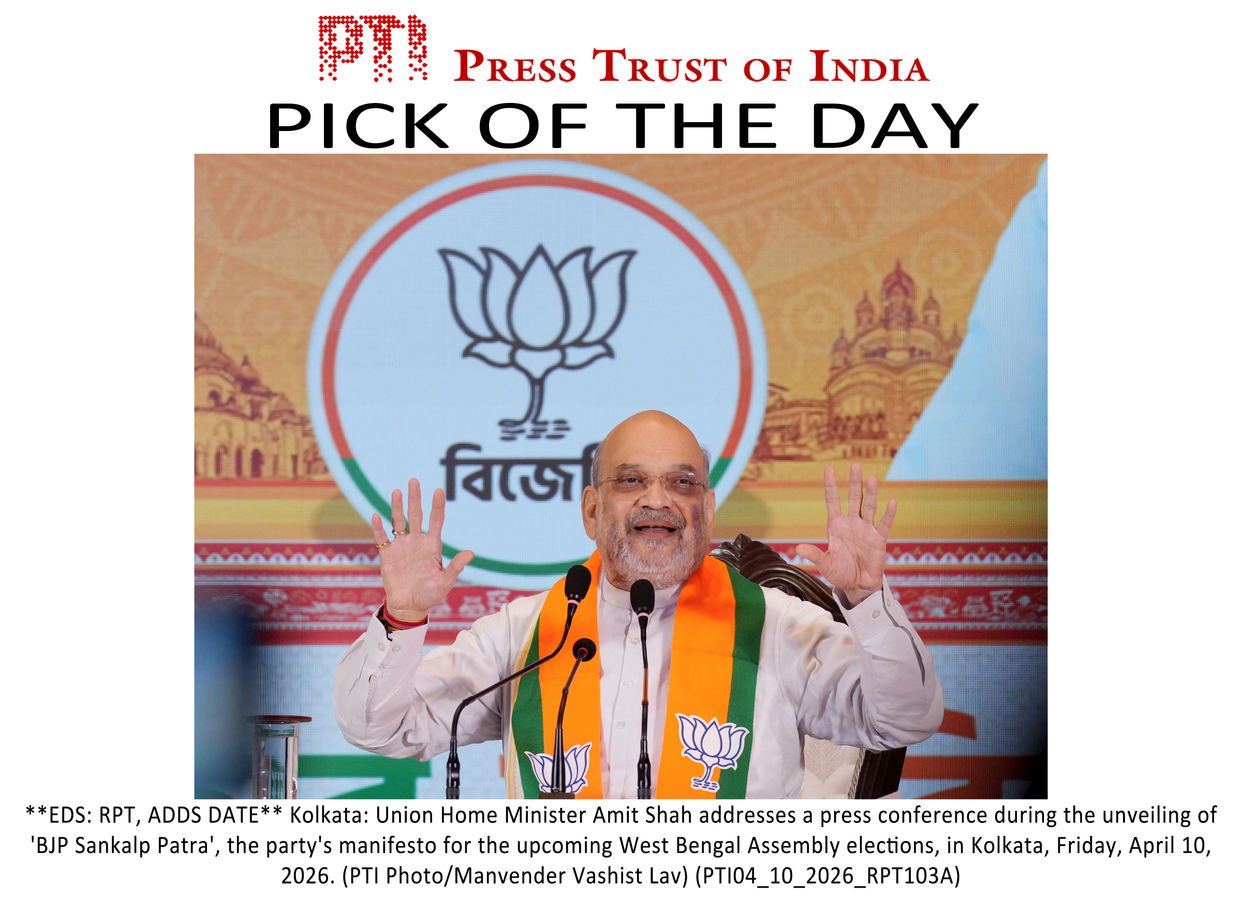
Kolkata, April 10 Union Home Minister Amit Shah on Friday unveiled the BJP's manifesto for the 2026 West Bengal assembly elections, outlining a sector-wise roadmap spanning industry, agriculture, and port-led development, while promising to revive Bengal's industrial fortunes.
Shah stressed that the BJP would address industrial concerns that have remained politically sensitive in the state, claiming that issues such as land acquisition—left unresolved during the Congress-led UPA era—have been successfully tackled elsewhere in the country.
"Problems that remained unresolved since the Manmohan Singh era have been solved in other parts of the country and can be resolved in Bengal too," he said.
Referring to the party's 'sankalp patra' as a roadmap for a developed Bengal and a vow of trust, Shah said, "The people of Bengal should trust us. Under Prime Minister Modi's leadership, we will also put Bengal on the path of development."
He added that a BJP-led government in the state would ensure solutions to long-pending industrial challenges.
"When the reins of the government come into our hands, the chief minister we choose will find solutions to all these problems. There will be a double-engine government, and we will revive Bengal's industry," the BJP leader said.
He cited Singur in the Hooghly district, where Tata Motors abandoned its Nano car factory in 2008 following intense anti-land acquisition movement led by the TMC, as a key industrial node.
"For job creation, an industrial park will be built in Singur," Shah said, adding that 50 per cent of the land would be reserved for MSMEs, while the remaining portion will be allocated to large-scale industries to ensure balanced growth and employment generation.
About the jute sector, Shah promised a comprehensive revival mechanism through modernization and reopening of closed mills.
He said, "We will re-establish the old glory of the 'Golden Fibre. The (BJP) government will launch a nationwide campaign to increase the use of eco-friendly jute products in bags, textiles, and packaging," with an eye on building a global supply chain for sustainable products.
Focusing on the tea industry in north Bengal, he announced the formation of a special commission to examine labour welfare and export potential, which will submit its report within one year.
"Tea garden workers will be granted land titles within 100 days of our government forming," Shah said.
He said welfare measures would include setting up schools and health centres for workers' families and ensuring minimum wages.
To protect the global reputation of Darjeeling Tea, he added that a "dedicated squad" would be created to curb fake products and promote Geographical Indication (GI) tagging. A laboratory would also be set up to develop new, high-yielding tea plant varieties to replace ageing bushes.
Outlining a maritime strategy, Shah said, "We will tap into the full potential of maritime trade by constructing modern deep-sea ports at Tajpur and Kulpi," while targeting a "130 per cent increase in port capacity" through modernisation of existing infrastructure.
He added that Haldia Port would be developed as a key hub for the "Blue Economy" under a time-bound roadmap, supported by new infrastructure for fisheries and aquaculture to position Bengal as a major export centre for marine products.
Shah also accused Chief Minister Mamata Banerjee of depriving the state of central health schemes for political reasons.
"Mamata Banerjee fears that if these are implemented in Bengal, Prime Minister Modi will become popular. That is why Bengal's poor have been deprived of these benefits," he said, referring to Ayushman Bharat and other health programmes.
Urging voters to back the BJP, Shah said a "double-engine government" would ensure faster implementation of projects, create jobs and deliver a "fear-free Bengal" on the "track of development".