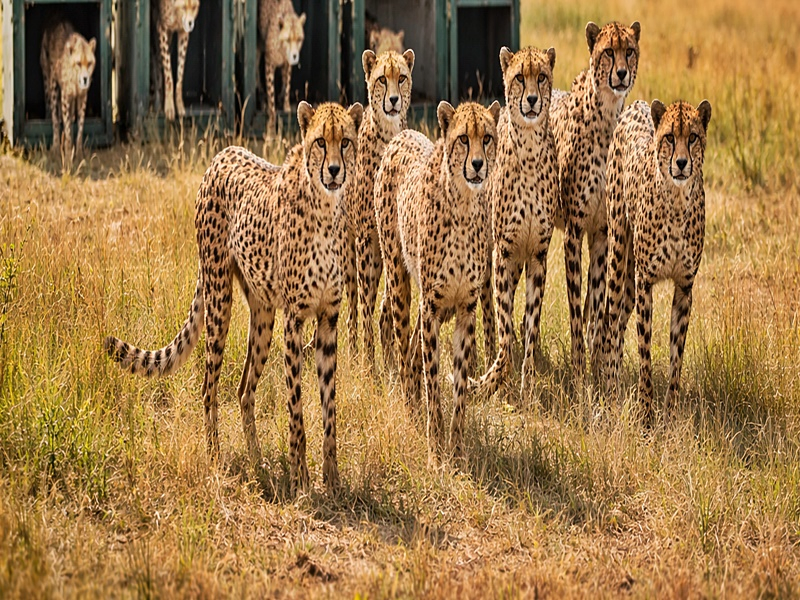
Bhopal, February 28 – Under the Centre’s ambitious ‘Project Cheetah’ reintroduction programme, India brought nine more cheetahs from Botswana on Saturday and released them into the Kuno National Park in the Sheopur district of Madhya Pradesh.
With this latest arrival, the total number of cheetahs at Kuno has risen to 48, including 28 cubs born in India, highlighting the growing population and the importance of local breeding for the project’s long-term success.
Although an earlier announcement had indicated that eight cheetahs would arrive in the third batch, nine were transported this time. Notably, six of the nine cheetahs released on Saturday are females, and three are males – the highest number of females in any batch so far.
In the first batch on September 17, 2022, eight cheetahs were brought from Namibia, including five females and three males. In the second batch on February 18, 2023, 12 cheetahs were brought from South Africa, comprising seven males and five females.
With this latest translocation, a total of 29 cheetahs have been brought to India in three batches – 16 females and 13 males.
Officials said the growing number of India-born cubs is central to the programme’s success, as these animals are adapting naturally to local conditions. Some of the cheetahs that have matured are expected to be shifted to the Nauradehi Wildlife Sanctuary, which will become the third habitat for the species in Madhya Pradesh after the Kuno National Park and the Gandhi Sagar Wildlife Sanctuary.
Former Principal Chief Conservator of Forests (PCCF) and Head of Forest Force in Madhya Pradesh, Alok Kumar, told
He said the survival of cubs born in India is crucial to achieving the objectives of Project Cheetah. “We have high hopes from Indian-born cubs because they are growing here and do not have to adapt to a new environment like the cheetahs brought from abroad,” he said.
Kumar noted that cheetahs require a substantial prey base and are generally less aggressive compared to other big cats. “Cheetahs tend to avoid confrontation, whereas tigers are territorial apex predators. Therefore, awareness and acceptance among local communities are essential for the success of the project,” he said.
He suggested that awareness campaigns in villages around Kuno and other potential habitats should continue to familiarise residents with the behaviour of cheetahs.
Welcoming the new batch, Chief Minister Mohan Yadav said Madhya Pradesh is fulfilling its responsibility under Project Cheetah with commitment. He said the initiative aims to establish a sustainable cheetah population in India and restore ecological balance.