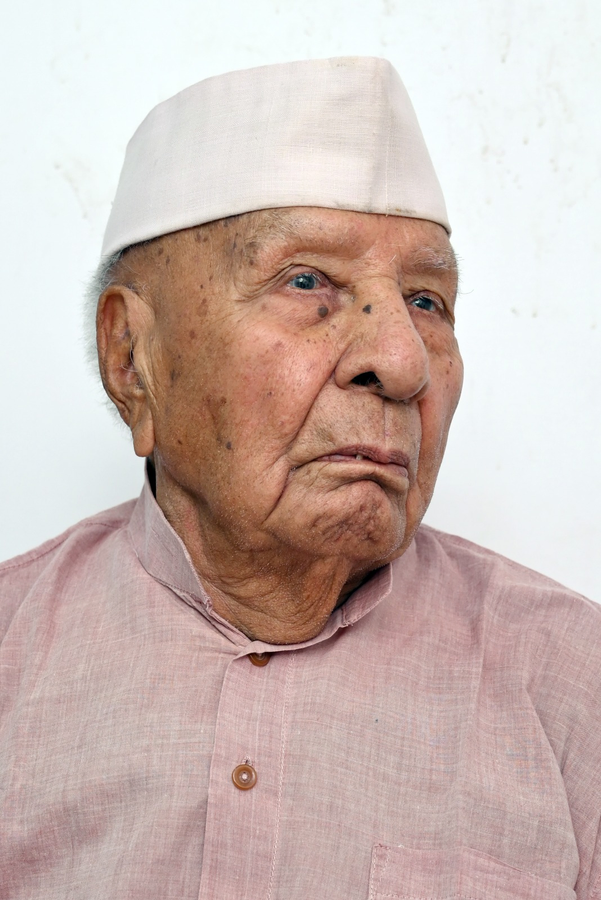
Jaipur, March 27 – This is the story of Pt. Ramkrishna Sharma, a veteran freedom fighter and socialist, who will be 100 years old on Saturday. He witnessed the political landscape of the country before independence and later played a key role in shaping the nation's democratic journey, serving as a four-time MLA and Member of Parliament from Bharatpur district. A man of strong principles, he advocates for integrity and service over power.
His life has been dedicated to fighting against social injustice, supporting farmers, and promoting water conservation in a region where scarcity is a constant challenge.
On the eve of his 100th birthday, Sharma reflects on his life with a sense of calm and purpose.
He has witnessed India's journey from a nation under colonial rule to a nation with its own destiny. A freedom fighter, a four-time MLA, and a former Member of Parliament, his life is a testament to the nation's progress.
However, beyond the titles and achievements, he is a man who prioritized principles over personal gain.
As he approaches his 100th birthday, Sharma reflects on the time when India was not yet independent – a time of fragile hope but unwavering unity.
"We didn't see caste or religious differences, but we had a common goal: to create an independent India," he recalls. "Our only dream was that the British should leave, and India should be free."
He expresses a quiet sense of pride in today's India. He sees the interconnectedness of the nation's infrastructure, from its railways to its bridges, as a fulfillment of a promise. "The leaders of that time gave us a strong democratic nation," he says.
"They ensured that everyone had the right to vote, regardless of caste, religion, or gender. Even countries like the United States didn't begin their democracy in this way," he adds.
At 100, Sharma remains focused on the present. "We need to increase voter participation," he insists. "And we must strive for true equality, not just in words, but in reality, in all aspects of society and the economy."
His own life has been shaped by sacrifice. During the Emergency, he spent nearly 19 months in jail, a period he views with quiet acceptance rather than bitterness.
One of the defining moments of his political career came shortly after independence. When offered the position of District Congress Committee Secretary, Mahatma Gandhi suggested dissolving the Congress to allow for a healthy democratic opposition. Sharma readily accepted.
"The next day, I resigned," he says simply. He went on to become a founding member of the Socialist Party, driven by the belief that democracy needed strong opposition based on principles. "The idea was to build an opposition based on policy," he explains.
He continued to refuse offers of power throughout his life. Over the years, he was offered opportunities to join the Congress and even the BJP in 1980, but he always declined.
"I never believed in party-hopping," he states firmly. "Politics should not be about convenience."
When asked if he regrets not achieving greater political success, he acknowledges that he might have been continuously elected as an MLA or MP if he had stayed in the Congress. However, he also emphasizes that "money played a role in politics, even then."
Instead, he chose a different path – one guided by integrity and socialist principles. He became a key figure in the socialist movement in India, working closely with leaders like Dr. Ram Manohar Lohia and Jayaprakash Narayan.
Even his reflections on history are honest and unfiltered. Speaking about Mahatma Gandhi, he says, "It is often said that he frequently visited Harijan bastis, but I didn't personally have the opportunity to see that."
At 100, Sharma remains clear-eyed and resolute. He strongly opposes the culture of political defections. "There should be strict laws," he says. "Those who switch parties should be barred from contesting elections for 10 years. It is morally wrong."
He then turns to his own health. "What is the secret to a long life?" he asks. "Buttermilk and two chapati, and walking – always walking."
He recalls walking 14 kilometers to school every day, and later 30 kilometers to college. Even today, his philosophy remains simple: live honestly, stay active, and carry no bitterness.
"I am satisfied. I have no regrets. I have served the nation with honesty and morality – that is enough," he says.
As the country debates its present and imagines its future, Sharma offers a perspective shaped by time.
He acknowledges the work of Prime Minister Narendra Modi, but gently pushes back against selective narratives. "It is not correct to say that all development has happened only after 2014," he says. "Projects like the Bhakra Dam, IITs, and IIMs were built before that. Every era has contributed."
In a world increasingly driven by speed, ambition, and shifting loyalties, Sharma stands as a quiet reminder of something rare – steadfastness.
A hundred years on, his life is not just a story of longevity, but of consistency – of a man who walked miles for education, stood firm in politics, endured jail for democracy, and still believes that the strength of a nation lies in equality and principles.
As he turns 100, Sharma does not ask for celebration. Only remembrance – of the values that built a nation, and of the responsibility to carry them forward.