Kolkata, March 26 – Ram Navami in West Bengal on Thursday turned into a political contest, with the BJP highlighting its Hindutva agenda and the ruling TMC also celebrating the festival to prevent the saffron camp from dominating the religious narrative during the high-stakes assembly elections.
Across Kolkata and several districts on Thursday, saffron flags were seen, chants of "Jai Shri Ram" echoed through crowded streets, and hundreds of processions snaked through neighborhoods, transforming what was once a relatively limited celebration in Bengal into one of the most politically charged festivals in the state's electoral calendar.
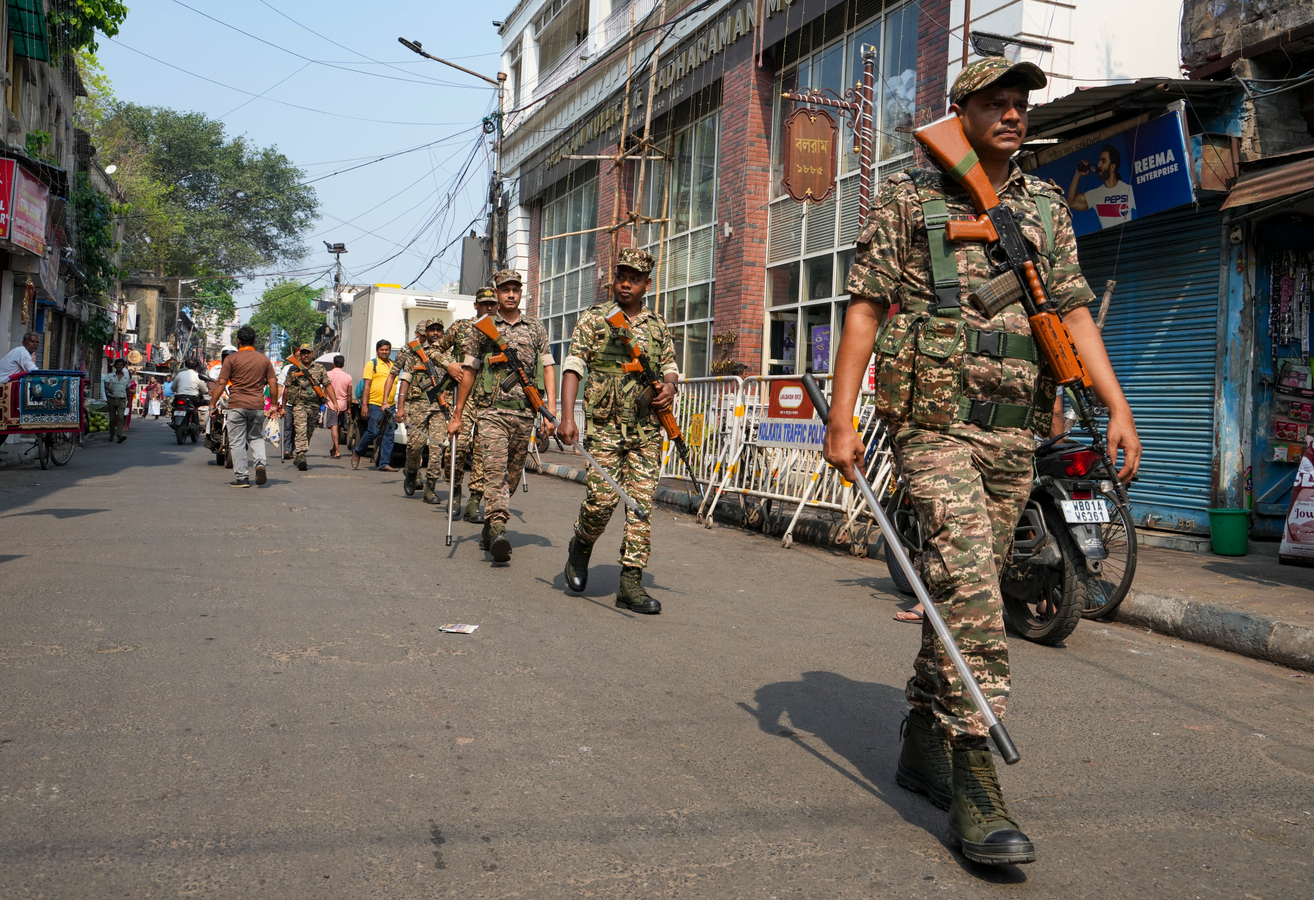
More than 60 rallies, both large and small, were organized across the city, while similar processions were organized in districts such as Howrah, Hooghly, Birbhum, and Uttar Dinajpur. Strict security arrangements were put in place, with thousands of police personnel deployed and central forces kept on standby in sensitive areas.
The festival's transformation into a political battleground was evident as leaders from both sides participated in the celebrations.
Opposition Leader Suvendu Adhikari joined a Ram Navami procession in Bhabanipur, the south Kolkata constituency where he is contesting against Chief Minister Mamata Banerjee in the upcoming elections.
"Ram Navami is a celebration of our civilization and culture. People across Bengal are coming out in large numbers to show their devotion," Adhikari said during the rally.
Several BJP leaders and candidates also participated in processions in their respective constituencies, turning the religious celebration into a demonstration of organizational strength.
For the saffron camp, Ram Navami has become a crucial instrument of political mobilization in Bengal over the past decade.
Party leaders said that the BJP and its ideological affiliates in the Sangh Parivar had planned programs across the state aimed at reaching nearly two crore people over two days of celebrations, highlighting the scale of the outreach.
The expansion of Ram Navami celebrations coincided with the BJP's steady rise in the state's political landscape after 2016, with the festival increasingly used to project Hindu identity and consolidate support.
However, the ruling TMC is no longer willing to concede this space.
Over the past few years, several TMC leaders have begun participating in Ram Navami events or organizing local processions, a shift that political observers see as part of the party's attempt to counter the BJP's Hindutva narrative.
Senior TMC leader Kunal Ghosh joined a Ram Navami rally in north Kolkata along with several local leaders.
"Ram does not belong to any political party. He belongs to everyone," Chief Minister Mamata Banerjee recently said, responding to the BJP's aggressive mobilization around the festival.
The chief minister's remarks are widely seen as an attempt to reclaim the cultural symbolism surrounding the festival and prevent the BJP from monopolizing the Hindu narrative.
In the politically charged atmosphere of the ongoing election campaign, Ram Navami has thus become an arena of competitive symbolism.
While the BJP frames the festival as a celebration of cultural identity and Hindu unity, the TMC seeks to balance participation with its long-standing secular image, resulting in what critics describe as a form of competitive religious politics.
Left and Congress leaders have accused the BJP of attempting to import what they call "North Indian Hindutva politics" into Bengal.
At the same time, they have criticised the TMC for engaging in "soft Hindutva" to counter the BJP's narrative rather than confronting it politically.
"This aggressive use of religion in politics is alien to Bengal's syncretic traditions," a senior CPI(M) leader said, alleging that both the BJP and the TMC were trying to reap electoral dividends from religious symbolism.
The political stakes surrounding Ram Navami have grown even sharper this year with the entry of several smaller Muslim political formations into the electoral fray.
Along with the presence of AIMIM, these emerging outfits are attempting to mobilize sections of the minority electorate, potentially altering the traditional arithmetic of Bengal's politics where Muslim votes have largely consolidated behind the TMC.
Analysts say that while the BJP hopes Ram Navami mobilization will help consolidate Hindu voters, the fragmentation of minority votes could introduce new uncertainties into the electoral contest.
Adding to the tension is the memory of clashes that have occasionally marred Ram Navami processions in the state in past years, particularly in districts such as Howrah and Hooghly.
Mindful of those experiences and the fact that the state is currently under the model code of conduct, the administration imposed strict guidelines on rallies, including restrictions on weapons and limits on the number of participants.
The police conducted route inspections and deployed drone surveillance to monitor the processions.
From university campuses where ABVP activists organised Ram Navami prayers amid slogan battles with Left student groups, to district towns where elaborate processions featured traditional martial displays and cultural programmes, the celebrations reflected the changing political grammar of Bengal.
What was once a relatively modest religious observance has, over the past decade, evolved into a symbolic battleground where religion, identity and electoral strategy intersect.