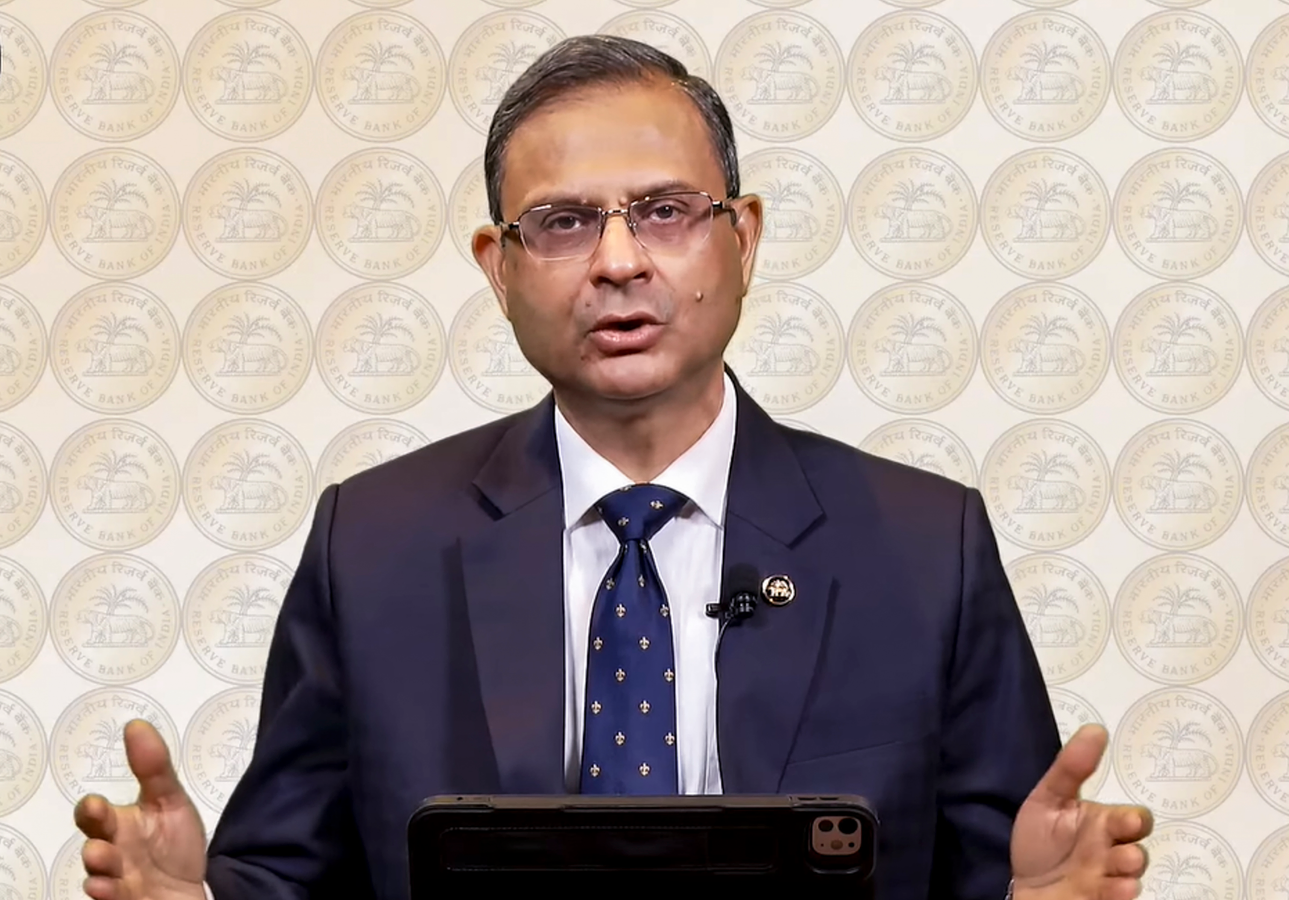
The Reserve Bank of India has maintained interest rates at 5.25 percent. Announcing the first bi-monthly monetary policy for the current fiscal, RBI Governor Sanjay Malhotra stated that the Monetary Policy Committee has unanimously decided to keep the repo rate at 5.25 percent with a neutral stance.
As a result, the standing deposit facility rate remains at 5 percent, and the marginal standing facility rate and the Bank Rate remain at 5.50 percent.
The bi-monthly meeting of the committee began on Monday under the chairmanship of the Governor.
The Monetary Policy Committee also expects that the GDP for the last financial year will be at 7.6 percent, while for the current fiscal year, it will be at 6.9 percent. The RBI projects that CPI inflation for the current financial year will be at 4.6 percent.
Mr. Malhotra said that persistently high energy prices due to the West Asia conflict and potential El Niño conditions pose upside risks to inflation.
Regarding the West Asia conflict, the RBI has adopted a wait-and-see approach, citing the changing circumstances and the evolving growth-inflation outlook.
Accordingly, the Monetary Policy Committee voted to keep the policy rate unchanged, while remaining vigilant and closely monitoring incoming information and assessing the balance of risks.
The Governor stated that the West Asia conflict will adversely impact growth. He added that higher input costs associated with an increase in energy prices, along with international freight and insurance costs and supply-chain disruptions, could constrain the availability of key inputs for downstream sectors, thereby impairing growth.
He added that the fundamentals of the Indian economy are on a stronger footing, providing it with greater resilience to withstand shocks now than in the past.
He said that several measures taken by the government targeted at supporting exports and protecting supply chains should mitigate the adverse impact of the conflict.
The Governor has noted that, despite stronger macroeconomic fundamentals, the Indian rupee depreciated more than the average in the previous years.
He reiterated that the exchange rate policy remains unchanged. He added that intervention in the foreign exchange market is aimed at smoothing excessive and disruptive volatility without targeting any specific level or band for the exchange rate.
Mr. Malhotra said that this is consistent with our long-standing policy of exchange rates being market-determined.
The RBI stands committed to this policy and would judiciously contain excessive or disruptive volatility to ensure that self-fulfilling expectations do not exacerbate currency movements beyond what is warranted by fundamentals, he added.