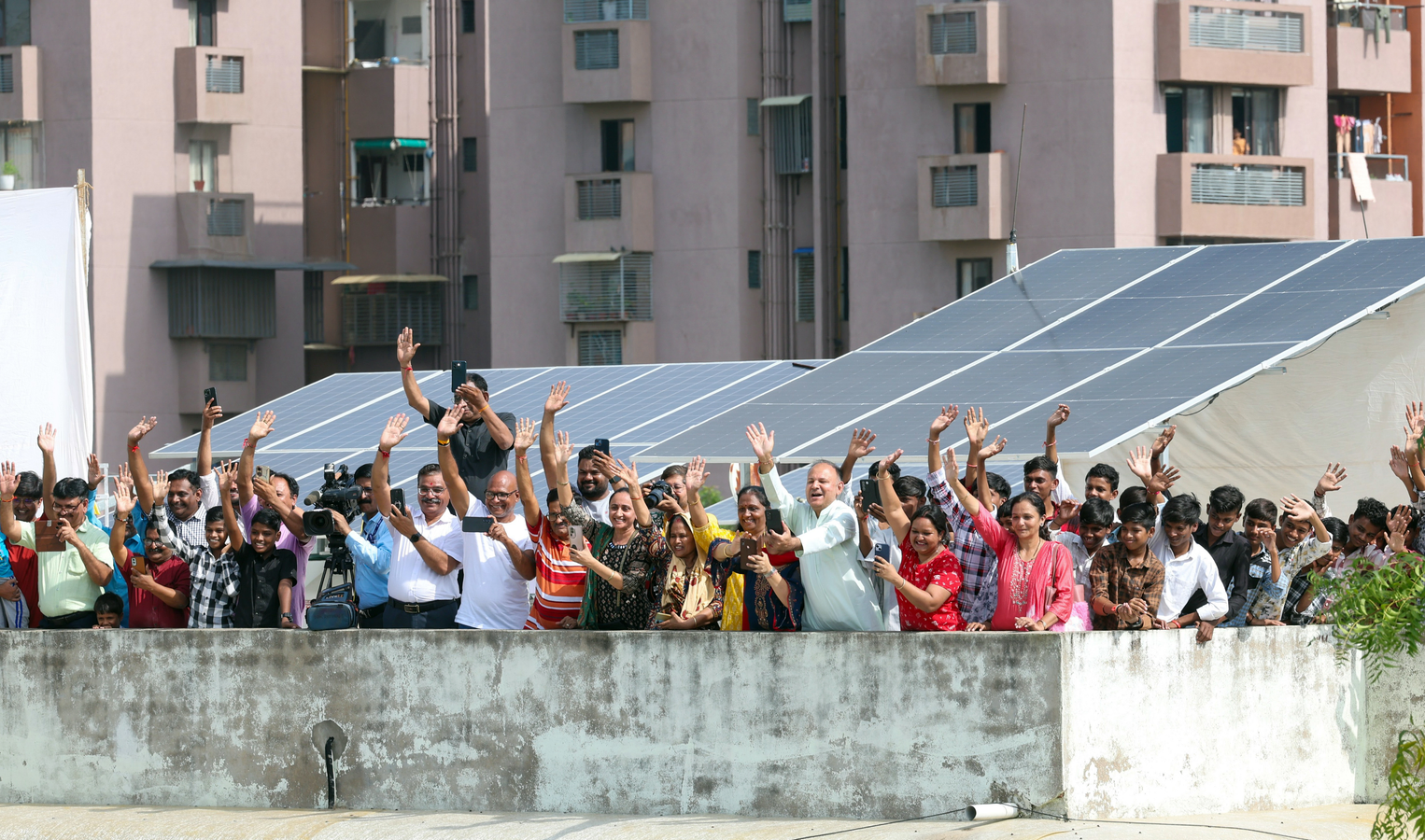
New Delhi, March 12 Strengthening the portal infrastructure and data validation, as well as onboarding power distribution companies, are key to achieving the target of installing rooftop solar systems for one crore households under the PM Surya Ghar: Muft Bijli Yojana, a parliamentary panel report said on Thursday.
The scheme, launched in February 2024, aims to benefit one crore households with a saving of Rs 75,000 crore annually by installing solar systems on their rooftops by March 2027.
During the last two years, around 23.29 lakh (rooftop solar) installations were achieved against the target of 61 lakh, and 80 per cent of the fund utilisation was achieved at Rs 22,402.97 crore out of the revised allocation of Rs 28,100 crore, according to the 12th report of the Committee on 'Demands for Grants (2026-27) of the Ministry of New and Renewable Energy' tabled in the Parliament.
The Committee reiterated the earlier recommendation that unless discoms are fully onboard, it would be difficult for PMSGMBY to achieve the targets as envisaged, it said.
It is also desired that the portal infrastructure and data validation systems be strengthened under the PMSGMBY, the report said.
It further stressed the need for a new Small Hydro Power scheme and said the ministry has not been able to start any SHP scheme since 2017.
Also, the panel noted that the north-east states have huge potential for SHP due to abundant sources of hydroelectricity.
This also presents an opportunity for the ministry to improve its budget utilisation in the north-eastern region, which has been lagging with the spending of a mere 10 per cent of the allocation, it stated.
With regard to the launch of Phase-III of Intra-State Green Energy Corridor (GEC) during 2026-27, the Committee expected its timely implementation, unlike Phase-I & II, urging the ministry to encourage states to adopt the central government's guidelines on Right of Way (RoW) and land acquisition related compensation, which in turn is expected to reduce tendering time as well as unnecessary court cases.
Further, the panel sought to know the reasons behind the review of the ambitious Inter-State GEC Phase-II project, which is based on reports of Front End Engineering and Design (FEED) studies.
The Committee also noted initial hiccups under the National Green Hydrogen Mission (NGHM), as out of the total budget of Rs 19,744 crore, which has to be spent till 2030, only around 1.3 per cent i.e., Rs 249.44 crore, could be spent in the last three years (January 2023 to January 2026).
However, it appreciated the recent progress under the Mission, which include incentivisation for electrolyser manufacturing and green hydrogen production, award of pilot projects to use green hydrogen in steel, mobility and shipping sectors, sanction of R&D projects and testing facilities.
It said the ministry should closely monitor all the pilot and R&D projects in order to understand the difficulties and concerns of different projects under the Mission and take effective measures to resolve them to ensure that the projects are able to progress without time and cost overruns.
The panel, while observing the budget utilisation trends of the ministry, noted an average utilisation of 82-83 per cent over the past five years.
Among reasons for under-utilisation of the budget, the committee noted COVID waves during 2021-22, non-receipt of adequate proposals from north-east states and delay in framing of scheme guidelines, as well as slow progress under schemes viz. NGHM, PM Surya Ghar, and Green Energy Corridor.