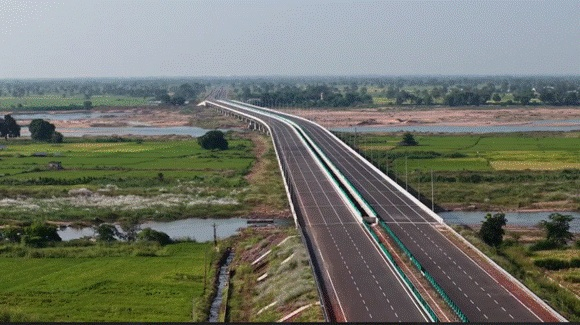
New Delhi, March 10: India's road network has expanded rapidly over the past 11 years, becoming the second-largest in the world. According to official data, the country has 1,46,560 km of national highways, making it the second-largest road network globally.
The government has constructed 57,125 km of national highways over the past five years, with an average of 34,215 lane-km per year. This has resulted in an average of approximately 33 crore person-days of employment, both direct and indirect, according to figures compiled by the Ministry of Road Transport & Highways (MoRTH) and presented in Parliament recently.
This growth, driven by flagship programs like Bharatmala, has seen the national highway network expand by 61 per cent, from 91,287 km in 2014 to 1,46,560 km in 2025.
The length of operational, access-controlled high-speed corridors and expressways has increased from a mere 93 km in 2014 to 3,052 km by the end of this year.
The length of 4-lane and above national highways, including access-controlled corridors, has more than doubled from 18,371 km in 2014 to 43,512 km currently.
The budgetary allocation for India's national highways has increased by over 500 per cent in the last decade, growing from approximately Rs 31,130 crore in 2013-14 to over Rs 2.7 lakh crore in 2023-24. This has been further increased to Rs 3.09 lakh crore in the 2026-27 budget.
The MoRTH has cumulatively monetized Rs 1,52,028 crore through various asset monetization schemes by November 2025 and has set a target of Rs 30,000 crore for the fiscal year 2025-26.
The government aims to operationalize 18,000 km of access-controlled national expressways by 2028-29. Additionally, a total of 26,000 km of access-controlled expressways are targeted for awarding by 2032-33. The government is also prioritizing the development of ring roads and bypasses for cities with a population of more than five lakh.
In addition, connectivity to ports, as prioritized by the Ministry of Shipping, Ports and Waterways, and connectivity to industrial nodes, as prioritized by the National Industrial Corridor Development Corporation (NICDC), are also being developed. These proposed developments will increase logistical efficiency, which will serve as a driver of economic growth.