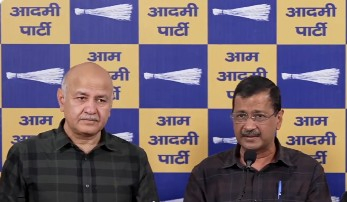
New Delhi, February 27 – A Delhi court has acquitted all 23 accused, including Aam Aadmi Party (AAP) Convenor Arvind Kejriwal and former Delhi Deputy Chief Minister Manish Sisodia, in the excise policy case being investigated by the Central Bureau of Investigation (CBI). The court stated that the prosecution failed to establish even a prima facie case or raise a "serious suspicion" warranting charges.
In a detailed order exceeding 1,100 paragraphs, Special Judge (Prevention of Corruption Act) Jitendra Singh of the Rouse Avenue Court said that the CBI's case "could not withstand judicial scrutiny" and was "completely discredited."
The Rouse Avenue Court's Special Judge discharged all the accused in connection with the Delhi excise policy case, observing that attempting to put the accused on trial without legally admissible evidence would constitute a "manifest miscarriage of justice."
The case concerned the Delhi Excise Policy 2021-22, introduced by the then AAP-led state government in November 2021, and later scrapped in 2022 amid allegations of corruption and bribery.
What are the allegations against Kejriwal and AAP? According to central investigation agencies, Kejriwal and other AAP leaders had accepted bribes from the "South Group" cartel, which was allegedly granted undue benefits under the 2021-22 excise policy.
The agencies alleged that the policy framework was manipulated to favor select liquor licensees in exchange for alleged upfront payments intended for electoral purposes, including the 2022 Goa Assembly elections.
A Comptroller and Auditor General (CAG) report claimed that irregularities in policy formulation and implementation resulted in an alleged loss exceeding Rs 2,026 crore.
The report stated that taxpayers suffered losses of about Rs 890 crore due to the then AAP-led Delhi government's decision not to re-tender surrendered retail liquor licenses, while an additional Rs 941 crore loss was attributed to exemptions granted to zonal licensees.
The audit findings also flagged alleged lack of transparency in pricing mechanisms, violations in license issuance and renewal, failure to penalize rule violators, and absence of approval from Delhi's Lieutenant Governor V.K. Saxena, the Cabinet, or the Legislative Assembly at key stages.
Sisodia's Group of Ministers was accused of not acting on recommendations of an expert panel and allowing allegedly disqualified entities to bid.
Kejriwal and Sisodia have consistently denied the allegations, describing the case as "politically motivated" and accusing the Bharatiya Janata Party of weaponizing central agencies.
However, after examining voluminous records and nearly 300 prosecution witnesses, the trial court concluded that the "theory of an overarching conspiracy" was "completely dismantled" and that the prosecution had failed to present any evidence at the initial stage.
Meanwhile, the CBI has moved the Delhi High Court against the trial court's discharge order, arguing that several aspects of the investigation were either ignored or not adequately considered by the court.
The case involves Manish Sisodia's arrest by the CBI in August 2022, along with 14 others, following the registration of an FIR. Subsequently, the Enforcement Directorate (ED) arrested Sisodia while he was already in judicial custody. Arvind Kejriwal was arrested by the ED in March 2024 after the Delhi High Court denied him protection. The Supreme Court granted interim bail to Kejriwal in the money laundering case until June 1, 2024, and directed him to surrender on June 2. Kejriwal was formally arrested by the CBI in the corruption case following his earlier arrest by the ED. The Supreme Court granted interim bail to Sisodia in both ED and CBI cases, stating that he cannot be indefinitely detained while awaiting trial. The CBI informed the Rouse Avenue Court that it had obtained the necessary sanction under the Prevention of Corruption Act to prosecute Arvind Kejriwal in the excise policy corruption case. The Supreme Court granted bail to Kejriwal in the CBI corruption case but declined to quash his arrest, leading to his release from custody. The Centre granted sanction to the ED to prosecute Kejriwal and Sisodia under the Prevention of Money Laundering Act (PMLA) following the recommendation of Delhi Lieutenant Governor V.K. Saxena. The Rouse Avenue Court discharged all the 23 accused, including Kejriwal and Sisodia, holding that the prosecution failed to establish even a prima facie case and that the underlying offense did not survive. With the CBI now having filed a revision petition before the Delhi High Court, the high-profile case that once dominated national political discourse appears set to enter its next legal chapter.