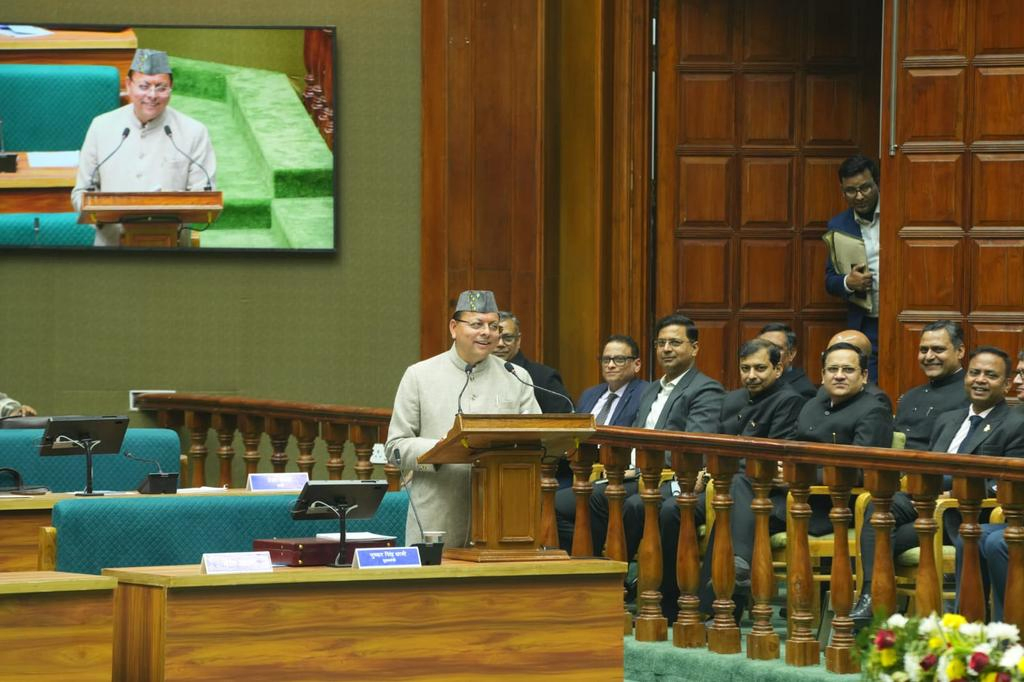
In Gairsain (Chamoli), March 9 – The Uttarakhand government presented a budget of ₹1.11 lakh crore for the financial year 2026-27, placing a strong emphasis on inclusive development through the "GYAN" model. Chief Minister Pushkar Singh Dhami stated that the state's development strategy is based on four pillars: welfare of the poor, empowerment of youth, support for farmers, and empowerment of women.
The budget was presented on the first day of the Assembly's Budget Session following the Governor's address, marking the first time such a session has been held in the state. The Uttarakhand Legislative Assembly session is scheduled from March 9 to March 13 at the Vidhan Bhavan in Bharadisain (Gairsain), the state's summer capital.
While presenting the budget, CM Dhami, who also holds the finance portfolio, emphasized that the government aims to ensure that every section of society becomes a part of the state's development process. "Our goal is to build a prosperous, empowered, and self-reliant Uttarakhand by connecting every citizen with the mainstream of development," he said.
Under the 'G' component of the GYAN model – "Garib Kalyan" (welfare of the poor) – the government has allocated significant funds to social welfare and housing schemes.
A major allocation of ₹1,300 crore has been made for the Annapurti Scheme, aimed at ensuring food security for economically weaker families. Additionally, ₹298.35 crore has been allocated for the rural component of Pradhan Mantri Awas Yojana (Rural) and ₹56.12 crore for Pradhan Mantri Awas Yojana (Urban).
The government has also set aside ₹25 crore for housing assistance for economically weaker sections (EWS). Another ₹42 crore will be used to provide free travel facilities to designated categories of passengers on buses operated by the state transport corporation.
To ease the financial burden on poor households, the budget includes a subsidy of ₹43.03 crore for cooking gas. Social security measures have also been strengthened, with ₹167.05 crore allocated for pension schemes, including the Divyang Pension, Teelu Rauteli Pension, and other welfare pensions.
In addition, ₹25 crore has been earmarked for the rehabilitation of families affected by natural disasters in the hill state.
The 'Y' in the GYAN model stands for "youth development." The government, led by CM Dhami, has announced several schemes aimed at boosting employment, entrepreneurship, and skill development.
A budgetary allocation of ₹60 crore has been made for the Chief Minister Self-Employment Scheme to encourage entrepreneurship among young people. Another ₹10 crore has been set aside for the Migration Prevention Scheme, which aims to reduce rural outmigration by creating employment opportunities within the state.
For skill development, ₹62.29 crore has been allocated to the Pandit Deendayal Upadhyay Grameen Kaushalya Yojana to train rural youth for employment.
The government has also allocated ₹155.38 crore as assistance to non-government colleges and ₹10 crore for payment of honorariums to education volunteers (Shiksha Mitras). Similarly, ₹10 crore has been earmarked for the Mukhyamantri Yuva Unnayan Yojana, and ₹3.34 crore for the ULLAS New Literacy Programme.
Under the 'A' component of the GYAN framework – "Annadata" (food security) – the government has proposed several measures to strengthen the agriculture, livestock, and fisheries sectors.
A provision of ₹39.90 crore has been made for the Trout Promotion Scheme to encourage fish farming in the state's cold-water regions. Another ₹3.5 crore has been allocated for a scheme to supply live sheep, goats, and poultry to battalions of the Indo-Tibetan Border Police, which will help local farmers generate income.
The Deendayal Upadhyay Cooperative Farmer Welfare Scheme has been allocated ₹42.5 crore to strengthen cooperative farming initiatives. Under the Mission Apple programme, ₹42 crore has been set aside to promote apple cultivation and improve orchard productivity.
To encourage dairy farmers, ₹32 crore has been allocated for the milk price incentive scheme for dairy producers. The Chief Minister State Agriculture Development Scheme will receive ₹20 crore to support agricultural innovations and infrastructure.
The government has also allocated ₹12.43 crore for the Chief Minister Fisheries Development Scheme and ₹160.13 crore for the Pradhan Mantri Matsya Sampada Yojana. In addition, ₹12 crore has been earmarked for the Millet Mission to promote traditional grains and strengthen nutritional security.
Other initiatives include ₹5.75 crore for promoting local crops and ₹12.06 crore for the Farmer Pension Scheme.
Chief Minister Pushkar Singh Dhami stated that the government is introducing a gender budget to promote gender equality, calling it a significant step towards women's empowerment. Under this initiative, an allocation of ₹19,692.02 crore has been made for the financial year 2026-27. The budget also outlines several new initiatives aimed at strengthening infrastructure, tourism, and technology in the state.
An allocation of ₹1,027 crore has been proposed as infrastructure support from the central government for the upcoming Kumbh Mela. Tourism infrastructure development will receive ₹100 crore to promote the state's tourism potential. ₹400 crore has been earmarked to ensure pothole-free roads across the state.
Several projects along the Ganga River have been proposed, including ₹10 crore each for the Haridwar Ganga Corridor Project and the Rishikesh Ganga Corridor Project. Another ₹10 crore has been allocated for the development of riverfront projects along the Saryu and other rivers.
To promote technological development, ₹15 crore has been earmarked for implementing cybersecurity systems, while ₹10.5 crore will be used to promote emerging technologies and artificial intelligence initiatives in the state.
The government has also allocated ₹10 crore for the development of a Spiritual Economic Zone, ₹5 crore for the House of Himalayas initiative, and ₹4.5 crore for the Uttarakhand and Bharat Darshan programme aimed at promoting cultural tourism.
Several social initiatives have also been included in the budget. The government has allocated ₹112.02 crore under the Nirbhaya Fund to enhance women's safety measures. Other provisions include ₹2 crore for the “Aapda Sakhi” programme to support women in disaster management, and ₹5 crore for the Gram Prahari initiative aimed at strengthening village-level monitoring systems.
Funds have also been set aside for social infrastructure, including ₹4.5 crore for de-addiction centres, ₹5 crore for library construction, and ₹10 crore for stadiums at the Nyaya Panchayat level.
In addition, ₹19 crore has been allocated for rescue centres and ₹3.73 crore for establishing a foreign employment cell to help youth explore overseas job opportunities.