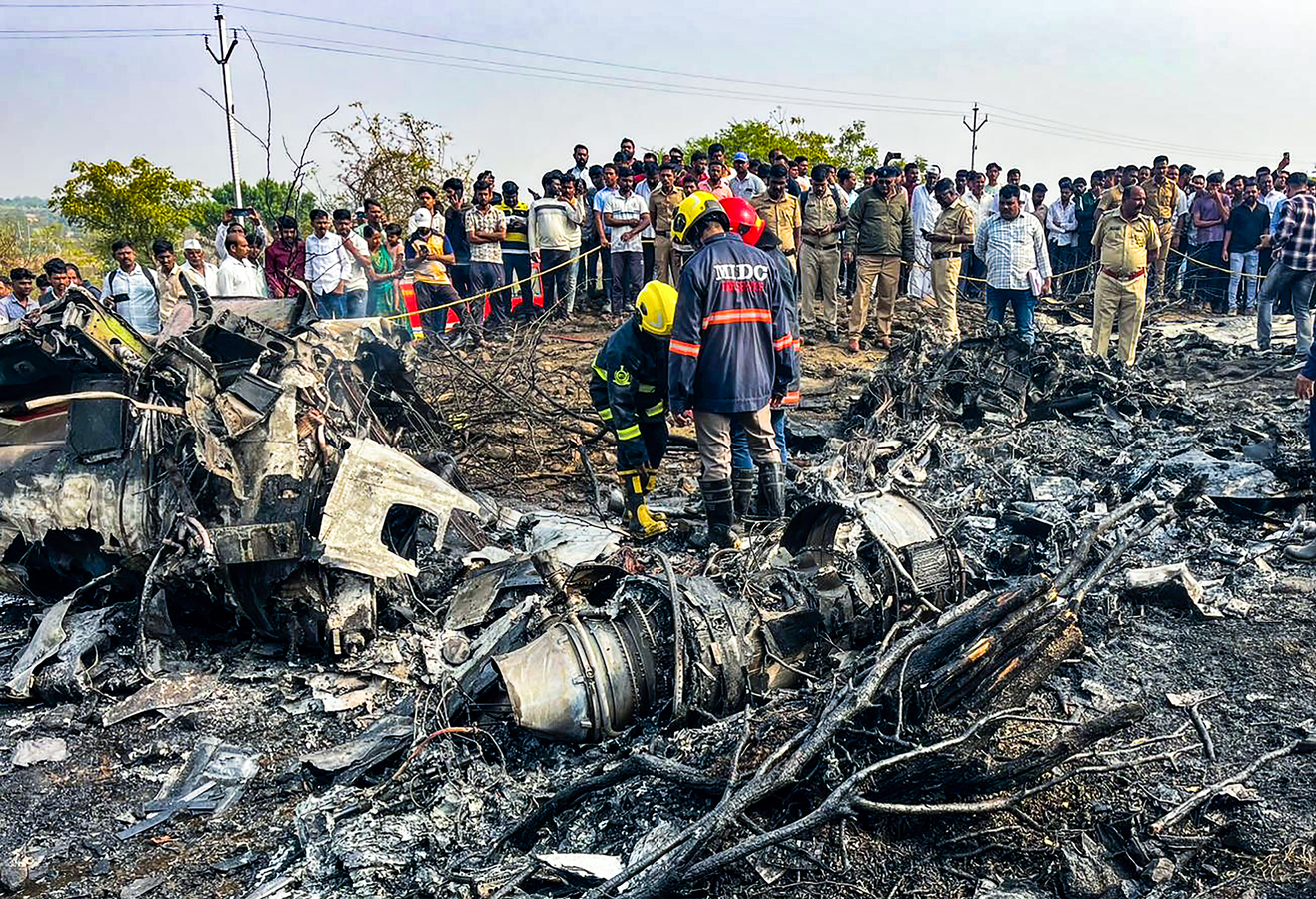
New Delhi, February 28 – The Aircraft Accident Investigation Bureau (AAIB) submitted its preliminary report on Saturday regarding the plane crash near Baramati, in which Maharashtra Deputy Chief Minister Ajit Pawar and four others died on January 28.
“The document has been prepared based on preliminary factual information and evidence collected during the initial stages of the investigation. The information is preliminary and subject to change. Therefore, no conclusions should be drawn from the information provided in the document unless otherwise specified,” the report states.
In accordance with Annex 13 of the Convention on International Civil Aviation Organisation (ICAO) and Rule 3 of Aircraft (Investigation of Accidents and Incidents), Rules 2025, the sole objective of investigating an accident/incident is to prevent accidents and incidents and not to assign blame or liability.
The investigation conducted in accordance with the above rules should be separate from any judicial or administrative proceedings to assign blame or liability. Consequently, using this report for any purpose other than preventing future accidents or incidents could lead to erroneous interpretations, the report states.
According to the report, both pilots had flown to Baramati earlier and were aware of the terrain of the airfield. According to the company records, the pilot in command (PIC) and first officer (FO) had prior experience operating VIP flights and other flights to uncontrolled airfields, including Baramati.
The report also states that the pre-flight breath analyser test for both pilots was conducted by a paramedic inside the aircraft. According to the video clip and the BA slip shared by the operator, the pre-flight BA test for both pilots was negative (satisfactory).
The report points out that on the day of the accident, the visibility at the Baramati airport was 3,000 meters, which was well below the minimum required for VFR flight (5,000 meters or 5 Km) at the time of the aircraft's landing.
In its interim safety recommendations, the report calls for tighter regulatory oversight of operations at smaller airfields, a review of their licensing, and urgent upgrades to landing and meteorological (MET) infrastructure.
The Aircraft Accident Investigation Bureau’s interim report states that the investigation is still underway, and the Cockpit Voice Recorder (CVR) data has not yet been downloaded with the help of the US transport crash probe body, the National Transportation Safety Board (NTSB).
“All aspects of the accident will be examined and investigated to bring out the facts, root causes, and contributory factors leading to the accident,” the preliminary report states.
It has recommended several interim safety recommendations for the aviation safety regulator, the Directorate General of Civil Aviation (DGCA), to implement.
The AAIB team carried out on-site activities and evidence collection under the guidance of the DG, AAIB. In accordance with ICAO Annex 13 and the Aircraft (Investigation of Accidents & Incidents) Rules, 2025, the initial notification of the accident was sent to the State of Design & Manufacture, which in this case is the National Transportation Safety Board (NTSB), USA. The NTSB, USA appointed an Accredited Representative and Technical Advisers from Bombardier, Honeywell and the Federal Aviation Administration (FAA) to assist in this investigation.
The AAIB investigation team is taking assistance from relevant subject matter experts like qualified pilots, Aircraft Maintenance Engineers (AME), Air Traffic Controllers, and Aviation Medicine Specialists to assist in the investigation.